

Every week, our engineering team reviews compliance questions from European partners. The most common concern? Whether firefighting drone manuals from Chinese suppliers actually meet EU Machinery Directive standards.
To verify EU Machinery Directive compliance for firefighting drone manuals from China, importers must check CE marking authenticity, confirm the Declaration of Conformity matches technical file data, verify manual translations meet local language requirements, and ensure risk assessments follow EN ISO 12100:2010 standards. An EU-based authorized representative must maintain accessible documentation.
This guide walks you through each verification step. We will cover specific safety instructions, technical file matching, customs requirements, and ongoing regulatory updates. Let us start with the manual content itself.
What specific safety instructions must I look for in a firefighting drone manual to ensure it meets EU Machinery Directive standards?
Our quality control team has rejected many draft manuals over the years. The reason is usually missing safety content that EU regulations require. This gap can cost importers thousands in delays and rework.
Firefighting drone manuals must include residual risk warnings, emergency stop procedures, payload hazard descriptions, maintenance intervals, operator qualification requirements, and foreseeable misuse scenarios. Instructions must appear in the official language of each target EU member state, clearly labeled as "Original instructions" or "Translation of original instructions."
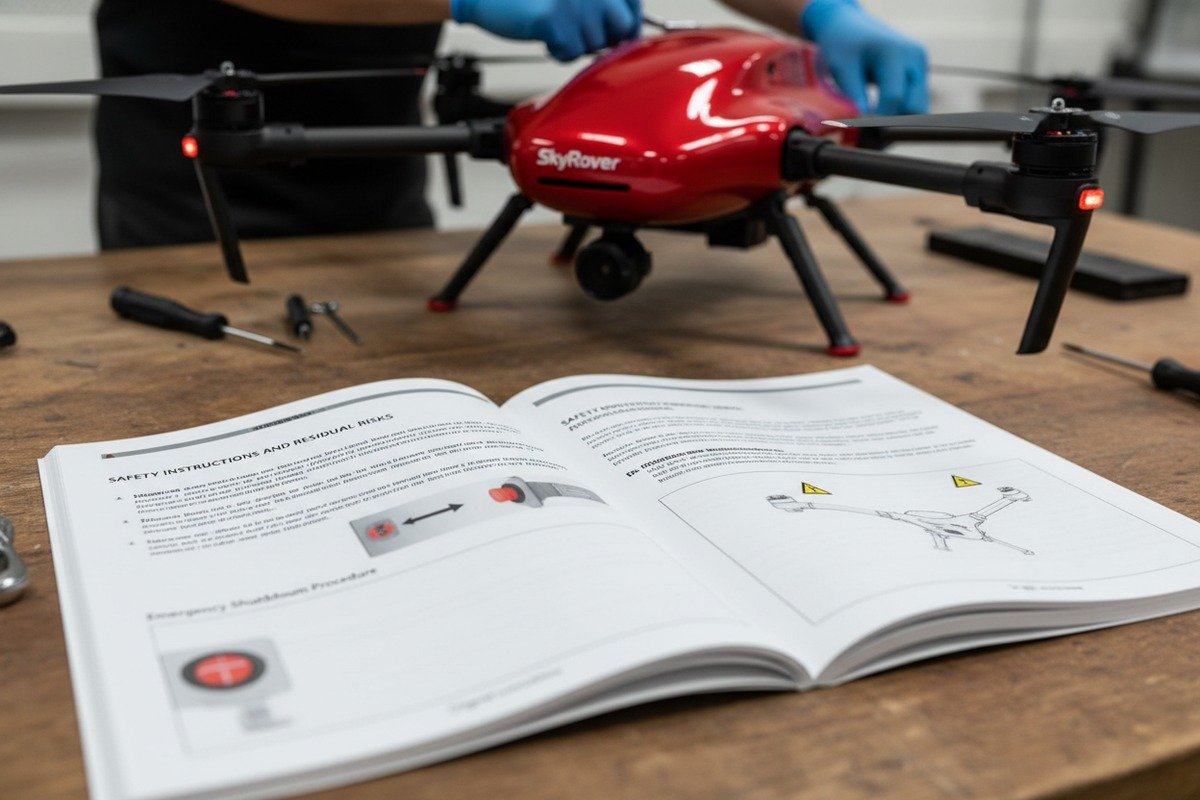
Mandatory Safety Content Categories
The EU Machinery Directive 2006/42/EC 1 and its successor Regulation (EU) 2023/1230 specify Essential Health and Safety Requirements (EHSRs) 2. For firefighting drones, these translate into concrete manual sections.
| Safety Category | Required Manual Content | Common Deficiency |
|---|---|---|
| Residual Risks | Warnings for risks that cannot be eliminated by design | Missing thermal runaway warnings for batteries |
| Emergency Procedures | Step-by-step emergency stop and controlled descent | No procedures for communication loss scenarios |
| Operator Qualifications | Training requirements and competency standards | Vague statements like "trained personnel only" |
| Maintenance Schedule | Inspection intervals and replacement criteria | No guidance on motor replacement timing |
| Foreseeable Misuse | Warnings against predictable improper use | Missing payload weight limit consequences |
Language and Labeling Requirements
When we prepare manuals for EU distribution, we always include clear language markers. The original language version must state "Original instructions." All translations must state "Translation of original instructions."
This is not optional. Market surveillance authorities check this labeling during inspections. Missing labels can trigger product holds.
Risk Assessment Documentation
Your supplier's manual should reference a risk assessment following EN ISO 12100:2010 3. This harmonized standard provides a framework for hazard identification and risk reduction.
For firefighting drones, specific risks include:
- Thermal hazards from fire proximity
- Mechanical hazards from propeller contact
- Electrical hazards from high-voltage batteries
- Chemical hazards from extinguishing agents
- Environmental hazards from operating in smoke
The manual must address protective measures for each identified risk. Our engineering team creates risk assessment matrices early in development. This ensures manual content matches actual product hazards.
Special Considerations for Payload Systems
Firefighting drones carry specialized payloads. These include water tanks, fire retardant dispensers, and thermal imaging cameras. Each payload type introduces unique hazards.
The manual must cover payload attachment procedures, weight limits, center of gravity effects, and release mechanism operation. Missing payload documentation is a frequent audit finding.
How can I verify that the technical file provided by my Chinese supplier matches the safety data in the drone's operator manual?
When we send technical files to European partners, we include cross-reference tables. But not every supplier does this. Mismatches between technical files and manuals cause serious compliance problems.
Verify technical file and manual alignment by comparing declared product specifications, matching risk assessment hazards to manual warnings, confirming test report parameters against stated performance limits, and checking that component certifications cover all listed parts. Request the Declaration of Conformity and verify it references the correct harmonized standards.

Understanding the Technical File Structure
A complete technical file under the Machinery Directive contains several elements. Each element should connect logically to manual content.
| Technical File Element | Manual Cross-Reference Point | Verification Method |
|---|---|---|
| General description | Product identification section | Serial number format match |
| Overall drawings | Dimensional specifications | Measurement comparison |
| Risk assessment | Safety warnings and precautions | Hazard-to-warning mapping |
| Test reports | Performance specifications | Parameter range verification |
| Quality control procedures | Maintenance instructions | Procedure consistency check |
| Declaration of Conformity 4 | CE marking information | Standard reference match |
Step-by-Step Verification Process
Start with the Declaration of Conformity. This single-page document lists applicable directives and harmonized standards. Common standards for firefighting drones include:
- EN ISO 12100:2010 for general machinery safety
- EN 62368-1 for audio/video and IT equipment safety
- EN 301 489 series for electromagnetic compatibility
- EN 300 328 for radio equipment
Check that each listed standard appears in the technical file's test reports. Then verify the manual references matching safety requirements.
Red Flags in Documentation
Our compliance team has identified common warning signs. These indicate potential mismatches between technical files and manuals:
- Test reports dated after the Declaration of Conformity
- Different product model numbers across documents
- Standards listed without corresponding test evidence
- Manual specifications exceeding tested parameters
- Missing notified body involvement for high-risk features
Component-Level Verification
Firefighting drones contain regulated components. Motors, batteries, and radio transmitters each require compliance documentation. The technical file should include sub-assembly certificates.
Cross-check component certifications against manual parts lists. If the manual lists a specific battery model, the technical file should contain that battery's safety certification.
Digital Documentation Requirements
The new Machinery Regulation (EU) 2023/1230 5 permits digital manuals. However, specific conditions apply. Digital manuals must be:
- Downloadable and printable
- Available free of charge
- Maintained online for at least 10 years
- Provided in paper form within one month upon request
Verify your supplier's digital manual delivery system meets these requirements before import.
Will my firefighting drones be rejected at EU customs if the user manual lacks the required EC Declaration of Conformity?
Several years ago, one of our European partners faced a three-week customs delay. The cause was a missing Declaration of Conformity page in the shipped manuals. This taught us to triple-check documentation before every shipment.
Yes, EU customs authorities can reject or hold firefighting drones lacking proper Declaration of Conformity documentation. Market surveillance officers verify CE marking legitimacy and may request technical documentation. Missing or deficient declarations trigger import holds, potential product seizure, and financial penalties for the importer.

Customs Inspection Procedures
EU member states conduct risk-based inspections on imported goods. Industrial drones from non-EU countries face heightened scrutiny. Customs officers check:
- Physical CE marking presence and format
- Declaration of Conformity availability
- Manual language compliance
- Product-document consistency
Consequences of Documentation Failures
The consequences vary based on deficiency severity. Minor issues may allow conditional release. Major problems trigger more serious responses.
| Documentation Issue | Likely Customs Response | Importer Impact |
|---|---|---|
| DoC not included with shipment | Hold pending document submission | 1-2 week delay |
| DoC references wrong product | Extended hold for verification | 2-4 week delay, possible rejection |
| No EU authorized representative | Rejection at border | Full shipment return or destruction |
| Suspected counterfeit CE mark | Seizure and investigation | Product confiscation, potential fines |
| Manual in wrong language | Conditional release with remediation | Post-import correction required |
The Authorized Representative Requirement
For products manufactured outside the EU, an authorized representative within the EU 6 must be designated. This representative's contact information must appear on the Declaration of Conformity.
The representative bears legal responsibility for documentation accessibility. They must provide technical files to market surveillance authorities upon request. Without this designation, products cannot legally enter the EU market.
Proactive Documentation Strategies
Our shipping team follows a documentation checklist for every EU-bound order:
- Include original Declaration of Conformity with each unit
- Attach translated manuals for destination country
- Provide authorized representative contact details
- Include CE marking placement photograph
- Add quick reference card for customs inspectors
This approach prevents most customs complications. We recommend importers request similar documentation packages from their suppliers.
Post-2024 Classification Requirements
Since 2024, drones require class identification labels (C0-C6) under Regulation (EU) 2019/945 7. Firefighting drones typically fall into specific or certified categories requiring additional documentation.
Customs officers now verify class markings alongside CE marking. Missing class identification can trigger holds even with valid Machinery Directive compliance.
How do I ensure my Chinese supplier has the engineering expertise to update my drone manuals as EU regulations evolve?
When we began exporting to Europe eight years ago, regulations were simpler. Today, our compliance team tracks multiple directives, regulations, and amendments. This expertise takes years to develop.
Evaluate supplier engineering expertise by reviewing their regulatory tracking systems, requesting evidence of past manual updates following regulation changes, verifying staff certifications in EU compliance standards, examining their relationships with EU Notified Bodies, and assessing their transition plans for the 2027 Machinery Regulation implementation.

Key Regulatory Changes Through 2027
The regulatory landscape is shifting significantly. Suppliers must demonstrate awareness and preparation for upcoming changes.
| Regulation | Effective Date | Manual Impact |
|---|---|---|
| Machinery Regulation (EU) 2023/1230 | January 20, 2027 | New cybersecurity requirements, digital manual provisions |
| Cyber Resilience Act | 2027 | Security update documentation, vulnerability disclosure |
| EU Drone Action Plan 2026 | Ongoing | Expanded ID requirements, counter-drone technology |
| prEN 4709 series standards | Progressive adoption | Updated C0-C6 class compliance criteria |
Evaluating Supplier Capabilities
Ask potential suppliers specific questions about their compliance infrastructure:
- Do you have dedicated regulatory compliance staff?
- How do you track EU Official Journal publications?
- When did you last update manuals for regulatory changes?
- What is your relationship with EU Notified Bodies 8?
- Can you provide your 2027 transition timeline?
Cybersecurity Documentation Requirements
The upcoming Machinery Regulation designates machinery with safety-related AI as high-risk. Many firefighting drones use autonomous features that may qualify.
Compliant suppliers must demonstrate:
- Software risk assessment procedures
- Cybersecurity update mechanisms
- Vulnerability disclosure processes
- Long-term security support commitments
Our software team maintains a dedicated cybersecurity documentation process. This includes regular penetration testing reports and update logs.
Partnership Models for Ongoing Compliance
Consider structuring supplier relationships to ensure continued compliance support. Effective approaches include:
- Annual compliance review meetings
- Shared regulatory monitoring subscriptions
- Joint Notified Body audit participation
- Contractual update delivery timelines
Warning Signs of Inadequate Expertise
Some suppliers lack genuine compliance capabilities. Watch for these indicators:
- Inability to name applicable harmonized standards
- No designated compliance personnel
- Generic responses to specific regulatory questions
- Resistance to providing technical file access
- Outdated CE certificates without recent renewals
Our team regularly participates in EASA working groups and standard development committees. This active engagement ensures we anticipate regulatory changes before they take effect.
Conclusion
Verifying EU Machinery Directive compliance for firefighting drone manuals requires systematic documentation review. Check safety instructions, match technical files to manuals, ensure customs-ready documentation, and partner with suppliers who track evolving regulations.
Footnotes
1. Official text of the foundational EU directive for machinery safety. ↩︎
2. Explains the core safety requirements for machinery under EU law. ↩︎
3. Provides guidelines for risk assessment and risk reduction in machinery design. ↩︎
4. Explains the purpose and content of the essential EU Declaration of Conformity. ↩︎
5. Official text of the new EU regulation replacing the Machinery Directive. ↩︎
6. Defines the role and responsibilities of an EU authorized representative for non-EU manufacturers. ↩︎
7. Official EU regulation establishing requirements for unmanned aircraft systems (drones). ↩︎
8. Explains the role of independent bodies in assessing conformity for CE marking. ↩︎



 English
  Español de México
  Deutsch
  Français
  Русский
  العربية
Comments
No comments yet. Be the first to share your thoughts!
Leave a Comment