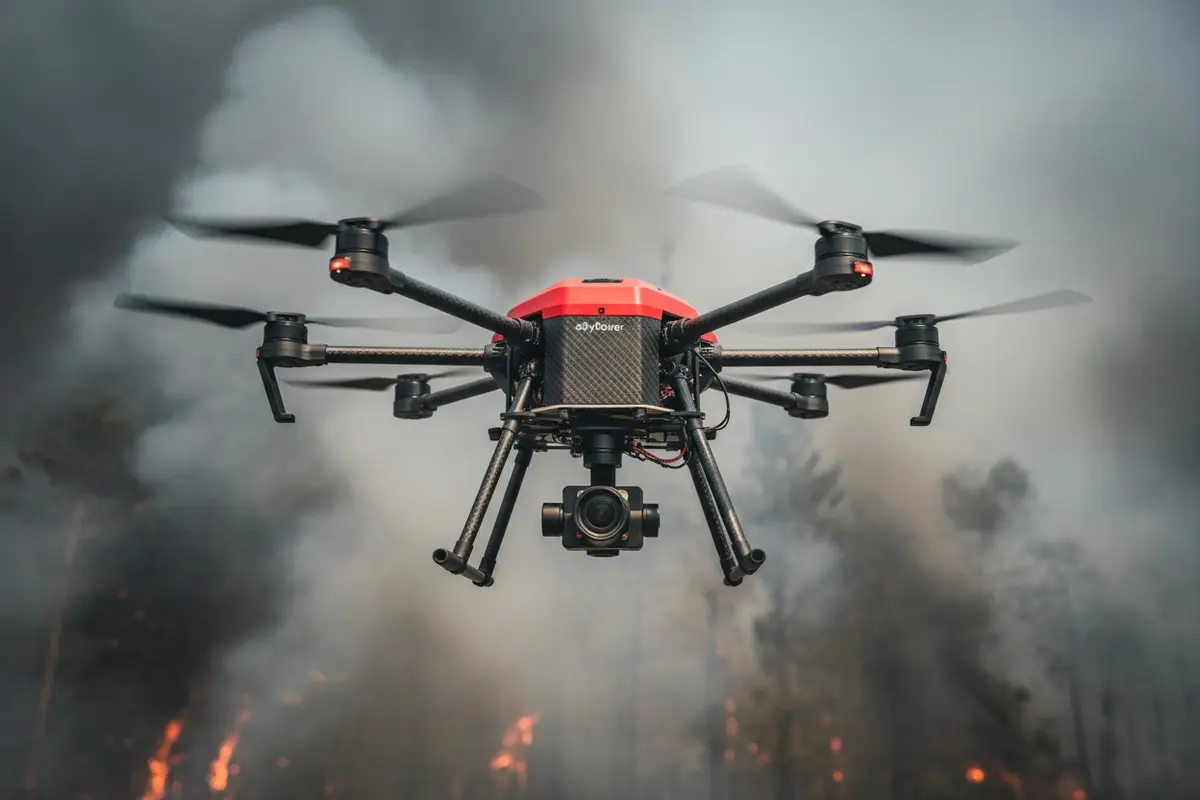

When our engineering team first tested drones near active fire zones, we watched helplessly as violent thermal updrafts tossed our prototype like a leaf. That moment changed everything about how we approach stability design.
Firefighting drones maintain stability against forest fire updrafts through advanced flight control systems combining gyroscopic sensors, IMUs, GPS/RTK positioning, and AI-driven algorithms that make rapid propeller adjustments at 50Hz or faster. Multi-rotor designs with high thrust-to-weight ratios and sensor fusion technology enable real-time compensation for sudden vertical wind shifts.
Understanding these stability systems matters whether you are a procurement manager sourcing equipment or a firefighting contractor evaluating drone solutions. Let me walk you through the core technologies that keep these machines steady in chaos.
What flight control technology ensures my firefighting drone stays level when hitting intense thermal updrafts?
Every week, our customer support team receives calls from fire departments frustrated with drones that flip or drift during thermal exposure. The problem is real. Forest fires 1 generate updrafts exceeding 50 km/h vertically.
Flight control technology uses gyroscopic sensors, accelerometers, and barometers integrated into an Inertial Measurement Unit (IMU) that detects orientation changes within milliseconds. PID controllers then calculate precise motor speed adjustments, while GPS/RTK provides position lock accuracy within centimeters to counteract drift.

How IMU Systems Detect Turbulence
The Inertial Measurement Unit 2 sits at the heart of every stable firefighting drone. When we calibrate our flight controllers at the factory, we test them against simulated turbulence patterns. The IMU contains three gyroscopes measuring rotation and three accelerometers measuring linear movement. Together, they create a complete picture of drone orientation 1,000 times per second.
When a thermal updraft hits, the IMU detects pitch and roll changes before humans could even perceive them. This data feeds directly into the flight controller.
The Role of PID Controllers
PID stands for Proportional, Integral, Derivative 3. These three mathematical functions work together to smooth out corrections. Here is how each component contributes:
| PID Component | Function | Firefighting Application |
|---|---|---|
| Proportional | Reacts to current error | Immediate response to updraft-induced tilt |
| Integral | Addresses accumulated error | Corrects persistent wind drift over time |
| Derivative | Predicts future error | Anticipates turbulence pattern continuation |
Our engineers spend considerable time tuning these values. A drone optimized for agricultural spraying will not perform well in fire conditions without recalibration.
GPS and RTK Positioning
Standard GPS provides accuracy within 2-5 meters. For firefighting operations, this is insufficient. A drone dropping water needs centimeter-level precision. RTK (Real-Time Kinematic) positioning 4 uses ground-based reference stations to achieve accuracy within 2 centimeters.
When updrafts push a drone off its designated position, RTK data immediately shows the deviation. The flight controller then increases thrust on specific motors to push back against the wind.
Redundant Systems for Safety
In our production line, we install dual IMUs and dual flight controllers on all heavy-lift models. If one sensor fails from heat exposure or smoke contamination, the backup takes over instantly. This redundancy has saved multiple drones from crashes during actual fire deployments.
| Redundancy Level | Components | Failure Protection |
|---|---|---|
| Basic | Single IMU, single controller | None |
| Standard | Dual IMU, single controller | Sensor failure |
| Advanced | Dual IMU, dual controller | Complete system failure |
Most firefighting applications require at least standard redundancy. Government contracts often mandate advanced redundancy levels.
How does the propulsion system of my drone provide enough power to resist sudden vertical wind shifts?
During export testing for our US distributors, we discovered that many drones marketed as "industrial" simply cannot generate enough thrust to fight updrafts. Motors rated for calm conditions fail catastrophically in fire environments.
Propulsion systems resist vertical wind shifts through high thrust-to-weight ratios (typically 2:1 or higher), powerful brushless motors capable of rapid RPM changes, and optimized propeller designs that maximize vertical thrust. Hybrid power systems now achieve 100-pound payloads with 2.5-hour flight times, providing sustained power reserves for emergency corrections.

Understanding Thrust-to-Weight Ratio
A drone weighing 20 kg needs motors that can collectively produce at least 40 kg of thrust. This 2:1 ratio provides the excess power needed to push against updrafts. In our experience exporting to European fire services, we recommend 2.5:1 for serious firefighting work.
The math is simple. If an updraft adds 10 kg of effective upward force, the drone needs that much extra thrust capacity just to maintain altitude. Without reserves, the drone rises uncontrollably.
Motor Response Speed
Brushless motors 5 can change RPM within 50 milliseconds. This speed matters because updrafts are not constant. They pulse and shift. A motor that takes 200 milliseconds to respond will always be fighting the last gust, not the current one.
| Motor Type | Response Time | Suitability |
|---|---|---|
| Brushed DC | 150-300ms | Not suitable |
| Brushless (standard) | 80-120ms | Light firefighting |
| Brushless (high-performance) | 30-50ms | Heavy-lift firefighting |
When we design custom solutions for clients, motor selection is one of the first conversations. Cheaper motors save money initially but fail when conditions get difficult.
Propeller Design Considerations
Propeller pitch, diameter, and blade count all affect thrust generation. Higher pitch propellers move more air per rotation but require more motor torque. Larger diameters provide more lift but increase inertia, slowing response times.
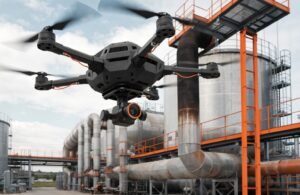
For firefighting drones, we typically recommend moderate pitch with optimized blade profiles. Carbon fiber 6 construction reduces weight while maintaining stiffness. The woven texture visible on our octocopter propellers is not decorative. It provides structural integrity under stress.
Hybrid Power Systems
Battery-only drones face flight time limitations. When our engineers developed the current generation of heavy-lift platforms, we integrated hybrid power options. A small internal combustion engine drives a generator that charges batteries mid-flight.
This approach delivers multiple benefits. Flight times extend to 2.5 hours. Payload capacity reaches 100 pounds or more. Most importantly, the battery always has power reserves for emergency thrust demands. A five-minute refuel gets the drone airborne again, compared to 30-60 minute battery recharges.
Can I work with your engineers to customize the stability software for my specific forest fire conditions?
Last year, a California distributor contacted us because off-the-shelf drones kept failing in specific terrain. Canyons funneled winds unpredictably. Standard stability algorithms could not adapt. This experience reinforced why customization matters.
Yes, our engineering team collaborates directly with clients to customize stability software for specific conditions. We adjust PID tuning parameters, modify sensor fusion algorithms, integrate terrain-following systems, and implement AI-driven prediction models trained on data from your actual operating environment. Remote and on-site technical support ensures ongoing optimization.

The Customization Process
When clients approach us for custom stability solutions, we follow a structured development path. First, we gather environmental data. What temperatures do you face? What wind speeds? What terrain features create unusual turbulence?
Our team then analyzes this data against existing algorithm performance. We identify gaps between standard software and specific requirements. From there, we propose modifications.
AI-Driven Adaptive Algorithms
Modern stability software goes beyond reactive corrections. Machine learning models 8 can predict updraft behavior based on thermal camera data and terrain mapping. When the drone sees a hotspot forming, it anticipates the resulting updraft before it arrives.
We train these models using client-supplied data whenever possible. A model trained on Australian bush fire conditions will not perfectly predict behavior in Portuguese forest fires. Terrain, vegetation, and weather patterns all differ.
| Customization Level | Included Services | Typical Timeline |
|---|---|---|
| Basic tuning | PID adjustment, sensor calibration | 1-2 weeks |
| Algorithm modification | Custom sensor fusion, terrain-following | 4-6 weeks |
| Full AI integration | Machine learning, predictive modeling | 8-12 weeks |
Terrain-Following Systems
Mountains, valleys, and ridges create complex wind patterns. Standard altitude-hold systems fail because they reference sea level, not ground distance. Terrain-following algorithms use LiDAR or radar to maintain consistent height above the actual surface.
This capability proves essential when drones must fly low for accurate payload delivery. A drone holding 50 meters above sea level might suddenly find itself 200 meters above a canyon floor, far too high for effective water drops.
Ongoing Support and Updates
Software customization is not a one-time event. Fire conditions change seasonally. New terrain opens for operations. Our support team provides remote updates and can dispatch technicians for on-site calibration when needed.
We understand that drone downtime during fire season costs money and potentially lives. Response times for support requests average under 24 hours. Critical issues receive immediate escalation.
What structural features prevent my drone from losing its flight path during high-temperature firefighting operations?
Our quality control team once received a returned drone with warped arms. The operator had flown too close to flame fronts. The carbon fiber held, but adhesive joints softened. This taught us that structural integrity requires attention at every connection point.
Structural features preventing flight path loss include carbon fiber composite frames with heat-resistant resins rated for 150°C or higher, aerodynamic arm profiles that reduce turbulence-induced oscillation, motor mounts with vibration damping, and centralized weight distribution that maintains stable center of gravity. Ruggedized electronics housings protect sensitive components from thermal damage.
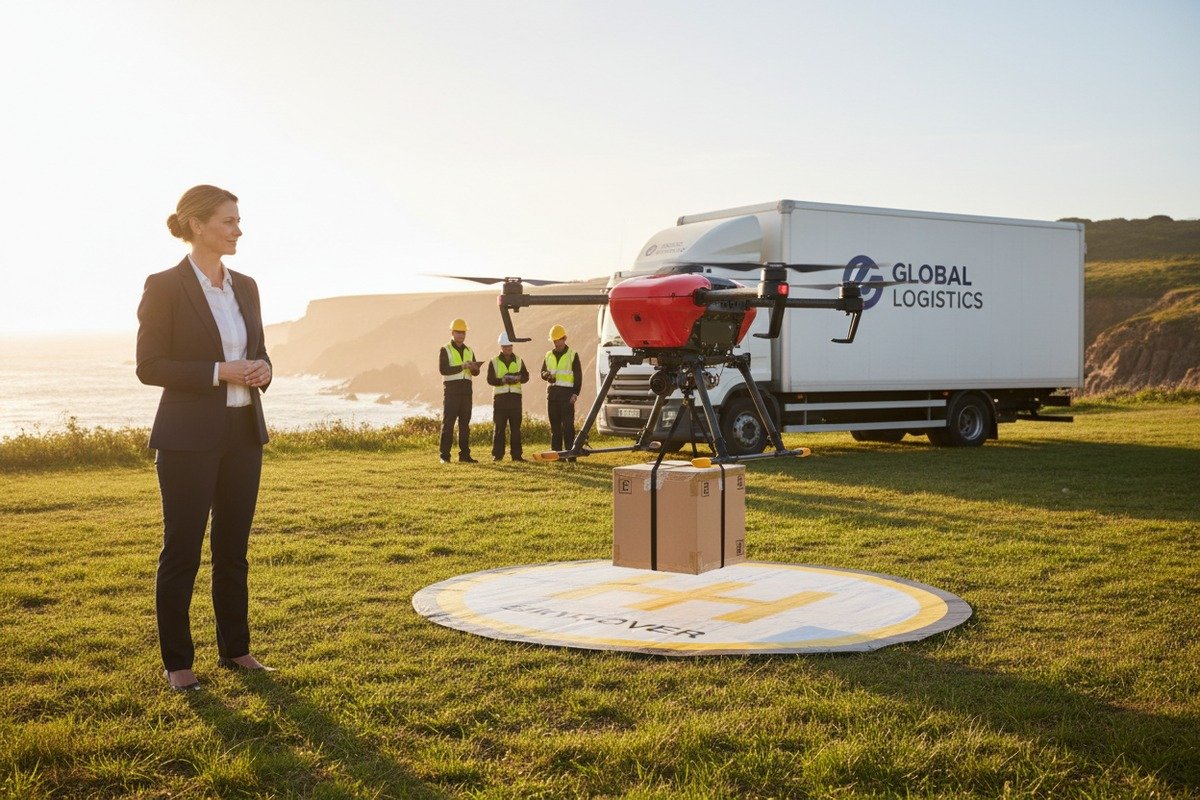
Carbon Fiber Frame Construction
Carbon fiber offers the best strength-to-weight ratio for drone applications. However, not all carbon fiber is equal. The resin system binding the fibers determines heat resistance. Standard epoxy resins soften around 80°C. High-temperature formulations withstand 150°C or more.
Our frame manufacturing process uses aerospace-grade prepreg materials cured at controlled temperatures. This produces consistent mechanical properties throughout the structure. Visual inspection cannot distinguish high-quality from low-quality carbon fiber. Only testing reveals the difference.
Aerodynamic Design Elements
Multi-rotor drones are not typically thought of as aerodynamic. However, arm shape significantly affects stability. Round tubes create more turbulent airflow than airfoil-shaped profiles. This turbulence transfers vibration to the central electronics housing.
When we design octocopter configurations, we position arms to minimize interference between propeller downwash streams. The eight-arm layout on our heavy-lift platform spreads this wash evenly, reducing oscillation compared to quadcopter designs.
Vibration Isolation
Motors produce vibration. Propellers produce more vibration. This mechanical noise confuses IMU sensors, causing false stability corrections. Effective vibration isolation breaks the transmission path between motors and sensors.
Our designs incorporate multiple isolation strategies:
- Rubber motor mounts absorbing high-frequency vibration
- Floating sensor boards on gel dampers
- Balanced propeller sets reducing source vibration
- Rigid frame construction preventing resonance
Thermal Protection for Electronics
Flight controllers, GPS receivers, and motor controllers all have temperature limits. Most consumer electronics fail above 70°C. Industrial-grade components extend this to 85°C or higher. Firefighting drones need even more protection.
We use aluminum heat sinks, thermal interface materials, and ventilated housings to dissipate heat. Critical components receive conformal coating protecting against smoke particulate contamination. The yellow aerodynamic cover visible on our octocopter design is not merely decorative. It directs airflow across internal heat sinks.
| Component | Standard Rating | Firefighting Rating |
|---|---|---|
| Flight controller | 70°C | 85°C+ |
| Motor ESC | 80°C | 100°C+ |
| Battery pack | 45°C | 60°C (with cooling) |
| GPS receiver | 65°C | 85°C+ |
Meeting these temperature requirements adds cost. However, a drone that shuts down mid-mission due to thermal overload provides no value regardless of purchase price.
Center of Gravity Management
Payload attachment directly affects stability. A water tank mounted too far forward shifts the center of gravity, making the drone nose-heavy. The flight controller compensates by increasing rear motor speed, reducing available thrust reserves.
Our payload mounting systems use adjustable positions to accommodate different load types and weights. We provide guidance documentation showing optimal configurations for each payload option. Some clients request custom mounting plates designed specifically for their preferred equipment.
Conclusion
Firefighting drone stability results from integrated systems working together: flight controllers, propulsion, software, and structure. When sourcing equipment, look beyond specifications to understand how these systems perform under actual fire conditions. Our team stands ready to discuss your specific requirements and develop solutions that keep your drones stable when conditions turn chaotic.
Footnotes
1. Explains the causes and impacts of wildfires, including their increasing intensity. ↩︎
2. Provides a detailed explanation of IMU meaning, definition, and working principles. ↩︎
3. Explains the fundamentals of PID control, including proportional, integral, and derivative terms. ↩︎
4. Details RTK positioning technology, explaining how it enhances GPS accuracy for drone applications. ↩︎
5. Describes the structure, working principles, and performance advantages of brushless motors in drones. ↩︎
6. Explains the benefits of carbon fiber for drone frames, including lightweight and high rigidity. ↩︎
7. Explains the importance of thrust-to-weight ratio for drone performance and payload capacity. ↩︎
8. Discusses the application of machine learning algorithms for drone detection, classification, and stability. ↩︎
 English
  Español de México
  Deutsch
  Français
  Русский
  العربية
Comments
No comments yet. Be the first to share your thoughts!
Leave a Comment