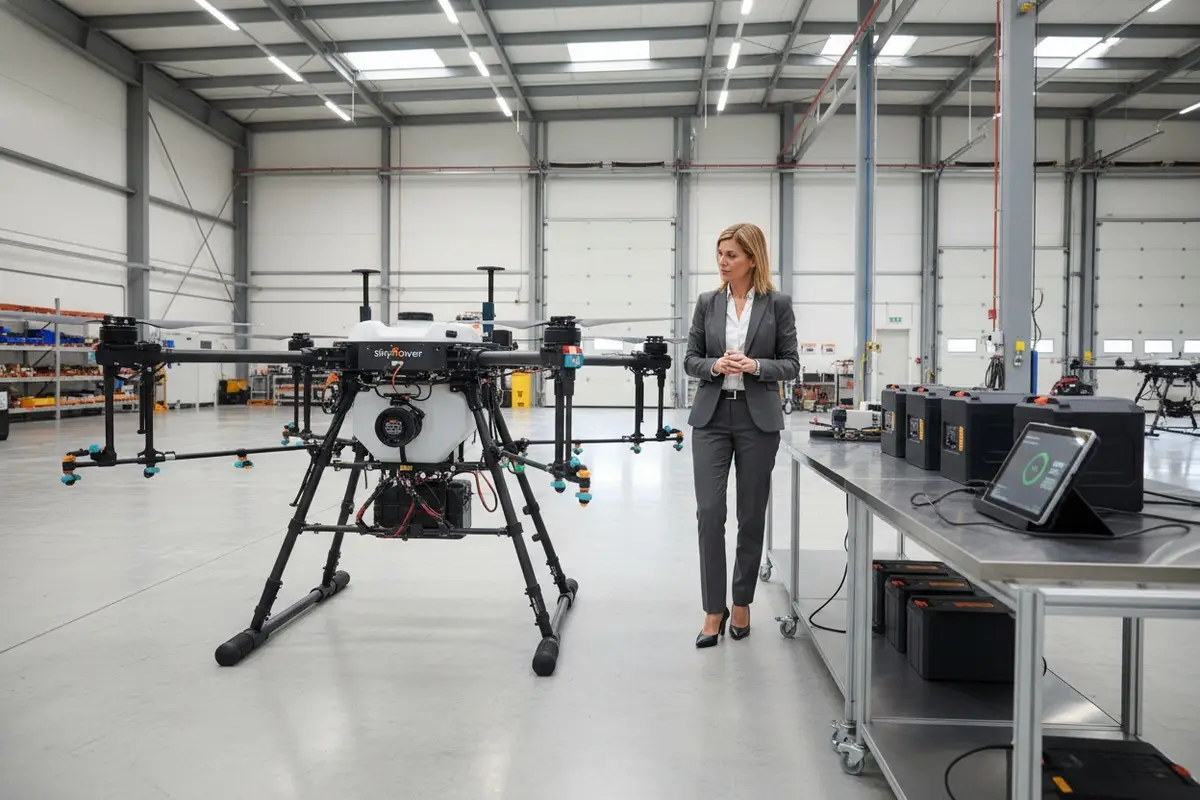
Last season, one of our clients lost nearly four productive hours daily waiting for batteries to charge IP ratings 1. When our engineering team visited their 100-acre operation, we saw the problem immediately. Slow charging meant fewer flights, wasted labor, and missed application windows.
To evaluate agricultural drone battery charge rates for fast turnaround sourcing, assess the C-rating, capacity, charging infrastructure compatibility, and cycle life. Prioritize batteries offering 3C-5C charge rates that deliver 80-95% charge in 9-12 minutes, while ensuring your supplier provides robust BMS technology and field-ready charging solutions.
This guide breaks down every factor you need to consider. We will cover calculation methods, longevity concerns, infrastructure requirements, and supplier verification. Let us help you make informed decisions that boost your daily output by 20-50%.
How do I calculate the actual charging time to ensure my agricultural drones stay in the air?
Our production floor tests hundreds of battery configurations each year. We have seen operators struggle with mismatched expectations because they never learned the basic math behind charge times. Understanding these calculations prevents costly surprises in the field.
Calculate charging time by dividing battery capacity (Ah) by charge current (A). For a 30Ah battery at 5C charging, the charge current is 150A, yielding roughly 12 minutes from 30% to 95%. Always factor in charger efficiency losses and temperature conditions, which can extend times by 10-20%.

Understanding C-Rating Mathematics
The C-rating 2 determines how fast a battery can safely charge or discharge. A 1C rate means the battery charges in one hour. A 5C rate means five times faster.
Here is the formula:
- Charge Current (A) = Capacity (Ah) × C-Rate
- Charge Time (hours) = Capacity (Ah) ÷ Charge Current (A)
For example, a 30Ah battery at 5C draws 150A. Theoretically, it charges in 12 minutes. However, most fast charges target 30%-95% state of charge, not 0%-100%.
Real-World Variables That Affect Timing
Temperature plays a critical role. Charging below 32°F slows chemical reactions significantly. Our quality control team always recommends charging in ambient temperatures between 50°F and 95°F for optimal speed.
Wind and payload during the previous flight also matter. A battery discharged under heavy load generates more internal heat. It needs cooling time before recharging safely.
Charging Time Comparison Table
| Battery Model | Capacity | C-Rate | Theoretical Charge Time | Real-World Time (30%-95%) |
|---|---|---|---|---|
| DJI T30 | 29,000mAh | 3C | 20 min | 9-12 min |
| XAG B13960S | 13,960mAh | 4C | 15 min | 11 min |
| Tattu 4.0 | 30,000mAh | 5C | 12 min | 9 min |
| Standard LiPo | 22,000mAh | 1C | 60 min | 50-55 min |
Planning Your Battery Rotation
Most efficient operations use three to six batteries per drone. While one flies, another cools, and others charge. This rotation eliminates downtime completely.
When we calibrate chargers for export shipments to the US market, we always include rotation planning documents. A well-planned rotation with 5C-capable batteries can support 25 or more flights per operational day.
Will prioritizing fast charge rates decrease the overall cycle life of my industrial drone batteries?
In our experience exporting to European and American markets, this question comes up in almost every procurement conversation. Buyers worry that speed sacrifices longevity. The truth requires nuance.
Fast charging at 3C-5C rates does accelerate battery degradation compared to 1C charging, potentially reducing cycle life by 15-30%. However, modern batteries with advanced BMS, thermal management, and quality cell construction can maintain 600-1,000 cycles even under fast-charge conditions, making the trade-off acceptable for high-output operations.

The Science Behind Degradation
Fast charging generates more heat. Heat accelerates chemical breakdown inside lithium polymer cells 3. Each charge cycle causes tiny amounts of lithium plating on electrodes. Higher currents increase this plating rate.
However, manufacturers have developed countermeasures. Our engineers integrate sophisticated Battery Management Systems 4 that monitor individual cell temperatures. When any cell approaches thermal limits, the BMS reduces charge current automatically.
Cycle Life Expectations by Charge Rate
| Charge Rate | Expected Cycle Life 5 | Heat Generation | Recommended Use Case |
|---|---|---|---|
| 1C | 800-1,000 cycles | Low | Storage, off-season |
| 2C | 700-900 cycles | Moderate | Daily operations |
| 3C | 600-800 cycles | Moderate-High | Fast turnaround |
| 5C | 500-700 cycles | High | Maximum productivity |
Breaking In New Batteries
One critical practice many operators overlook involves initial conditioning. New batteries perform best when their first five to ten cycles use 1C charging. This break-in period allows cells to stabilize before experiencing high-current stress.
Our factory conditioning process includes three slow cycles before shipment. This ensures batteries arrive ready for fast-charge deployment without sacrificing initial cell health.
Cost-Per-Cycle Analysis
Consider a $1,200 battery. At 1C charging with 900 cycles, cost per cycle equals $1.33. At 5C charging with 600 cycles, cost per cycle equals $2.00. However, 5C charging might enable three times more daily flights.
If each flight generates $15 in service revenue, the increased throughput easily offsets the higher per-cycle cost. Smart operators calculate total operational value, not just battery replacement expenses.
Thermal Management Technologies
Modern fast-charge systems include active cooling. XAG's GC4000+ charger uses hydro-cooling to maintain safe temperatures during 4C charging. Tattu batteries incorporate ventilation channels and MOSFET modules that distribute heat away from critical cells.
When we design battery packs for our agricultural drones, thermal management 6 receives equal priority to capacity and weight. A well-cooled battery at 5C often outlasts a poorly cooled battery at 3C.
What infrastructure should I expect from a supplier to support high-speed charging for my fleet?
When we prepare shipments for large agricultural operations, infrastructure discussions happen early. The best batteries become useless without proper charging support. Your supplier should provide comprehensive solutions, not just standalone products. charging infrastructure compatibility 7
Expect suppliers to provide compatible high-wattage chargers (minimum 9,000W for 9-minute charges), generator recommendations for field operations, multi-channel charging stations, cooling systems, and detailed electrical specifications. Quality suppliers also offer training documentation, spare parts availability, and technical support for infrastructure setup.

Power Requirements for Fast Charging
Fast charging demands significant electrical capacity. A 5C charge on a 30Ah battery requires approximately 150A at 50V, meaning 7,500W just for the charge current. Accounting for charger efficiency and cooling systems, plan for 9,000-12,000W total.
Infrastructure Components Checklist
| Component | Minimum Specification | Recommended Specification | Purpose |
|---|---|---|---|
| Generator | 9,000W | 12,000W | Field power source |
| Charger | Dual-channel, 3,000W per channel | Quad-channel, 4,000W per channel | Simultaneous charging |
| Cooling System | Passive ventilation | Active hydro-cooling | Temperature management |
| Voltage Accuracy | ±0.5V | ±0.1V | Cell balancing |
| Protection Features | Over-temperature shutoff | Full suite (over-temp, short-circuit, over-current) | Safety |
Field-Ready Charging Solutions
Remote agricultural sites rarely have grid power. Your supplier should recommend generator specifications and fuel consumption rates. For example, XAG's GC4000+ charger consumes fuel at 0.6L/kWh, making operational cost planning straightforward.
Some operations benefit from hybrid solar-generator setups. While solar alone cannot support fast charging, it can supplement generator power and reduce fuel costs by 20-30%.
Multi-Battery Management
Efficient fleet operations require simultaneous charging of multiple batteries. Our charger systems support two to four batteries at once. This capability proves essential when rotating six or more batteries per drone.
Look for chargers with independent channel monitoring. Each battery should receive optimized charging parameters regardless of its neighbors' states. Our engineering team programs channel isolation to prevent cross-interference during uneven charge cycles.
Supplier Support Expectations
Beyond hardware, quality suppliers provide ongoing support. This includes firmware updates for chargers, replacement parts with reasonable lead times, and technical consultation for field troubleshooting.
When our clients face charging issues in the field, they contact our technical team directly. We provide remote diagnostics through BMS data logs and can often resolve problems within hours rather than days.
How can I confirm that my OEM partner provides the battery stability needed for rapid turnaround operations?
Our factory has produced thousands of battery systems for partners worldwide. We understand the verification challenges buyers face. Confirming stability requires more than reviewing spec sheets.
Confirm OEM partner battery stability by requesting BMS data logs from field testing, verifying cell balancing accuracy within ±0.1V, examining thermal management certifications, and reviewing cycle life documentation under fast-charge conditions. Reputable partners also provide IP ratings for environmental protection and third-party safety certifications.

Key Verification Metrics
When evaluating potential OEM partners, request specific data points. Vague claims about "high quality" mean nothing without supporting evidence.
OEM Partner Evaluation Criteria
| Verification Area | What to Request | Acceptable Standard | Red Flag |
|---|---|---|---|
| Cell Balancing | Voltage deviation data | ±0.1V across all cells | >±0.3V deviation |
| Thermal Performance | Heat dissipation test results | <45°C surface temp at 5C | No thermal data available |
| Cycle Life | Capacity retention charts | >80% at 500 cycles | No long-term testing |
| Environmental Rating | IP certification documents | IP54 minimum | No IP rating |
| Safety Certification | UL/CE documentation | Current certifications | Expired or missing certs |
BMS Data Analysis
Quality Battery Management Systems log extensive operational data. Request sample logs showing voltage, temperature, and current readings across multiple charge-discharge cycles.
Our BMS records data points every second during charging. This allows our engineering team to identify potential cell degradation before failures occur. Partners who cannot provide similar data likely lack the monitoring sophistication required for reliable fast-charge operations.
Field Testing Documentation
Laboratory testing under controlled conditions tells only part of the story. Request field testing data from agricultural operations similar to your intended use.
Look for performance consistency across temperature ranges from 32°F to 100°F. Wind exposure data shows how batteries perform under variable thermal loads. Payload testing confirms capacity delivery under maximum weight configurations.
Manufacturing Quality Control
Visit the factory if possible. Observe cell sorting procedures, assembly cleanliness, and testing protocols. Our production line includes automated cell matching that ensures capacity variation stays below 2% within each pack.
Ask about supplier relationships for cells. Quality OEM partners source from established cell manufacturers like Samsung, LG, or CATL. They maintain traceability from raw cell to finished product.
Communication and Support Capabilities
Stability extends beyond hardware. Your OEM partner should demonstrate responsive technical support, clear documentation in your language, and established processes for handling warranty claims.
During our initial conversations with new partners, we provide engineering contacts, response time commitments, and detailed product specifications. Partners who hesitate to share this information may struggle to support you after purchase.
Long-Term Partnership Indicators
Reliable OEM partners invest in continuous improvement. Ask about research and development activities. Inquire about upcoming product iterations and how they address current limitations.
Our roadmap includes next-generation high-voltage systems targeting 2026 market requirements. We share this information with partners to help them plan inventory and marketing strategies accordingly.
Conclusion
Evaluating agricultural drone battery charge rates requires understanding C-rating calculations, longevity trade-offs, infrastructure demands, and supplier verification methods. Fast turnaround sourcing succeeds when you balance speed with stability. Apply these frameworks to your sourcing decisions, and your fleet will maximize productivity every season.
Footnotes
1. Defines IP ratings and explains their significance for ingress protection against solids and liquids. ↩︎
2. Explains C-rating definition, calculation, and impact on battery operation. ↩︎
3. Provides a comprehensive overview of lithium polymer battery technology and characteristics. ↩︎
4. Provides a comprehensive overview of battery management systems. ↩︎
5. Explains battery cycle life, its definition, and importance for battery longevity. ↩︎
6. Explains the importance of battery thermal management for safety, performance, and longevity. ↩︎
7. Describes key features and components of drone autonomous charging systems. ↩︎
8. Details global battery safety standards and the importance of third-party certifications like UL. ↩︎


 English
  Español de México
  Deutsch
  Français
  Русский
  العربية
Comments
No comments yet. Be the first to share your thoughts!
Leave a Comment