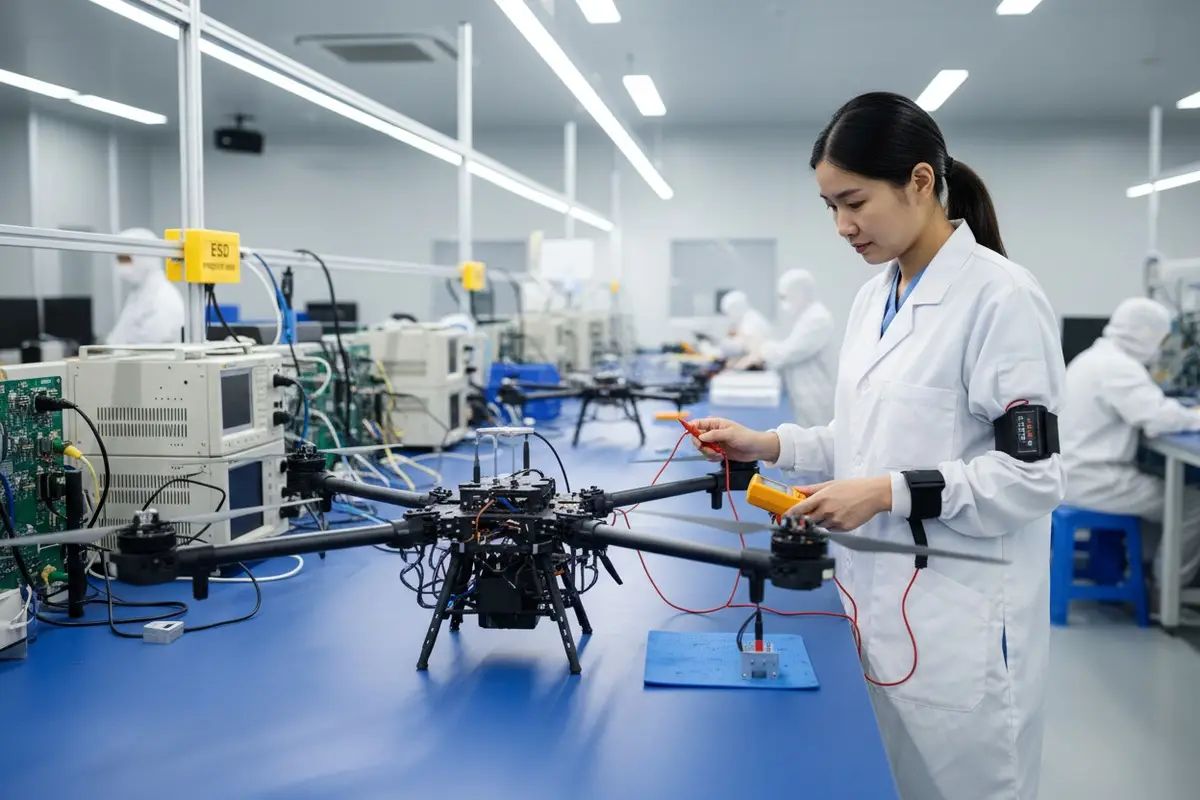

When our engineering team first started exporting agricultural drones to the US market, we discovered that nearly 15% of field failures traced back to ESD damage 1 during manufacturing. This silent killer affects flight controllers, GPS modules, and ESCs without any visible signs. The real problem? Many buyers never think to audit their supplier’s static control measures until drones start malfunctioning mid-spray.
To verify supplier ESD control when sourcing agricultural drones, request ANSI/ESD S20.20 certification, audit their ESD Protected Areas with grounded workstations, check personnel grounding protocols, review packaging procedures using anti-static materials, and demand documented ESD control plans covering all manufacturing stages.
The following sections break down exactly what to look for when auditing factories IEC 61340-5-1 compliance 2. We will cover certifications, grounding verification, failure causes, and documentation requirements.
What ESD certifications should I look for when auditing an agricultural drone factory?
Our quality control team visits partner facilities regularly common point grounding systems 3. We have learned that certifications alone do not guarantee protection. But they provide a critical starting point for your audit.
Look for ANSI/ESD S20.20 certification as the primary standard for drone factories. Additionally, check for ISO 9001 with ESD-specific clauses, IEC 61340-5-1 compliance, and NASA JSC equivalent standards for high-sensitivity components like flight controllers and GPS modules.

Understanding Key ESD Certifications
Not all certifications carry equal weight. ANSI/ESD S20.20 remains the gold standard for electronics manufacturing 4. It covers facility requirements, personnel training, and process controls.
Here is what each certification means for your agricultural drone supplier:
| Certification | What It Covers | Why It Matters for Drones |
|---|---|---|
| ANSI/ESD S20.20 | Complete ESD program management | Ensures systematic protection for all sensitive components |
| IEC 61340-5-1 | International ESD protection requirements | Validates global manufacturing standards |
| ISO 9001 + ESD clauses | Quality management with static control | Shows integration of ESD into overall quality system |
| NASA NPD-8730.5 | Aerospace-grade handling procedures | Indicates highest protection level for critical avionics |
Certification Classes and Sensitivity Thresholds
Different drone components have different sensitivity levels. Your supplier should understand these thresholds.
Class 1 facilities handle components damaged below 250 volts. This includes most modern flight controllers. Class 2 covers 250-1999 volt sensitivity. Class 3 handles components above 1999 volts.
Agricultural drones typically contain Class 1 and Class 2 components. GPS modules and IMUs fall into Class 1. Some ESC circuits can tolerate Class 2 levels.
Red Flags During Certification Review
Watch for suppliers who claim "adequate" ESD control without specific certifications. This vague language often hides poor practices.
Ask to see current certification dates. Expired certifications mean lapsed audits. Request copies of third-party audit reports. Self-certification offers less assurance.
Check if certifications cover the specific production lines making your drones. Some factories certify only certain areas.
How can I verify that my supplier uses proper ESD grounding on their drone assembly line?
During factory visits to our own assembly areas, we always demonstrate grounding systems to visiting clients. Proper grounding forms the foundation of all ESD protection. Without it, other measures become meaningless.
Verify proper ESD grounding by inspecting common point grounding systems connecting all workstations, testing personnel wrist straps for less than 35 megohms resistance, checking floor mat conductivity, examining equipment grounding connections, and confirming all grounding paths lead to a single reference point.

Common Point Grounding Systems
Every conductive element in an ESD Protected Area must connect to one electrical potential. This includes workbenches, floor mats, equipment, and personnel.
When inspecting a supplier's facility, trace the grounding paths. They should all lead to a common ground point. Separate grounds create potential differences. These differences cause discharge events.
Test grounding connections with a meter. Resistance should measure below specified limits. Loose connections increase resistance over time.
Personnel Grounding Verification
Workers represent the biggest ESD risk. Human bodies generate and store significant static charges. Proper grounding keeps workers at the same potential as their workstations.
| Grounding Method | Resistance Limit | Best Application |
|---|---|---|
| Wrist straps | <35 megohms | Seated assembly work |
| Heel straps | <35 megohms | Mobile workers |
| ESD footwear | <35 megohms | Standing workstations |
| Conductive flooring | 10^5 to 10^9 ohms | Full facility coverage |
Ask to see the supplier's daily testing records. Workers should test wrist straps before each shift. Testing stations should display pass/fail results clearly.
Workstation and Equipment Grounding
Each assembly station needs grounded work surfaces. These surfaces slowly dissipate charges from components placed on them.
Soldering irons, test equipment, and handling tools all require grounding. Look for three-prong plugs on all equipment. Check that outlets provide actual earth ground.
Automated assembly equipment needs special attention. Robotic arms can build significant charges through movement. Conveyor belts generate friction. Both require active grounding solutions.
Testing Grounding During Audits
Bring a surface resistance meter 6 to audits. Test work surfaces at multiple points. Values should fall between 10^6 and 10^9 ohms for dissipative materials.
Check continuity from work surfaces to ground points. Any breaks in the path compromise the entire system.
Ask suppliers to demonstrate their testing procedures. Observe whether workers follow protocols consistently.
Why does poor ESD control at the factory lead to frequent malfunctions in my agricultural drones?
Our service team tracks warranty returns carefully. We have seen how ESD damage manifests in the field. The connection between factory conditions and field failures often surprises our customers.
Poor ESD control causes agricultural drone malfunctions because static discharge damages sensitive semiconductors in flight controllers, GPS modules, and ESCs. Damage can be immediate or latent, with latent failures causing unpredictable crashes, imprecise spraying, and communication losses during critical field operations weeks after purchase.

Understanding ESD Damage Mechanisms
Static discharges happen incredibly fast. In nanoseconds, thousands of volts surge through tiny transistors. This creates microscopic damage invisible to the eye.
Immediate failures are obvious. The component stops working right away. Quality control catches these before shipping.
Latent failures 7 are dangerous. The component works initially but fails unpredictably later. Heat cycling, vibration, and humidity accelerate degradation of damaged areas.
Vulnerable Drone Subsystems
Agricultural drones contain multiple ESD-sensitive systems. Understanding these helps you ask better questions during audits.
| Subsystem | ESD Sensitivity | Typical Failure Mode |
|---|---|---|
| Flight controller MCU | Class 1 (<250V) | Erratic flight behavior, crashes |
| GPS receiver | Class 1 (<250V) | Position drift, signal loss |
| IMU sensors | Class 1 (<250V) | Calibration errors, attitude drift |
| ESC circuits | Class 2 (250-1999V) | Motor control issues, power loss |
| Radio transceivers | Class 1 (<250V) | Communication dropouts |
| Camera/sensor boards | Class 1 (<250V) | Image artifacts, sensor failures |
How Agricultural Conditions Worsen Latent Damage
Farm environments stress damaged components harder than lab conditions. Temperature swings from cold mornings to hot afternoons cause expansion and contraction. This widens microscopic cracks from ESD damage.
Dust infiltration increases thermal stress. Vibration from rotors and payload pumps adds mechanical stress. Humidity fluctuations affect damaged oxide layers.
A drone with latent ESD damage might fly perfectly for weeks. Then it fails during a critical spraying operation. The crop suffers. The farmer loses money. You lose a customer.
Calculating the True Cost of ESD Failures
Field failures cost far more than factory rejects. Consider these factors:
Warranty replacement costs include the component, labor, and shipping. Downtime during peak spraying seasons causes crop damage. Your reputation suffers with each failure.
One study estimates ESD-related failures cause 15% of UAV crashes. At an average drone value of several thousand dollars, plus crop damage liability, poor ESD control becomes extremely expensive.
When evaluating suppliers, factor these costs into their pricing. A slightly cheaper supplier with weak ESD controls may cost you much more in warranty claims.
What documentation should I request to prove my drone manufacturer maintains high ESD standards?
When we prepare documentation packages for export customers, we include comprehensive ESD records. This documentation proves our commitment to quality. Request similar documentation from any supplier you evaluate.
Request these documents to verify ESD standards: current ESD Control Plan per ANSI/ESD S6.1, facility certification certificates with audit dates, personnel training records, equipment calibration logs, material specifications for packaging, incoming inspection procedures for components, and corrective action reports for any ESD incidents.

Essential ESD Control Plan Elements
The ESD Control Plan 8 should cover all processes from receiving to shipping. It specifies procedures for every operation that involves ESD-sensitive components.
Review the plan for these elements:
- Scope and coverage of ESD-sensitive operations
- Defined responsibilities for ESD program management
- Specific procedures for handling, storage, and transport
- Training requirements and schedules
- Audit and verification procedures
- Corrective action processes
A complete plan runs many pages. Vague or brief documents suggest insufficient attention to ESD control.
Training and Calibration Records
Training records prove workers understand ESD risks and procedures. Look for initial training dates, refresher schedules, and competency assessments.
Calibration records for ESD monitoring equipment ensure measurements remain accurate. Key equipment includes:
| Equipment Type | Calibration Frequency | What It Verifies |
|---|---|---|
| Wrist strap testers | Annual | Personnel grounding |
| Surface resistance meters | Annual | Workstation compliance |
| Ionizer balance meters | Semi-annual | Air ionization effectiveness |
| Charge plate monitors | Annual | Ionizer performance |
Request calibration certificates from accredited laboratories. Internal calibration without traceability provides less assurance.
Packaging and Material Specifications
ESD-safe packaging protects drones during shipping. Ask for specifications on all packaging materials.
Shielding bags should meet ANSI/ESD STM11.31 requirements. These bags block external fields and dissipate charges. Foam inserts should be dissipative or conductive, not standard polyurethane.
Verify that packaging suppliers provide test reports. Materials can degrade over time or vary between batches.
Incoming Inspection Documentation
Quality suppliers inspect incoming components for ESD sensitivity ratings. They verify that component suppliers also maintain ESD controls.
Ask to see incoming inspection procedures. These should include:
- Verification of ESD packaging integrity
- Component sensitivity classification checks
- Supplier ESD certification reviews
- Sampling and testing procedures for critical components
Audit Reports and Corrective Actions
Regular internal audits show ongoing commitment to ESD control. External audit reports from certification bodies provide independent verification.
Corrective action reports reveal how suppliers respond to problems. Look for systematic root cause analysis and effective preventive measures.
A supplier who claims zero ESD incidents may not be monitoring effectively. Some incidents are inevitable. What matters is detection and response.
Conclusion
Verifying supplier ESD control protects your agricultural drone investments and your customers' operations. Request certifications, audit grounding systems, understand failure mechanisms, and demand complete documentation. These steps separate reliable suppliers from risky ones.
Footnotes
1. Replaced with ‘EOS/ESD Fundamentals Part 1 – ESD Association’ which provides a comprehensive overview of ESD damage. ↩︎
2. Provides an international standard for electrostatic discharge protection requirements. ↩︎
3. Replaced with ‘Part 3: Basic ESD Control Procedures and Materials – ESD Association’ which defines and explains common point grounding. ↩︎
4. Replaced with ‘ESD Fundamentals – Part 2: Principles of ESD Control’ from the ESD Association, focusing on ESD control in manufacturing. ↩︎
5. Defines the key standard for electrostatic discharge control programs. ↩︎
6. Tool used for verifying ESD dissipative properties of materials. ↩︎
7. Replaced with ‘Electrostatic Discharge (ESD) – Texas Instruments’ which provides a clear explanation of latent failures. ↩︎
8. Details the essential documentation for managing ESD risks. ↩︎

 English
  Español de México
  Deutsch
  Français
  Русский
  العربية
Comments
No comments yet. Be the first to share your thoughts!
Leave a Comment