
When we first started shipping firefighting drones overseas, customers always asked one question: how long must I wait for testing before deployment Payload Operation Testing 1? This uncertainty creates real problems. Procurement timelines get delayed. Budgets become unpredictable. Fire seasons approach while drones sit in testing labs.
The required testing period for firefighting drone reliability typically ranges from 50 to 200 hours of flight testing, combined with environmental stress tests lasting 2 to 8 weeks. Custom engineering or software development can extend this timeline by an additional 4 to 12 weeks depending on project complexity.
Let me walk you through exactly what this testing involves, why it matters, and how you can plan your procurement timeline around these requirements.
How many hours of flight testing should I expect to ensure my firefighting drone is truly reliable?
Our engineering team has refined flight testing protocols over hundreds of deployments Environmental Stress Testing 2. Buyers often underestimate the hours needed. They assume a few test flights prove reliability. That assumption leads to equipment failures during actual emergencies RTCA DO-160G standards 3.
You should expect between 50 and 200 hours of cumulative flight testing to verify firefighting drone reliability. This includes 20-40 hours of basic maneuver testing, 30-80 hours of payload operation tests, and 20-80 hours of environmental stress flights under various weather conditions.

Breaking Down Flight Test Categories
Flight testing falls into three main categories. Each serves a specific purpose in proving your drone can perform under pressure.
Basic Maneuver Testing covers takeoff, landing, hovering, and navigation. NIST developed standardized tests 4 in 2018 that measure both aircraft capability and pilot proficiency. These tests use white buckets with black rings as alignment targets. Pilots must demonstrate precision in positioning.
Payload Operation Testing evaluates how drones perform with firefighting equipment attached. This includes water tanks, thermal cameras, and communication relays. Weight distribution changes flight characteristics dramatically. We test at 50%, 75%, and 100% payload capacity.
Environmental Stress Testing pushes drones to their operational limits. Current commercial firefighting drones must handle temperatures from 10°F to 104°F. Wind resistance requirements reach 22.4 to 39 feet per second.
Standard Flight Testing Timeline
| Test Phase | Hours Required | Duration | Purpose |
|---|---|---|---|
| Basic Maneuvers | 20-40 hours | 1-2 weeks | Verify flight stability and control |
| Payload Operations | 30-80 hours | 2-4 weeks | Test equipment integration |
| Environmental Stress | 20-80 hours | 2-4 weeks | Validate extreme condition performance |
| Total | 50-200 hours | 5-10 weeks | Complete reliability verification |
Why Hour Requirements Vary
Hour requirements depend on your specific application. A drone used only for aerial reconnaissance needs fewer hours than one dropping fire retardant. Autonomous flight features require extensive AI validation. Swarm operations multiply testing complexity.
Fire department drone adoption doubled between 2020 and 2021. This growth pushed manufacturers to establish clearer testing benchmarks. The FAA granted its first Beyond Visual Line of Sight waiver 5 for firefighting in 2021, creating new testing requirements for extended-range operations.
Our production line runs accelerated life testing called HALT (Highly Accelerated Life Testing 6). This method identifies potential failure points faster than real-time testing. We calculate Mean Time Between Failures 7 to predict product lifespan before shipping.
How long will the testing phase take if I require custom engineering or software development for my order?
When customers request custom features, we always explain the timeline impact upfront. Custom work extends testing significantly. The engineering team must validate every modification against firefighting safety standards.
Custom engineering or software development adds 4 to 12 weeks to your testing timeline. Simple modifications like payload mounting require 4-6 weeks. Complex software integrations or new sensor systems need 8-12 weeks. AI-based autonomous features may require additional validation periods of 6-8 weeks.

Types of Custom Modifications and Their Testing Requirements
Not all customizations are equal. A custom paint job adds zero testing time. A new flight control algorithm adds months.
Hardware Modifications include custom payload mounts, specialized camera housings, and modified frame designs. These require structural testing, vibration analysis, and flight characteristic verification. Our engineers perform finite element analysis 8 before physical testing begins.
Software Development covers custom flight planning systems, specialized data processing, and integration with existing command systems. Software reliability testing includes continuous integration validation. We test firmware updates for stability, security, and compatibility.
AI and Autonomous Features demand the most extensive testing. Autonomous firefighting decisions must be validated across diverse scenarios. We simulate thousands of firefighting situations before real-world trials.
Custom Development Timeline Breakdown
| Modification Type | Engineering Time | Testing Time | Total Added Time |
|---|---|---|---|
| Payload Integration | 1-2 weeks | 3-4 weeks | 4-6 weeks |
| Software Customization | 2-4 weeks | 4-6 weeks | 6-10 weeks |
| Sensor Integration | 2-3 weeks | 4-6 weeks | 6-9 weeks |
| AI/Autonomous Features | 4-6 weeks | 6-8 weeks | 10-14 weeks |
| Full Custom Platform | 6-10 weeks | 8-12 weeks | 14-22 weeks |
Interoperability Testing Considerations
Many customers need drones that work with existing systems. Fire departments often have established command and control infrastructure. Your drone must integrate seamlessly.
Interoperability testing validates communication protocols, data formats, and operational handoffs. Swarm reliability testing ensures multiple drones coordinate without conflicts. These requirements add 2-4 weeks to testing timelines.
We recommend discussing custom requirements early in the procurement process. Early planning prevents timeline surprises. Our design team can identify potential testing bottlenecks before engineering begins.
Managing Custom Project Timelines
Successful custom projects follow a structured process. First, we document all requirements in detail. Second, our engineers create a testing protocol specific to your modifications. Third, we establish milestone reviews to track progress.
Clear communication prevents delays. Weekly progress reports keep you informed. Video conferences allow you to observe critical tests remotely.
What specific durability tests should my supplier conduct to guarantee performance in extreme fire conditions?
Our quality control team runs every firefighting drone through a punishing test sequence. Fires create brutal conditions. Heat, smoke, turbulence, and electromagnetic interference all attack drone systems simultaneously.
Your supplier should conduct heat chamber testing up to 140°F, smoke exposure tests for optical system clarity, vibration testing at multiple frequencies, IP55 water and dust resistance verification, and electromagnetic compatibility testing per RTCA DO-160G standards. These tests simulate real firefighting conditions systematically.
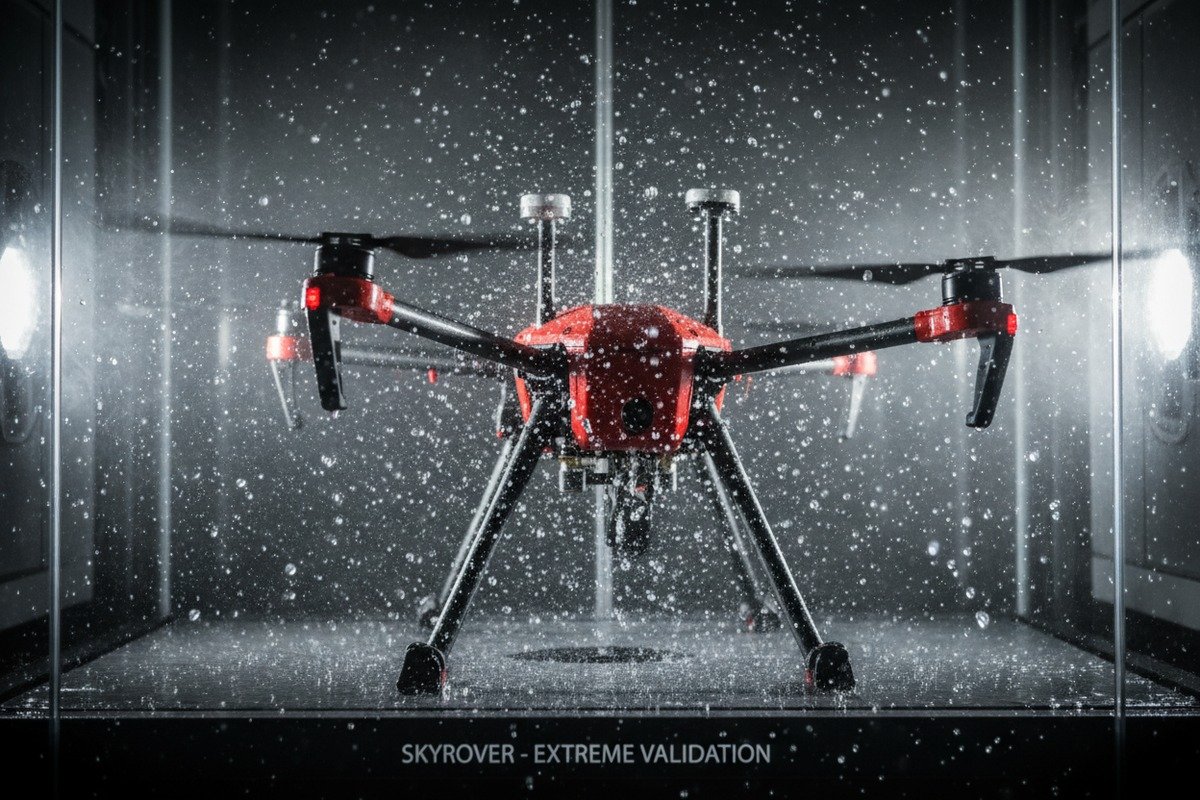
Essential Environmental Tests
Fire conditions destroy equipment not built to withstand them. Each environmental test targets specific failure modes.
Heat Chamber Testing exposes drones to temperatures beyond normal operating limits. We test at 140°F for extended periods. Electronics must function without thermal throttling. Battery performance must remain stable.
Smoke Exposure Testing verifies optical system performance. Cameras and sensors must provide clear images through smoke. Lens coatings must resist soot accumulation. Infrared sensors must maintain calibration.
Vibration Testing identifies weak structural points. Fire-induced turbulence creates intense vibration patterns. We test at frequencies from 10Hz to 2000Hz. Components must remain securely mounted.
Environmental Compliance Standards
| Test Category | Standard | Parameters | Pass Criteria |
|---|---|---|---|
| Temperature | RTCA DO-160G | -40°F to 140°F | Full function maintained |
| Altitude | RTCA DO-160G | 0 to 15,000 feet | Stable flight performance |
| Vibration | RTCA DO-160G | 10-2000 Hz | No structural failure |
| Water/Dust | IP55 | Direct water spray | No internal moisture |
| EMC | LVD 2014/35/EU | RF interference | No signal disruption |
Accelerated Life Testing Methods
Real-world testing takes too long to be practical. Accelerated methods compress years of wear into weeks.
HALT (Highly Accelerated Life Testing) applies extreme stress to find design weaknesses. Temperature cycling, vibration escalation, and combined stresses reveal failure points quickly. Our engineers use HALT data to improve designs before production.
MTBF (Mean Time Between Failures) Estimation predicts operational lifespan. We calculate expected failure rates for each component. This data helps you plan maintenance schedules and spare parts inventory.
Ongoing Performance Monitoring
Initial testing proves capability. Ongoing monitoring proves sustained reliability.
Flight logs track performance trends over time. Physical inspections identify wear before failure occurs. Incident reports create learning opportunities. We recommend quarterly performance reviews for deployed drones.
Post-incident forensic analysis examines any failures during actual operations. This analysis informs future design improvements. It also updates testing protocols to catch similar issues.
How does the mandatory testing period impact my total procurement timeline and door-to-door delivery schedule?
We ship firefighting drones to fire departments across the United States and Europe every month. The most common complaint from new customers? Nobody told them about testing timelines upfront. This creates budget cycles missed and fire seasons unprepared.
Mandatory testing periods add 8 to 16 weeks to your total procurement timeline. Combined with 2-4 weeks for manufacturing and 2-3 weeks for international shipping and customs clearance, expect a total door-to-door timeline of 12 to 23 weeks from order confirmation to operational deployment.

Complete Procurement Timeline Phases
Understanding each phase helps you plan accurately. Each phase has minimum durations that cannot be compressed without risking quality.
Order Processing and Confirmation takes 1-2 weeks. This includes technical specification review, pricing finalization, and contract execution. For government procurement, this phase may extend due to approval processes.
Manufacturing and Assembly requires 2-4 weeks for standard configurations. Our production facility in Xi'an maintains component inventory to minimize delays. Custom configurations add to this timeline based on complexity.
Testing and Validation consumes 8-16 weeks depending on configuration and requirements. This is the longest phase and the most variable. Custom features significantly extend testing duration.
Shipping and Customs Clearance needs 2-3 weeks for door-to-door delivery. Air freight is faster but more expensive. Sea freight saves money but adds 2-4 additional weeks.
Complete Timeline Summary
| Phase | Standard Configuration | Custom Configuration |
|---|---|---|
| Order Processing | 1-2 weeks | 2-3 weeks |
| Manufacturing | 2-3 weeks | 3-5 weeks |
| Standard Testing | 8-10 weeks | 8-10 weeks |
| Custom Testing | N/A | 4-12 weeks |
| Shipping (Air) | 1-2 weeks | 1-2 weeks |
| Customs Clearance | 1 week | 1 week |
| Total | 13-18 weeks | 19-33 weeks |
Strategies to Optimize Your Timeline
Early planning is the most effective strategy. Contact suppliers 6-9 months before your deployment deadline. This buffer accommodates unexpected delays without crisis.
Pilot Programs allow parallel evaluation and procurement. Some fire departments run one-year pilot programs with defined evaluation windows. Data from pilots accelerates subsequent procurement decisions.
Pre-tested Configurations ship faster than custom builds. Our standard firefighting drone packages complete testing before orders arrive. You trade customization for speed.
Phased Deployment spreads risk across multiple delivery windows. Order initial units early for testing and training. Order production quantities after validating performance.
Documentation for Customs Clearance
Proper documentation prevents customs delays. Fire departments and government contractors need specific paperwork for import approval.
We provide complete export documentation including certificates of conformity, safety test reports, and end-user declarations. Our experience exporting to the US and Europe means we know exactly what customs officials require.
FAA waivers may require additional lead time for approval. BVLOS operations need waiver applications submitted months in advance. We help customers prepare waiver application supporting documents.
Conclusion
Testing periods for firefighting drones range from 8 to 16 weeks depending on configuration complexity. Plan your procurement timeline accordingly. Contact us early to discuss your specific requirements and delivery schedule.
Footnotes
1. Explains how to test a UAV’s ability to lift and carry a payload. ↩︎
2. Describes a project focused on testing drones in extreme environmental conditions. ↩︎
3. Provides an overview of the RTCA DO-160G standard for environmental testing of airborne equipment. ↩︎
4. NIST provides standard test methods for evaluating drone capabilities and pilot proficiency. ↩︎
5. Explains the FAA’s Part 91 BVLOS waiver process for public safety agencies. ↩︎
6. Provides a comprehensive definition and overview of HALT methodology. ↩︎
7. Original URL was 404. Found an authoritative definition of Mean Time Between Failures on Wikipedia. ↩︎
8. Explains FEA as a method for predicting object behavior and validating designs virtually. ↩︎

 English
  Español de México
  Deutsch
  Français
  Русский
  العربية
