
When our engineering team first started receiving requests from fire department distributors about branding options, we realized this was a major gap in the market OEM services 1. Your clients want their equipment to look professional and unified, but most drone manufacturers ignore this need entirely.
Yes, you can customize boot screens and software logos for firefighting drones when you partner with manufacturers offering OEM services. At SkyRover, we provide full white-label options including custom boot animations, branded flight control interfaces, and personalized splash screens that display your company identity from the moment the drone powers on.
Let me walk you through exactly how this works, what options exist, and how our team makes customization simple for distributors and dealers worldwide.
How can I add my own company logo to the firefighting drone's flight control software?
Our development team fields this question almost weekly from new partners. You want your brand front and center when clients use your equipment. The problem is most enterprise drone makers lock their software completely.
Adding your company logo to flight control software requires working with a manufacturer that offers software customization. Our team integrates your logo into the main interface, status screens, and mission planning dashboards. This process typically takes 2-3 weeks and creates a seamless branded experience throughout the entire software ecosystem.

Understanding Flight Control Software Architecture
Flight control software 2 has several layers. The base layer handles stability and motor control. The interface layer shows pilots what they need to see. Your logo lives in this interface layer.
When our engineers customize software, we work with vector files 3 of your logo. We then integrate these into multiple touchpoints. The pilot sees your brand on the home screen. It appears in mission reports. It shows in the app icon itself.
Where Your Logo Can Appear
| Location | Visibility | Technical Requirement |
|---|---|---|
| App splash screen | Every app launch | PNG or SVG, 512×512 minimum |
| Main dashboard header | Constant during flight | PNG, 200×60 pixels |
| Mission report watermark | On all exported files | Transparent PNG |
| App store icon | When downloading | PNG, 1024×1024 |
| PDF export headers | On all documentation | Vector format preferred |
The Integration Process
First, you send us your brand guidelines. Our designers review color codes, logo variations, and spacing rules. We then create mockups showing exactly how your logo will appear.
After your approval, our software team implements the changes. They test on multiple device types. Android tablets, iPads, and various phone sizes all display correctly.
We then compile a custom build for your distribution. You receive an APK or IPA file 4 depending on your market. Some partners request both versions.
Common Concerns Addressed
Many distributors worry about update compatibility. Our architecture keeps your branding separate from core functions. When we release flight safety updates, your custom branding remains intact.
You also retain flexibility. Want to change your logo later? We can push updates without disrupting your clients' operations.
Can I customize the boot screen to feature my brand identity during the power-on sequence?
During factory visits, our partners often watch drones power up and immediately ask about that boot sequence. Those first seconds matter. They set expectations for quality and professionalism.
Boot screen customization is absolutely possible with SkyRover drones. We replace the default startup animation with your branded sequence, including your logo, company colors, and optional tagline. The boot screen displays for 8-12 seconds during system initialization, giving strong brand visibility every time the drone activates.

What Makes Boot Screens Different
Boot screens appear on different hardware than flight software. Your drone may have an onboard display. The controller has its own screen. FPV goggles 5 show separate boot sequences.
Each requires different file formats and resolutions. Our team handles all of these variations for you.
Technical Specifications by Display Type
| Display Type | Resolution | File Format | Max File Size | Color Depth |
|---|---|---|---|---|
| Onboard OLED | 128×64 | BMP | 50KB | Monochrome |
| Controller LCD | 1280×720 | JPG/PNG | 200KB | Full color |
| FPV Goggles | 1280×960 | JPG | 100KB | Full color |
| Ground Station Tablet | Device dependent | PNG | 500KB | Full color |
Static vs. Animated Options
You have two choices for boot screens. Static images are simpler. Your logo appears, holds for the boot duration, then transitions to the main interface.
Animated sequences feel more premium. Our designers can create a 3-5 second animation showing your logo assembling, pulsing, or revealing with effects. This requires additional development time but creates stronger impressions.
Implementation Without Risk
Our firmware architecture 6 uses a modular approach. Boot screens load from a specific partition. If corruption occurs, the system defaults to a safe mode. This prevents boot failures during critical operations.
We test every custom boot screen extensively. Cold weather startups. Hot environment conditions. Low battery scenarios. Your branding must never interfere with mission readiness.
Consistency Across Your Fleet
When you order multiple units, every drone ships with identical branding. We document the exact specifications used. Future orders match perfectly. Your clients see uniform professionalism across their entire fleet.
What options do I have for developing custom software features tailored to my firefighting operations?
Our collaboration with fire equipment distributors taught us something important. Generic drone software frustrates specialized users. Firefighters need tools designed for their exact workflows.
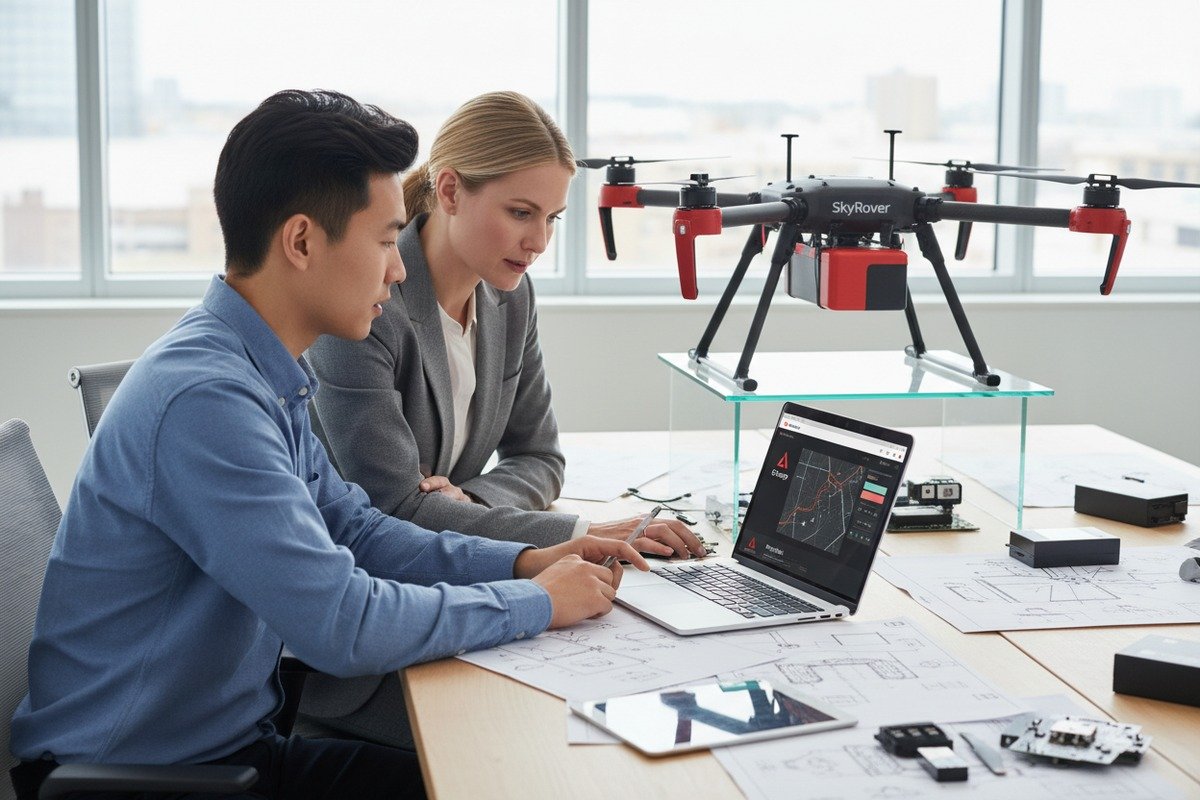
Custom software development options include thermal imaging overlays, automated fire perimeter mapping, smoke penetration algorithms, real-time temperature logging, integration with existing fire department CAD systems, and specialized waypoint planning for structure fires. Our development team works directly with you to prioritize features that solve your clients' specific operational challenges.
Core Customization Categories
Software customization falls into three main categories. Interface modifications change how pilots interact with the system. Functional additions create new capabilities. Integration features connect the drone to external systems.
Popular Custom Features for Firefighting
| Feature Category | Specific Capability | Development Time | Complexity Level |
|---|---|---|---|
| Thermal Analysis | Hotspot auto-detection | 3-4 weeks | Medium |
| Mission Planning | Fire perimeter auto-trace | 4-6 weeks | High |
| Reporting | Automated incident logs | 2-3 weeks | Low |
| Integration | CAD/dispatch system link | 6-8 weeks | High |
| Safety | No-fly zone geofencing | 2-3 weeks | Medium |
| Communication | Radio frequency relay | 4-5 weeks | Medium |
The Development Partnership Process
We start with a discovery call. You describe your clients' pain points. What tasks take too long? What information do they lack during operations? What mistakes happen with current equipment?
Our product managers create a feature specification document. This details exactly what the software will do. How screens will look. What data gets captured. You approve before coding begins.
Development happens in sprints. Every two weeks, you see progress. You can request adjustments early. This prevents costly rewrites later.
Real Examples From Our Partners
One European distributor needed drones that logged GPS coordinates every time thermal anomalies 7 exceeded 200°C. We built this feature with exportable CSV files compatible with their fire investigation software.
A US partner required automatic no-fly zone updates from FAA databases. Our team created an API integration 8 that syncs restrictions before every flight.
Protecting Your Investment
Custom software features become part of your competitive advantage. We offer exclusivity agreements for significant developments. Your competitors cannot access identical capabilities.
All custom code remains documented. If you ever need modifications, our team can adjust quickly. You also receive technical documentation for your support staff.
How does SkyRover support my need for a fully white-labeled software interface for my local clients?
When our first major distributor asked for complete white-labeling, we built an entire system around this need. Your local clients should never see our name. They should see yours.
SkyRover provides comprehensive white-label support including complete brand replacement across all software touchpoints, custom packaging with your company identity, localized user manuals in your market's language, and dedicated technical documentation under your brand. We become invisible while you build your reputation as a premium drone provider.

What Full White-Labeling Includes
White-labeling goes far beyond a logo swap. Every customer touchpoint carries your identity. This creates a cohesive experience that builds trust with end users.
Complete White-Label Package Components
| Component | Standard Customization | Premium Customization |
|---|---|---|
| Software interface | Your logo and colors | Complete UI redesign |
| Boot screens | Static branded image | Custom animation |
| User manuals | Your branding, standard content | Fully rewritten content |
| Packaging | Logo stickers | Custom printed boxes |
| Warranty cards | Your company details | Custom design |
| Training videos | Your logo watermark | Fully rebranded narration |
| Support portal | Subdomain option | Dedicated domain |
The Localization Advantage
Your local clients expect local language support. We translate interfaces into the languages you need. Currently, our team supports English, Spanish, German, French, Portuguese, and Italian for primary markets.
Translation covers more than software text. User manuals, quick-start guides, and warning labels all receive localized versions. This reduces support calls and improves safety compliance.
Maintaining the Illusion
Technical support requires careful handling. When your clients contact you, they expect your team to have answers. We provide comprehensive training for your support staff. They learn the systems deeply enough to troubleshoot independently.
For complex issues, we offer white-label escalation. Your staff contacts our engineers directly. We solve problems behind the scenes. Your clients never know we exist.
Business Benefits of White-Labeling
This approach protects your margins. When clients search for your drones, they find your company. Not a Chinese manufacturer they could contact directly. Your brand equity grows with every sale.
It also enables premium pricing. A fully branded, localized product commands higher prices than generic imports. Your clients recognize the investment you've made in serving their market.
Minimum Order Considerations
Full white-labeling requires investment from both sides. We set minimum order quantities that make customization economically viable. For most partners, this means 20-50 units per order depending on customization depth.
Smaller initial orders are possible with partial customization. Software branding might be included, while custom packaging waits for larger orders. We work flexibly with growing distributors.
Conclusion
Customizing boot screens and software logos for firefighting drones is not only possible but increasingly expected by professional distributors. Our team at SkyRover has built systems specifically to support your branding needs, from simple logo additions to complete white-label programs. Contact us to discuss how we can make your drone fleet truly yours.
Footnotes
1. Explains the concept of Original Equipment Manufacturer (OEM) in business. ↩︎
2. Provides an overview of software controlling unmanned aerial vehicles. ↩︎
3. Replaced with an authoritative Wikipedia article defining vector graphics. ↩︎
4. Explains IPA files as iOS application archive files, similar to APK for Android. ↩︎
5. Describes FPV goggles as devices for immersive, first-person drone piloting. ↩︎
6. Explains the foundational design of software embedded within hardware devices. ↩︎
7. Defines thermal anomalies as deviations from a reference temperature or average. ↩︎
8. Describes API integration as connecting software systems for seamless data transfer. ↩︎

 English
  Español de México
  Deutsch
  Français
  Русский
  العربية
