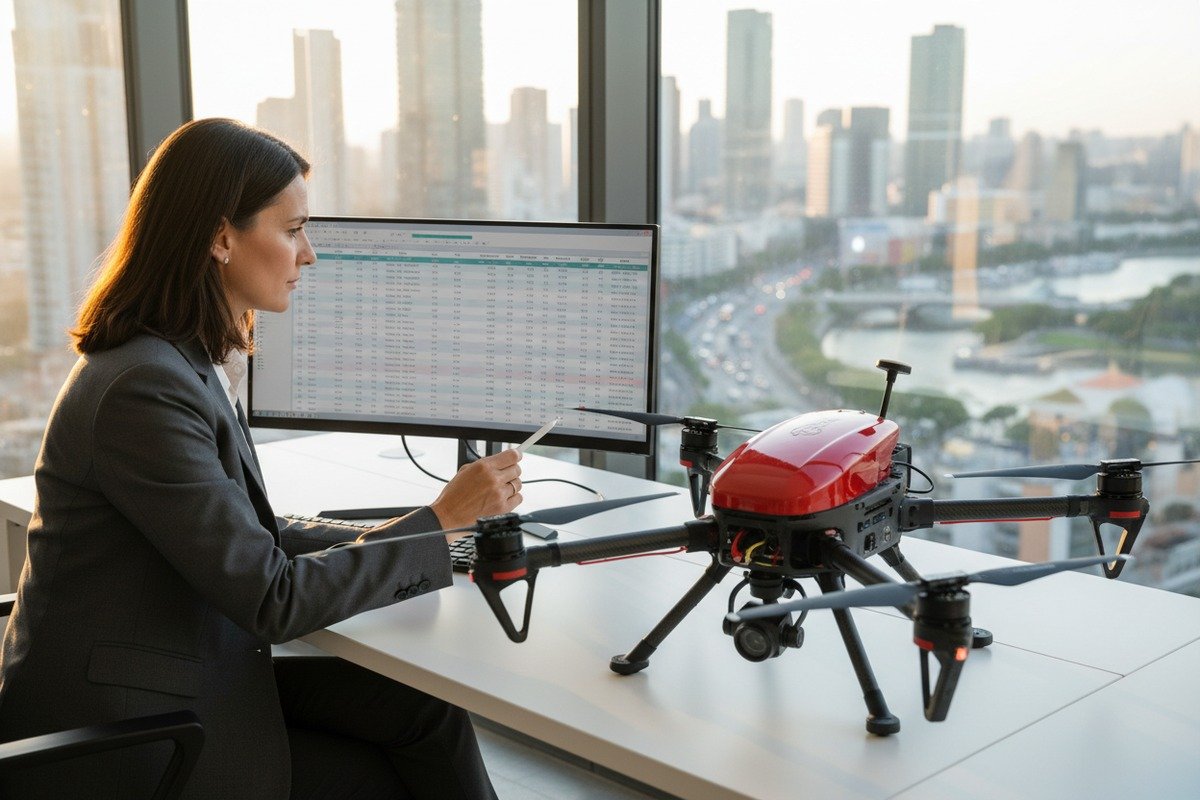
When our production team ships firefighting drones overseas, procurement managers often discover their budget fell short FCC compliance 1. The invoice price is just the beginning.
To calculate total landed cost for Chinese firefighting drones, add the product price, international shipping, customs duties (including Section 301 tariffs up to 25%), insurance, brokerage fees, certifications, and domestic freight. This typically increases the base cost by 25-40%, so budgeting only for the drone price leads to significant shortfalls.
Let me walk you through each cost component. By the end, you will know exactly how to budget for your next drone procurement project.
How do I accurately calculate the shipping and door-to-door delivery fees for my drone order?
Our logistics team handles hundreds of drone shipments yearly NFPA compliance 2. One common mistake? Buyers assume shipping is a flat fee. It is not. Your shipping cost depends on weight, volume, delivery speed, and battery regulations.
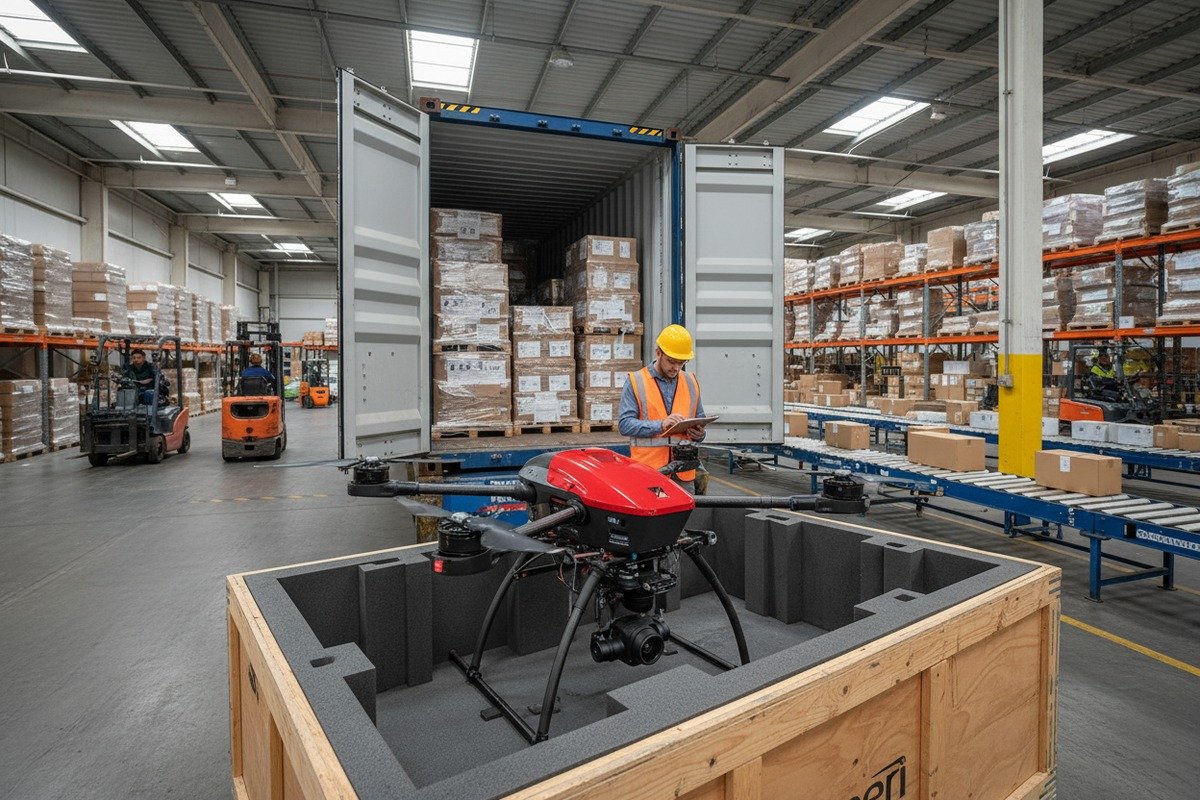
Shipping costs for firefighting drones from China include ocean freight ($2,500-$7,500 per 40ft container), air freight ($10-20 per kg), plus surcharges for lithium batteries, port handling, and last-mile delivery. Door-to-door service adds customs clearance and domestic trucking, typically $500-$2,000 depending on destination.
Understanding Freight Options
You have three main choices: ocean, air, and express courier. Each has trade-offs.
Ocean freight works best for bulk orders. A 40ft container from Shanghai to Los Angeles costs $3,000-$6,000 in 2026. Transit takes 20-35 days. This method suits orders of 50+ drones.
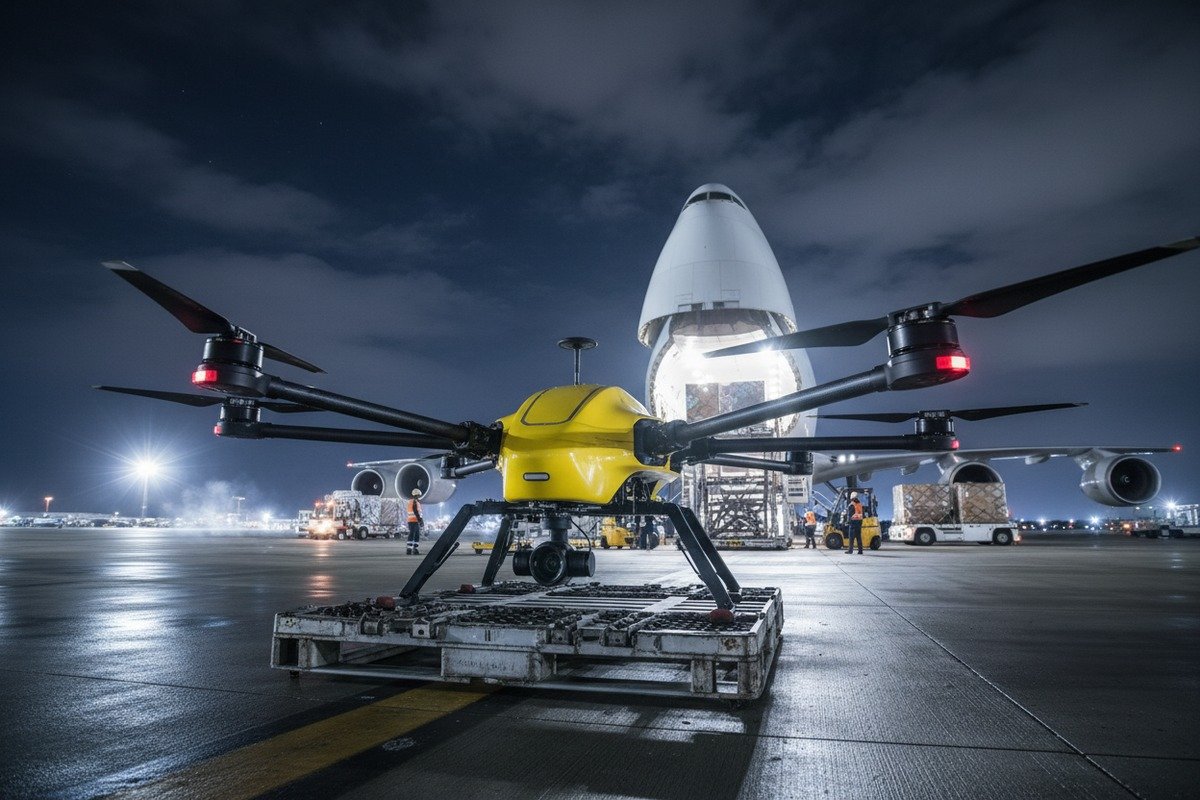
Air freight is faster but pricier. Expect $10-20 per kilogram. A 30kg firefighting drone costs $300-$600 just for air shipping. Transit takes 5-10 days.
Express couriers like DHL or FedEx handle small orders well. They manage customs paperwork too. But rates run 2-3x higher than standard air freight.
How to Calculate Volume-Based Costs
Ocean freight uses cubic meters (CBM). Here is the formula:
CBM = Length (m) × Width (m) × Height (m)
A typical firefighting drone in packaging measures 1.2m × 0.8m × 0.6m = 0.576 CBM.
| Shipping Method | Unit Cost | 10 Drones | 100 Drones | 500 Drones |
|---|---|---|---|---|
| Ocean Freight | $130/CBM | $750 | $7,500 | $37,500 |
| Air Freight | $15/kg | $4,500 | $45,000 | $225,000 |
| Express Courier | $25/kg | $7,500 | $75,000 | $375,000 |
Lithium Battery Surcharges
Firefighting drones contain large lithium batteries 3. Carriers charge extra for these. DHL adds $30-50 per package. Air cargo requires UN38.3 certification and special packaging. Our team includes this documentation with every shipment, but the surcharges still apply.
Last-Mile Delivery Costs
Door-to-door means delivery to your warehouse. After customs clearance, domestic trucking adds $200-$800 depending on distance from the port. Rural locations cost more. Some buyers choose to pick up from a bonded warehouse to save money.
Fuel and Sustainability Surcharges
Carriers now add 5-10% eco-compliance fees. In 2026, DHL and UPS include carbon offset charges. These fees fluctuate monthly based on fuel prices. Budget an extra 8% on top of quoted freight rates.
What import duties and customs clearance charges should I expect when sourcing drones from China?
In our experience exporting to the US and EU, tariffs surprise buyers most often. Our sales team now provides duty estimates upfront because the gap between product price and landed cost can reach 40%.
Firefighting drones from China face US import duties including a base rate of 0-7.5% plus Section 301 tariffs of 25%, totaling approximately 25-32%. Add customs brokerage fees ($150-$500), Merchandise Processing Fee (0.3464%), and harbor maintenance fees. EU buyers pay 0% duty but 20% VAT on the landed value.
Understanding HTS Codes for Drones
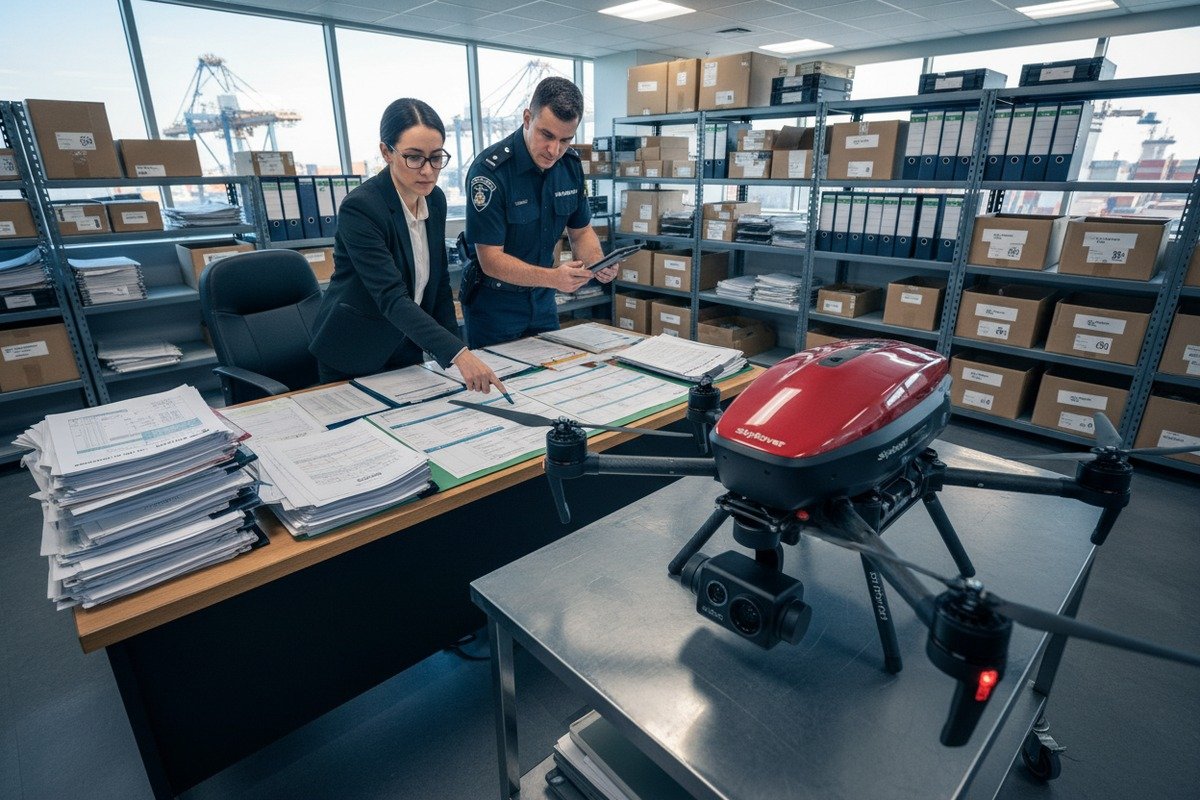
The Harmonized Tariff Schedule code 4 determines your duty rate. Drones fall under Chapter 88.
| HTS Code | Description | Base Duty | China Section 301 | Total US Duty |
|---|---|---|---|---|
| 8806.21 | Drones ≤250g | 0% | 25% | 25% |
| 8806.22 | Drones 250g-7kg | 0% | 25% | 25% |
| 8806.23 | Drones 7-25kg | 0% | 25% | 25% |
| 8806.24 | Drones >25kg | 0% | 25% | 25% |
Firefighting drones typically weigh 15-40kg, placing them in 8806.23 or 8806.24. The good news: the base MFN rate is 0%. The bad news: Section 301 adds 25%.
Calculating Total Duty Cost
Here is a real example. You order 100 firefighting drones at $4,000 each.
- Product value: $400,000
- Ocean freight: $5,000
- Insurance: $8,000
- Customs value (CIF): $413,000
- Section 301 duty (25%): $103,250
- Merchandise Processing Fee (0.3464%): $1,430
- Harbor Maintenance Fee (0.125%): $516
- Total duties and fees: $105,196
That is $1,052 per drone in duties alone.
Customs Brokerage Fees
A licensed customs broker handles paperwork. Fees range from $150 for simple shipments to $500+ for complex entries. They verify HTS codes, file ISF (Importer Security Filing), and resolve holds. Our shipping partners include brokerage in door-to-door quotes.
Potential Tariff Exemptions
Some firefighting equipment qualifies for duty exemptions. Government agencies purchasing for public safety may apply for exclusions. The process takes 3-6 months. We have helped several fire department suppliers navigate these applications successfully.
EU Import Considerations
The European Union charges 0% duty on drones under HTS 8806. However, VAT applies. Most EU countries charge 19-25% VAT on the CIF value plus duty. Germany charges 19%. France charges 20%. This VAT is recoverable if you are a registered business.
Currency and Bank Fees
Wire transfers from USD to CNY incur bank fees. Expect 1-3% in currency conversion costs. Some buyers use trade finance platforms to reduce these fees. Our finance team accepts multiple payment methods to minimize conversion losses.
How can I factor in the costs of OEM customization and product certifications for my procurement budget?
When we calibrate our flight controllers for specific payloads, buyers ask about customization costs. OEM branding and certifications add $200-$2,000 per unit depending on requirements.
OEM customization costs include logo printing ($5-20/unit), custom packaging ($10-50/unit), software modifications ($2,000-$15,000 one-time), and hardware changes ($5,000-$50,000 tooling). Certifications like FAA Part 107 waivers, CE marking, and FCC compliance add $5,000-$30,000 per model, spread across your order quantity.
Types of OEM Customization
Our engineering team offers several customization levels:
Basic branding includes logo printing on the drone body and controller. We use UV printing or laser etching. Cost: $5-20 per unit with a $500 minimum setup fee.
Custom packaging ranges from simple branded boxes to full retail packaging with foam inserts. Basic boxes cost $10-15 per unit. Premium retail packaging runs $30-50 per unit.
Software customization involves flight parameter adjustments, custom app interfaces, or proprietary control protocols. Simple parameter changes cost $2,000-$5,000. Full app development runs $10,000-$50,000.
Hardware modifications require tooling changes. New payload mounts cost $5,000-$15,000 in tooling. Custom frame designs start at $20,000. These costs amortize across your order volume.
Certification Requirements by Market
| Certification | Market | Cost Range | Timeline | Notes |
|---|---|---|---|---|
| CE Marking 6 | EU | $5,000-$15,000 | 6-12 weeks | Required for EU sales |
| FCC Part 15 | USA | $3,000-$8,000 | 4-8 weeks | Radio frequency compliance |
| FAA Part 107 Waiver | USA | $0 (application) | 90-120 days | Operator certification |
| RED Directive | EU | $8,000-$20,000 | 8-16 weeks | Radio equipment directive |
| UN38.3 | Global | $2,000-$5,000 | 4-6 weeks | Battery transport certification |
Amortizing Certification Costs
Certifications are one-time costs per model. Order volume matters. If CE marking costs $10,000 and you order 100 drones, that adds $100 per unit. Order 1,000 drones, and it drops to $10 per unit.
Our team already holds CE, FCC, and UN38.3 certifications for standard models. Buyers using our existing certified designs avoid most certification costs.
Firefighting-Specific Certifications
Firefighting drones may require additional approvals:
- NFPA compliance: National Fire Protection Association standards
- Public safety waivers: FAA waivers for operation over people
- Thermal camera export licenses: ITAR restrictions on certain sensors
Some thermal imaging sensors require US export licenses. We use non-ITAR sensors to simplify your import process. This is something our R&D team specifically chose to reduce buyer complications.
MOQ Considerations for Custom Orders
Minimum order quantities affect unit costs. Our standard firefighting drone MOQ is 10 units. Custom hardware modifications require 50+ units to justify tooling costs. Software customization has no MOQ but carries fixed development fees.
Our after-sales team handles 200+ support tickets monthly. The question we hear most: "Why didn't anyone tell me spare parts cost this much?" Long-term costs often exceed initial purchase savings.
Hidden expenses include spare parts inventory (budget 10-15% of drone value annually), technical support contracts ($500-$2,000/year per unit), software updates and licensing ($200-$1,000/year), training programs ($1,000-$5,000 per operator), and warranty extensions (3-5% of drone value). Total cost of ownership typically adds 20-30% to the purchase price over three years.
Essential Spare Parts Inventory
Firefighting drones operate in harsh conditions. Parts wear out faster than consumer drones. We recommend stocking these items:
| Component | Replacement Frequency | Cost Range | Stock Recommendation |
|---|---|---|---|
| Propellers | Every 50-100 flight hours | $50-$150/set | 3 sets per drone |
| Motors | Every 500-800 hours | $200-$500 each | 2 per drone |
| Batteries | 300-500 charge cycles | $500-$1,500 each | 3 per drone |
| Landing gear | As needed | $100-$300 | 1 per drone |
| Camera gimbals | Every 1,000 hours | $800-$2,000 | 1 per 5 drones |
| ESCs | Every 800-1,200 hours | $150-$400 | 2 per drone |
For a fleet of 20 drones, initial spare parts inventory costs $15,000-$30,000. Annual replenishment runs $5,000-$10,000.
Technical Support Models
We offer three support tiers:
Basic support includes email assistance during business hours (China time). Response within 48 hours. Free for the first year, then $200/year per unit.
Standard support adds video call troubleshooting, firmware updates, and 24-hour response time. Cost: $500/year per unit.
Premium support includes on-site technician visits (travel costs extra), priority parts shipping, and dedicated account manager. Cost: $1,500-$2,000/year per unit.
Training Program Costs
Untrained operators crash drones. Training reduces accidents by 60-70% in our experience. Options include:
- Online training: $200-$500 per operator
- On-site training in China: $1,000-$2,000 per person plus travel
- Trainer visits your location: $5,000-$10,000 per session for groups
We include basic online training with orders over 20 units. Advanced pilot certification requires in-person training.
Software Licensing and Updates
Some features require ongoing licenses:
- Flight planning software: $100-$500/year
- Thermal imaging analysis: $200-$800/year
- Fleet management platforms: $50-$200/month
- Mapping and surveying tools: $500-$2,000/year
Our base software is license-free. Premium analytics features carry subscription costs.
Warranty Considerations
Standard warranty covers manufacturing defects for 12 months. Extended warranties add protection:
- 2-year extension: 3% of drone value
- 3-year extension: 5% of drone value
- Accidental damage coverage: 8-12% of drone value
We ship warranty parts within 5-7 business days. Express shipping (2-3 days) costs extra.
Calculating Total Cost of Ownership
Here is a three-year TCO example for 10 firefighting drones at $4,500 each:
| Cost Category | Year 1 | Year 2 | Year 3 | Total |
|---|---|---|---|---|
| Product cost | $45,000 | — | — | $45,000 |
| Landed cost additions | $13,500 | — | — | $13,500 |
| Spare parts | $8,000 | $5,000 | $5,000 | $18,000 |
| Technical support | $2,000 | $5,000 | $5,000 | $12,000 |
| Training | $3,000 | $500 | $500 | $4,000 |
| Software licenses | $1,000 | $1,000 | $1,000 | $3,000 |
| Annual total | $72,500 | $11,500 | $11,500 | $95,500 |
The $45,000 product cost becomes $95,500 over three years. Per-drone TCO: $9,550 versus $4,500 purchase price.
Conclusion
Total landed cost 8 includes far more than the drone price. Shipping, duties, certifications, and ongoing support can add 40-60% to your initial budget. Use the formulas and tables above to calculate accurate costs before committing to any supplier.
Footnotes
1. Provides official FCC information regarding compliance for drones. ↩︎
2. Direct link to the National Fire Protection Association standard for drones. ↩︎
3. Provides official regulations for shipping lithium batteries by air. ↩︎
4. Authoritative government source (.gov) providing direct access to the Harmonized Tariff Schedule of the United States. ↩︎
5. Authoritative government source (.gov) providing an overview of Section 301 investigations and related tariffs. ↩︎
6. Official EU guidance on CE marking requirements for products. ↩︎
7. Defines Total Cost of Ownership, including direct and indirect costs. ↩︎
8. Explains the full scope of costs beyond purchase price. ↩︎

 English
  Español de México
  Deutsch
  Français
  Русский
  العربية
