

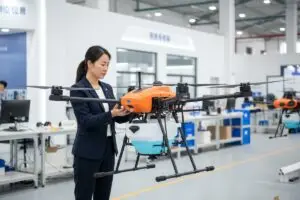
Last month, our quality team caught a cracked propeller mount on an outgoing unit—a defect invisible to casual inspection flight stability 1. That close call reminded us why systematic testing protocols 2 matter for every drone leaving our Xi’an facility.
To create an effective sample testing checklist for agricultural drones, you must systematically evaluate flight stability, spraying precision, structural durability, and software reliability. A comprehensive checklist should include pre-flight inspections, loaded flight tests, spray pattern verification, environmental stress assessments, and software customization checks to ensure the drone meets your operational requirements.
The following sections break down each critical testing area GPS positioning accuracy 3. You will find practical metrics, testing procedures, and evaluation criteria that our engineering team uses daily when preparing drones for export to the US and European markets.
What flight stability and endurance metrics should I prioritize when testing a sample agricultural drone?
When we ship our SkyRover agricultural units to distributors in Texas or California, flight performance data becomes the first conversation topic Droplet Density Standards 4. Buyers want proof that drones handle real field conditions, not just laboratory settings.
Prioritize hover stability variance (under ±0.5m), GPS positioning accuracy (RTK-level ±2cm), battery endurance under full payload, motor response latency, and return-to-home reliability. Test these metrics across multiple flights with both empty and loaded tanks to establish consistent baseline performance data.

Understanding Hover Stability Standards
Hover stability tells you how well the drone maintains position without pilot input IP rating verification 5. Our engineers test this by lifting the drone to 3 meters with an empty tank, then releasing controls for 60 seconds. The drone should not drift more than 0.5 meters in any direction.
For loaded tests, we fill the tank to maximum capacity and repeat the hover test at 2.5 meters. Additional weight affects stability, so you need both measurements Chemical resistance testing 6. Record wind speed during each test—anything above 5 m/s will skew results.
Battery Endurance Testing Protocol
Battery performance determines how much work gets done per flight Firmware Stability Assessment 7. We use a standardized testing protocol that tracks real-world endurance, not manufacturer claims.
| Test Condition | Expected Flight Time | Acceptable Variance |
|---|---|---|
| Empty tank hover | 35-45 minutes | ±5 minutes |
| 50% payload cruise | 20-30 minutes | ±3 minutes |
| Full payload spray mission | 12-18 minutes | ±2 minutes |
| Return-to-home reserve | 5 minutes minimum | Must always meet |
Run at least three full discharge cycles before recording final numbers. New batteries need conditioning. Document ambient temperature for each test because cold weather reduces capacity by 15-25%.
Motor Response and Control Latency
Control latency measures how quickly the drone responds to stick inputs. During our production testing, we perform the "stick check" sequence: left, right, forward, back, up, down. Each movement should produce immediate, proportional response without hesitation or overcorrection.
For hexacopter configurations like our industrial spraying units, test each motor individually using diagnostic software. Motor RPM variance across all six should stay within 3%. Uneven motors cause stability problems that worsen under load.
GPS and RTK Positioning Verification
Modern precision agriculture demands centimeter-level accuracy. Standard GPS provides 2-3 meter accuracy, which works for basic operations. RTK GPS brings this down to 2-5 centimeters, essential for variable-rate application.
Test GPS signal acquisition time from cold start. Good units lock satellites within 60 seconds. Then verify position hold accuracy by marking a ground point, flying away, and returning. The drone should land within 10cm of the original mark with RTK enabled.
How can I verify the actual spraying precision and coverage efficiency during my field trials?
Our R&D team spent six months perfecting nozzle configurations for American cotton fields and European vineyards. Each crop type demands different droplet sizes and coverage patterns. Field trials reveal whether specifications translate to actual performance.
Verify spraying precision by conducting water-sensitive paper tests across multiple flight passes, measuring droplet density per square centimeter, checking overlap consistency at recommended speeds, and analyzing coverage uniformity at field edges and turns. Target 20-30 droplets per cm² for pesticides and 50-70 droplets per cm² for fungicides.

Setting Up Water-Sensitive Paper Tests
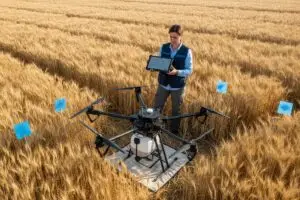
Water-sensitive paper turns blue when liquid contacts it. This cheap tool provides immediate visual feedback on spray coverage. Place papers at regular intervals across your test area—we recommend a 5×5 grid pattern covering at least 100 square meters.
Fly the drone at operational height (typically 2-3 meters above crop canopy) and standard speed. Collect papers immediately after the pass. Photograph each paper with a ruler for scale, then analyze droplet distribution.
Droplet Density Standards by Application
Different chemicals require different coverage levels. Underapplication wastes money; overapplication damages crops and violates regulations.
| Application Type | Target Droplet Density | Droplet Size Range | Flight Height |
|---|---|---|---|
| Herbicides | 20-30 per cm² | 300-500 microns | 2-3 meters |
| Insecticides | 30-50 per cm² | 150-300 microns | 1.5-2 meters |
| Fungicides | 50-70 per cm² | 100-200 microns | 1-1.5 meters |
| Fertilizer spray | 15-25 per cm² | 400-600 microns | 3-4 meters |
Our spray systems allow nozzle changes and pressure adjustments to achieve these targets. During sample testing, verify the supplier can provide appropriate nozzle options for your intended applications.
Overlap Consistency Analysis
Proper overlap prevents gaps in coverage. Industry standard calls for 70-80% forward overlap and 60-70% side overlap. However, these percentages depend on flight speed, spray width, and wind conditions.
Mark your test field with parallel lines at the drone's rated swath width. Fly multiple passes and check coverage at the seam areas. If you see stripes of different saturation on water-sensitive papers, the overlap settings need adjustment.
Edge and Turn Performance
Drone spraying often fails at field boundaries and turning points. The drone slows down during turns, which can cause overapplication. Some systems compensate by reducing pump pressure automatically—ask your supplier if this feature exists.
Test edge performance by placing water-sensitive papers at the exact boundary of your programmed flight path. Good systems should stop spraying precisely at the boundary, not before or after. This matters for fields next to sensitive areas like waterways or organic farms.
What durability benchmarks should my checklist include to ensure the drone withstands harsh agricultural environments?
Every drone we build goes through environmental stress testing before shipping. Agricultural work means dust, chemicals, temperature swings, and rough handling. Our export customers in Arizona and Spain face extreme conditions that destroy poorly built equipment.
Your durability checklist should include IP rating verification (minimum IP54), chemical corrosion resistance testing, impact resistance assessments, motor and bearing lifespan projections, and frame material certification. Also verify that replacement parts are available and affordable for components that wear out during normal operation.

IP Rating and Ingress Protection
IP ratings tell you how well the drone resists dust and water. The first digit indicates dust protection (0-6), the second indicates water protection (0-9). Agricultural drones need at least IP54—dust protected and splash resistant.
| IP Rating | Dust Protection | Water Protection | Suitability |
|---|---|---|---|
| IP43 | Some dust enters | Light spray | Indoor only |
| IP54 | Dust protected | Splash resistant | Light agriculture |
| IP55 | Dust protected | Water jets | Standard agriculture |
| IP67 | Dust tight | Immersion proof | All conditions |
Request documentation proving the stated IP rating. Some manufacturers claim ratings without independent testing. Our units undergo third-party certification at accredited laboratories.
Chemical Resistance Testing
Pesticides, herbicides, and fertilizers contain corrosive chemicals. These substances contact the drone during loading, spraying, and cleaning. Components made from incompatible plastics will crack and fail.
Test chemical resistance by applying small amounts of your intended spray materials to non-critical parts. Wait 24 hours and check for discoloration, softening, or cracking. Better yet, request material safety data from the manufacturer showing compatibility with common agricultural chemicals.
Frame and Structural Integrity
Carbon fiber frames offer the best strength-to-weight ratio. However, quality varies enormously between manufacturers. Inspect the frame for uniform weave patterns, smooth finish, and proper bonding at joints.
Our structural testing includes a drop test from 1 meter onto concrete. The frame should show no cracks or deformation. We also apply lateral pressure to each arm—they should flex slightly but return to original position without permanent bend.
Component Lifespan Projections
Certain parts wear out regardless of build quality. Motors, propellers, and pump components have finite lifespans. Understand replacement intervals before purchasing.
Standard lifespan benchmarks:
- Brushless motors: 500-1000 flight hours
- Propellers: 100-200 flight hours
- Pump seals: 200-400 operating hours
- Batteries: 300-500 charge cycles
- Spray nozzles: 100-300 operating hours
Ask suppliers about parts availability and pricing. We maintain parts inventory in US warehouses for quick replacement shipping to American customers.
Temperature and Humidity Tolerance
Agricultural work happens in extreme conditions. Early morning spraying means cold, damp air. Midday operations bring intense heat. Your drone must handle both.
Test the drone at temperature extremes if possible. At minimum, verify the manufacturer's stated operating range. Most quality units operate from -10°C to 45°C. Battery performance suffers below 0°C and above 40°C, so plan accordingly.
How do I evaluate the software reliability and OEM customization potential of the sample unit?
Software issues cause more returns to our facility than hardware problems. When our team develops custom solutions for European distributors, we spend twice as long on software validation as hardware testing. Your checklist must address this often-overlooked area.
Evaluate software reliability by testing firmware stability across 20+ flights, verifying mission planning accuracy against actual flight paths, checking fail-safe behavior under signal loss, and assessing data export compatibility with common farm management platforms. For OEM potential, confirm the manufacturer offers SDK access, white-label app options, and parameter customization without voiding warranties.

Firmware Stability Assessment
Firmware controls everything the drone does. Unstable firmware causes erratic behavior, failed missions, and crashes. Test firmware stability by running identical missions multiple times over several days.
Create a simple mission with 10 waypoints covering a square pattern. Fly this mission 20 times and compare results. GPS tracks should overlap almost perfectly. Any significant deviation indicates firmware or hardware problems.
Also test firmware behavior after updates. Some manufacturers push updates that introduce new bugs. Ask about update testing procedures and rollback options if problems occur.
Mission Planning Accuracy
The mission planning software creates the flight path. Accuracy depends on how well the planned path matches actual execution.
| Planning Parameter | Acceptable Tolerance |
|---|---|
| Waypoint position | ±1 meter |
| Flight altitude | ±0.5 meters |
| Flight speed | ±10% of setting |
| Swath width | ±5% of setting |
| Total coverage area | ±3% of planned |
Use RTK positioning during tests to verify actual versus planned positions. Standard GPS lacks the precision for meaningful comparison.
Fail-Safe Function Testing
Fail-safes protect your investment when things go wrong. Every agricultural drone should include return-to-home, low battery landing, and signal loss protocols.
Test each fail-safe intentionally:
- Turn off the controller during flight to trigger signal loss response
- Let battery drain to trigger low battery return
- Activate return-to-home button manually
- Test geofence boundary behavior
Document response times and accuracy. The drone should begin return procedures within 3 seconds of trigger condition. Landing accuracy should stay within 2 meters of home point.
Data Export and Integration
Farm management software 9 needs drone data in compatible formats. Check what file types the drone exports: common formats include shapefiles, GeoTIFF, KML, and CSV.
Ask about API availability for direct integration with platforms like John Deere Operations Center, Climate FieldView, or Trimble Ag Software. Our systems support standard data protocols that work with most major platforms used by American and European farms.
OEM Customization Options
If you plan to resell drones under your own brand, customization capability matters. Different manufacturers offer different levels of flexibility.
Essential OEM features to verify:
- White-label mobile app with your branding
- Custom parameter settings (speed limits, altitude limits, geofence defaults)
- Hardware color and decal options
- Custom packaging and documentation
- SDK access for software development
- Training materials in your language
We provide full OEM services including app customization, parameter adjustment, and branded packaging. Our engineering team can collaborate on feature development for specific market requirements.
Cybersecurity Considerations
Agricultural drones collect sensitive data about farm operations. Security vulnerabilities put customer data at risk and may violate privacy regulations in some markets.
Verify that the drone uses encrypted communication between controller and aircraft. Check data storage encryption on the drone and in associated cloud services. Ask about security audit history and compliance with regulations like GDPR for European markets.
Conclusion
A systematic testing checklist transforms sample evaluation from guesswork into reliable decision-making. Use these benchmarks to verify flight performance, spraying accuracy, physical durability, and software reliability before committing to any agricultural drone supplier.
Footnotes
1. Details factors affecting drone flight stability and its importance. ↩︎
2. Explains systematic processes in quality assurance and meeting standards. ↩︎
3. Explains RTK GPS accuracy and its critical role in precision agriculture. ↩︎
4. Provides standards and classifications for pesticide droplet sizes in agriculture. ↩︎
5. Explains the IP code and its classification system for ingress protection. ↩︎
6. Discusses the importance and methods of testing plastics for chemical resistance. ↩︎
7. Explains the systematic process and importance of embedded firmware testing. ↩︎
8. Describes how water-sensitive paper is used to assess spray coverage. ↩︎
9. Highlights the role of software in managing drone data for farming operations. ↩︎

 English
  Español de México
  Deutsch
  Français
  Русский
  العربية
Comments
No comments yet. Be the first to share your thoughts!
Leave a Comment