
When our export team first encountered NDAA compliance questions from American partners, we realized this wasn’t just paperwork GPS unit 1. It was a make-or-break issue for distributors facing federal scrutiny and potential penalties.
US distributors verify NDAA restrictions by checking the FCC Covered List, reviewing the DIU Blue UAS Cleared List, auditing component origins, requesting formal compliance letters from manufacturers, and confirming suppliers are not headquartered in China, Russia, Iran, or North Korea.
The landscape changed dramatically after December 2025. Let me walk you through exactly how verification works today and what steps protect your business.
How can I verify if a specific agricultural drone manufacturer is currently on the NDAA restricted list?
Our engineers receive this question weekly from US distribution partners. The confusion is real. Multiple government lists exist, and knowing which one to check first saves time and prevents costly mistakes.
To verify if an agricultural drone manufacturer is NDAA restricted, check the FCC Covered List for banned entities, review the DIU Blue UAS Cleared List for approved drones, audit the origin of critical components including flight controllers and radios, and request formal compliance documentation from the supplier.

Understanding the Key Government Lists
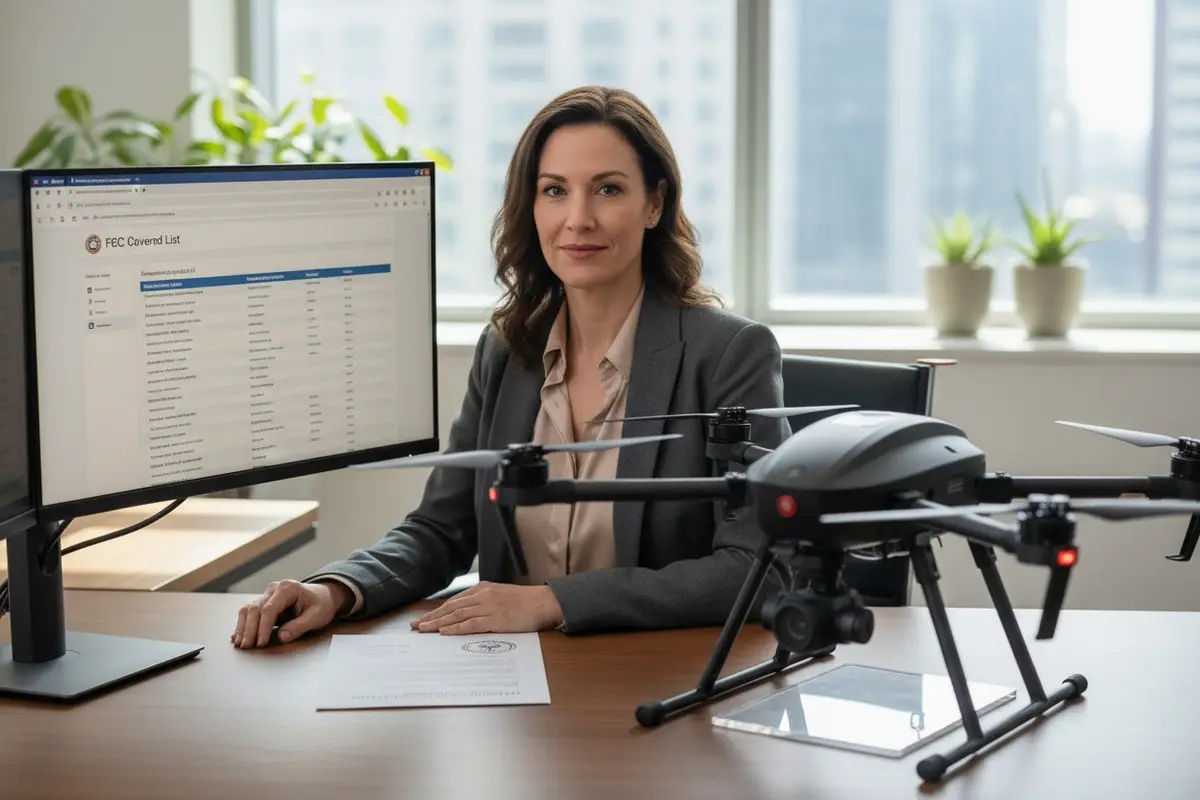
The verification process starts with knowing which lists matter. The FCC Covered List 2 is your first stop. This list identifies companies whose products pose national security risks. If a manufacturer appears here, their equipment cannot receive new FCC authorizations.
The DIU Blue UAS Cleared List 3 works differently. It shows drones that passed DoD cybersecurity validation. Being on this list signals strong compliance credentials.
Here's a quick comparison:
| List Name | Purpose | Updated By | Key Implication |
|---|---|---|---|
| FCC Covered List | Identifies banned entities | FCC | No new equipment authorizations |
| DIU Blue UAS Cleared List | Shows DoD-approved drones | Defense Innovation Unit | Eligible for federal contracts |
| AUVSI Green UAS | Certifies supply chain security 4 | Industry association | Demonstrates cybersecurity compliance |
Step-by-Step Verification Process
First, visit the FCC's official resources and search for the manufacturer name. DJI and Autel both appear on restricted lists as of late 2025.
Second, examine component origins. This requires digging deeper. We provide our distribution partners with detailed component manifests showing where each critical part originates. The flight controller 5, radio module, GPS unit, camera, gimbal, and ground control software all need verification.
Third, request written documentation. A formal compliance letter should reference Section 848 of the FY2020 NDAA specifically. Vague statements don't provide legal protection.
Critical Components to Audit
Not all drone parts carry equal weight. Focus your verification on these elements:
| Component | Why It Matters | Red Flag Origins |
|---|---|---|
| Flight Controller | Core processing unit | China, Russia, Iran, North Korea |
| Radio/Data Link | Transmission security | Same as above |
| GPS Module | Location data handling | Same as above |
| Operating Software | Data storage and access | Same as above |
| Ground Control Station | Command interface | Same as above |
When we design our agricultural sprayers, we document every supplier relationship. This transparency helps partners conduct their own audits quickly.
Self-Certification Reality Check
Here's something many distributors don't realize: no official government body certifies NDAA compliance. Companies can self-certify. This means due diligence falls entirely on you.
Ask manufacturers pointed questions. Where is your flight controller manufactured? Who supplies your data transmission modules 6? Can you provide a supply chain map?
Legitimate suppliers answer these questions readily. Evasive responses signal problems.
What compliance certifications should I ask for to ensure my drone imports meet US security standards?
During our product development process, we build compliance documentation into every step. But we've learned that many distributors don't know what documents to request. This knowledge gap creates risk on both sides.
Request a formal NDAA compliance letter referencing Section 848 of FY2020 NDAA, a detailed component origin manifest, DIU Blue UAS Cleared List status, AUVSI Green UAS certification, FCC equipment authorization documentation, and supply chain transparency reports covering all critical subsystems.

Essential Documentation Categories
Break your documentation requests into three tiers. Tier one covers basic legal compliance. Tier two addresses supply chain transparency. Tier three demonstrates cybersecurity measures.
| Tier | Document Type | What It Proves |
|---|---|---|
| 1 | NDAA Compliance Letter | Manufacturer claims compliance |
| 1 | Country of Origin Statement | Manufacturing location verified |
| 2 | Component Manifest | Parts sources identified |
| 2 | Supply Chain Map | Supplier relationships documented |
| 3 | Cybersecurity Assessment | Data protection measures exist |
| 3 | Green UAS Certification | Independent security validation |
The Blue UAS Cleared List Advantage
Drones on the Blue UAS Cleared List have undergone DoD cybersecurity validation. This matters beyond federal contracts. It signals rigorous security testing that commercial distributors can leverage as a selling point.
However, Blue UAS listing alone doesn't guarantee full NDAA compliance. The list focuses on cybersecurity, not comprehensive supply chain origin. You still need component-level verification.
AUVSI Green UAS Certification Explained
The Association for Uncrewed Vehicle Systems International runs the Green UAS program. This certification addresses both supply chain security and cybersecurity assurance.
Green UAS certification involves third-party auditing. Unlike self-certification, an outside organization verifies claims. Our team completed this process and can confirm it requires substantial documentation.
For agricultural operations, Green UAS certification demonstrates due diligence to customers who serve federal grantees. The USDA's "Golden Rule" prohibits restricted drones for operations receiving federal funding.
Agricultural-Specific Certifications
Spray drones face additional requirements beyond NDAA compliance. Drones exceeding 55 pounds need FAA Section 44807 exemptions 7. All commercial agricultural operations require Part 137 certification.
State pesticide applicator licenses add another layer. California's requirements differ from Texas. Your suppliers should understand these variations and provide appropriate documentation support.
When we ship agricultural drones to US partners, we include compliance checklists covering:
- Federal NDAA documentation
- FAA operational certifications
- State-specific requirements
- Local pesticide regulations
Data Security Documentation
Beyond physical components, data handling matters enormously. Request documentation showing:
How flight data is stored and transmitted. Where cloud servers are located. What encryption standards protect information. Who can access operational data.
Chinese-manufactured drones face heightened scrutiny on data security. Our approach involves local data storage options and transparent server location disclosure. This addresses concerns without sacrificing functionality.
What are the potential consequences for my distribution company if I source drones from an NDAA-restricted supplier?
We've watched partner companies face serious problems from non-compliance. The consequences extend far beyond fines. Your business reputation, customer relationships, and future opportunities all hang in the balance.
Consequences include exclusion from federal contracts and grants, potential civil penalties, loss of existing government customers, reputational damage affecting commercial sales, inventory writedowns on restricted products, and legal liability if customers face enforcement actions from using your supplied equipment.

Direct Financial Penalties
The FY2024 NDAA and subsequent legislation created multiple penalty pathways. Contract debarment prevents your company from bidding on federal work. This extends beyond drone contracts to any government business.
Civil fines vary based on violation severity and intent. Knowing violations carry higher penalties than inadvertent mistakes. However, "I didn't know" provides limited protection when verification tools exist.
The Federal Funding Cascade Effect
The USDA's "Golden Rule" creates ripple effects throughout agricultural markets. Operations receiving federal grants, loans, or contracts cannot use restricted drones. This affects:
- Farm subsidy recipients
- Conservation program participants
- Rural development grant holders
- Agricultural research institutions
If your customers serve these markets, your non-compliant inventory becomes unsellable to a significant buyer segment.
Customer Relationship Damage
Beyond direct penalties, consider how violations affect trust. A customer who faces enforcement because of equipment you supplied won't remain a customer. They'll likely share their experience with industry peers.
Agricultural markets are smaller than they appear. Word travels fast. One compliance failure can close doors across multiple regions.
Inventory and Financial Statement Impacts
Post-December 2025 enforcement caught many distributors holding restricted inventory. The accounting implications include:
| Scenario | Financial Impact | Timing |
|---|---|---|
| Restricted inventory on hand | Writedown or write-off | Immediate |
| Pending orders for restricted products | Contract cancellation costs | Variable |
| Warranty obligations on sold restricted drones | Contingent liability | Ongoing |
| Customer returns | Revenue reversal | Immediate |
Legal Exposure Beyond Direct Violations
Your liability doesn't end with your own compliance. If customers face problems using drones you supplied without proper verification, they may pursue claims against you.
Contractual provisions help but don't eliminate risk entirely. The strongest protection comes from thorough verification before any product enters your inventory.
Our recommendation to distribution partners: build compliance verification into your purchasing procedures. Don't rely solely on supplier assurances. Conduct independent checks before committing to orders.
How can I identify reliable Chinese drone partners that provide the technical support and durability I need while remaining compliant?
From our headquarters in Xi'an, we've helped numerous US distributors navigate this exact challenge. The path forward requires balancing compliance demands with practical operational needs. Quality Chinese manufacturing can still serve your business when approached correctly.
Identify reliable Chinese drone partners by verifying component supply chains for NDAA-restricted origins, requiring comprehensive compliance documentation, evaluating technical support capabilities including remote and on-site assistance, assessing track record for durability and quality control, and confirming OEM flexibility for compliant configurations.

Component Sourcing Transparency
Not all Chinese manufacturers source components identically. Some purchase flight controllers and radios from the same restricted suppliers. Others have diversified their supply chains to include compliant alternatives.
Ask potential partners these specific questions:
Where are your flight controllers manufactured? What company supplies your data transmission modules? Can you provide alternative configurations using compliant components? Do you have relationships with component suppliers outside restricted countries?
Technical Support Evaluation Criteria
Agricultural drones require ongoing support. Spray systems need calibration. Flight controllers need firmware updates. Parts need replacement.
Evaluate support capabilities across multiple dimensions:
| Support Type | What to Assess | Questions to Ask |
|---|---|---|
| Remote Support | Response time, expertise level | What are your support hours? How quickly do you respond? |
| Documentation | Quality, language, completeness | Can I see sample technical manuals? |
| Parts Availability | Inventory levels, shipping speed | What is your typical parts delivery time? |
| On-site Support | Availability, cost structure | Do you offer technician visits? What are the costs? |
| Training | Programs available, formats | What training do you provide for our technicians? |
Our team maintains US-timezone support hours specifically for American partners. We've found this single factor dramatically improves distributor satisfaction.
Durability Track Record Assessment
Request references from existing US customers. Ask about:
Mean time between failures. Common maintenance issues. Parts that need frequent replacement. Overall satisfaction with product lifespan.
Agricultural operations stress drones heavily. Dust, chemicals, temperature extremes, and constant use reveal quality differences quickly.
OEM Flexibility for Compliance
The most valuable Chinese partners offer configuration flexibility. They can substitute components to meet compliance requirements. They support custom branding. They adapt documentation for specific market needs.
When our customers request compliant configurations, we provide detailed specifications showing exactly which components changed. This transparency supports their own verification processes.
Quality Control Verification
Visit the facility if possible. If not, request video documentation of manufacturing processes. Look for:
Incoming component inspection procedures. Assembly quality checkpoints. Final product testing protocols. Calibration and verification equipment.
ISO certifications 8 provide baseline assurance but don't guarantee quality. Actual process documentation matters more.
Partnership Structure Considerations
Consider how the relationship will function long-term. Exclusive distribution agreements provide market protection but require volume commitments. Non-exclusive arrangements offer flexibility but less supplier investment in your success.
Our most successful partnerships involve regular communication, shared market intelligence, and collaborative problem-solving. When US regulations changed, we worked directly with affected partners to reconfigure products and update documentation.
Conclusion
NDAA compliance verification requires systematic effort but protects your distribution business from serious consequences. Check official lists, audit component origins, request proper documentation, and partner with transparent manufacturers who support your compliance needs.
Footnotes
1. GPS modules are used for location data handling. ↩︎
2. The FCC Covered List identifies companies whose products pose national security risks. ↩︎
3. The DIU Blue UAS Cleared List shows drones that passed DoD cybersecurity validation. ↩︎
4. Supply chain security is important for cybersecurity assurance. ↩︎
5. A flight controller is a core processing unit in drones. ↩︎
6. Data transmission modules are used for transmitting data wirelessly. ↩︎
7. FAA Section 44807 provides exemptions for certain drone operations. ↩︎
8. ISO certifications provide assurance for quality control. ↩︎


 English
  Español de México
  Deutsch
  Français
  Русский
  العربية
Comments
No comments yet. Be the first to share your thoughts!
Leave a Comment