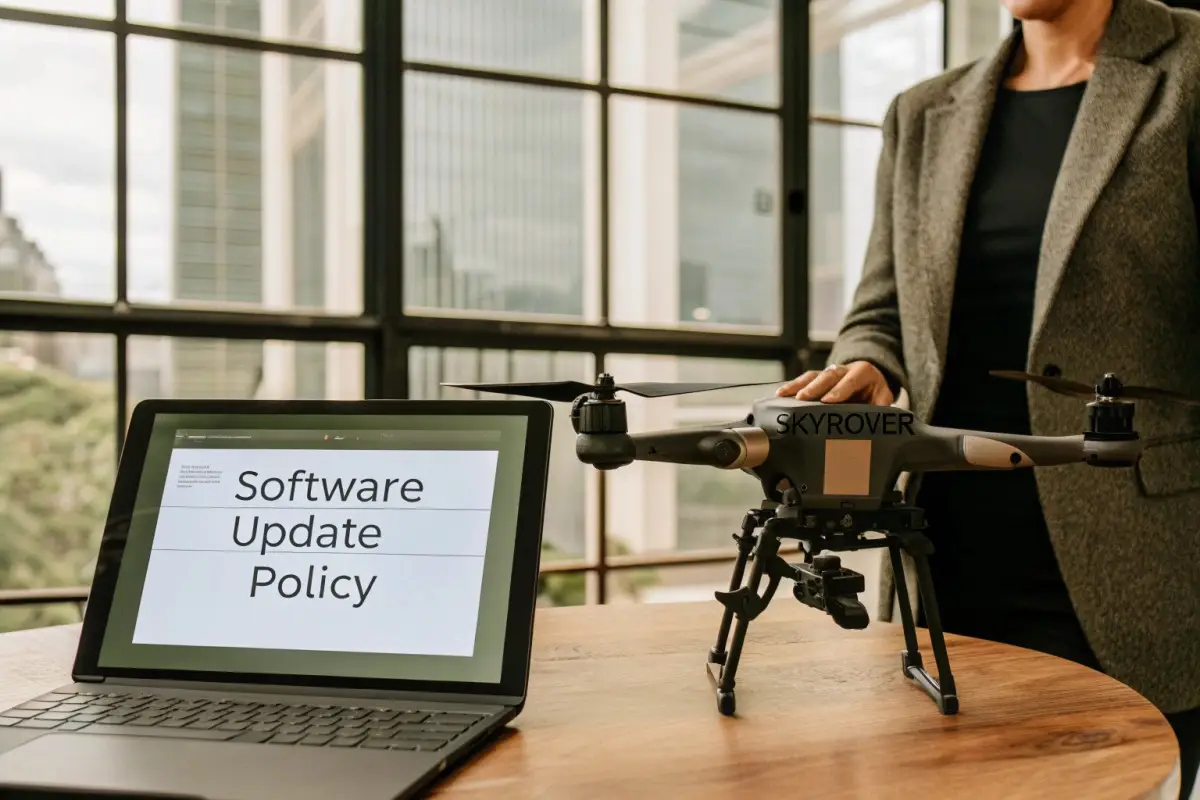

Last summer, our engineering team watched a fire agency lose three days of aerial operations Remote ID re-certification requirements 1. The reason? A surprise firmware push locked their entire fleet during peak wildfire season. From our production floor to field testing, we have seen how software updates can transform a life-saving tool into a grounded asset overnight.
To ask firefighting drone suppliers about software update grounding risks, request their written update policy, ask if updates can be deferred during emergencies, clarify Remote ID re-certification requirements, and confirm offline operational capabilities. Always get SLA commitments for advance notice before any mandatory updates.
This guide walks you through the exact questions to ask, the red flags to watch for, and how to protect your fleet from unexpected downtime OEM manufacturers 2. Whether you manage a municipal fire department or supply drones to emergency responders, these insights will help you stay airborne when it matters most.
How do I ask my supplier if a missed software update will ground my firefighting drone fleet?
When we ship firefighting drones to North American agencies, this question comes up in nearly every procurement call end-of-life policy document 3. A missed update can mean different things depending on your supplier's policies—from minor feature loss to complete flight lockout.
Ask your supplier directly: "Will skipping or delaying a software update result in my drones being remotely disabled or flight-restricted?" Request documentation showing exactly which functions degrade without updates and whether Remote ID compliance requires immediate patching.
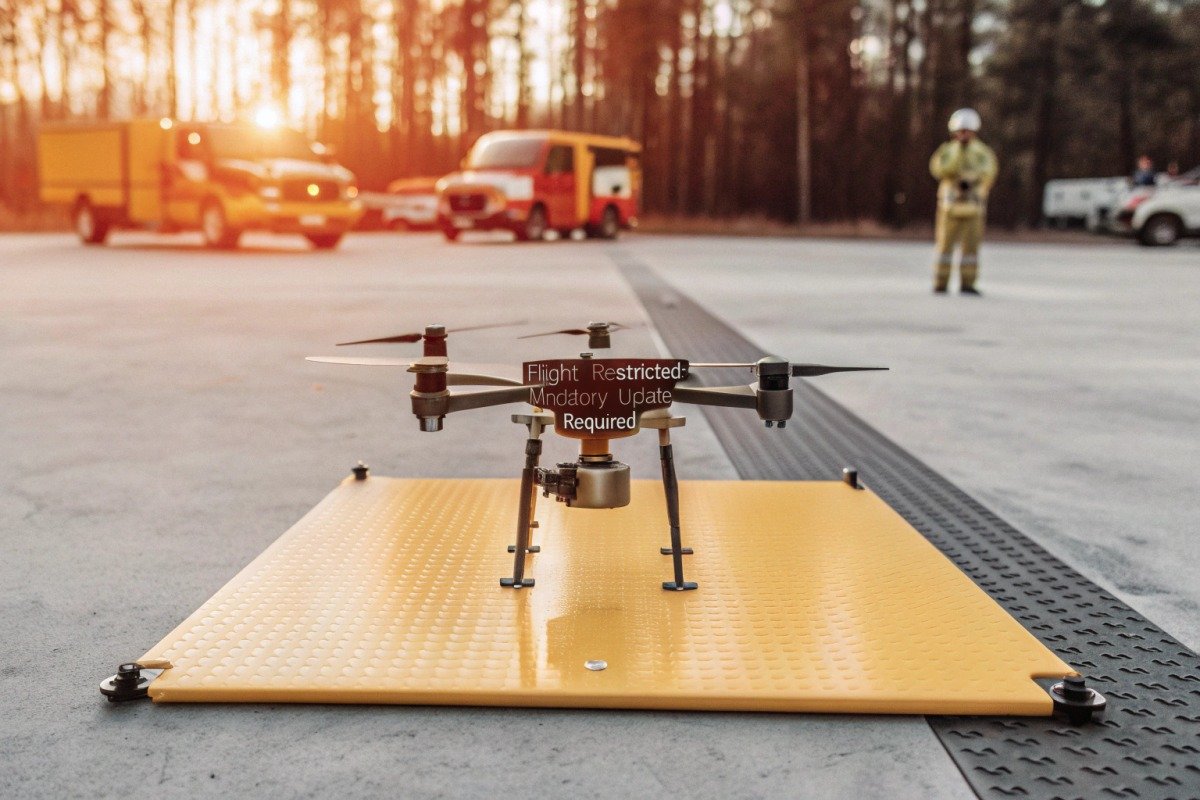
Understanding Update Categories and Their Impact
Not all software updates carry the same weight. Your supplier should clearly distinguish between these categories:
| Update Type | Typical Impact if Missed | Grounding Risk |
|---|---|---|
| Firmware (Flight Controller) 4 | Potential stability issues, GPS drift | High – May trigger safety lockout |
| Application Software | Missing features, UI bugs | Low – Usually optional |
| Payload Integration | Thermal camera sync issues | Medium – Mission capability loss |
| Remote ID Compliance | Regulatory violation, airspace lockout | High – FAA enforcement risk |
| Security Patches | Cybersecurity vulnerabilities | Medium – Data integrity concerns |
Key Questions to Ask Your Supplier
Start with these specific inquiries during your procurement discussions:
- "Does your system distinguish between critical and optional updates?"
- "Can we defer updates during active fire season without losing core flight functions?"
- "What is the maximum time we can operate without updating before lockout occurs?"
- "Will missed updates trigger automatic geo-fencing restrictions?"
Red Flags in Supplier Responses
Watch for vague answers like "updates are always recommended" without specifics. Our clients report the most problems with suppliers who cannot provide written documentation of their update enforcement policies. If a supplier says "trust us, it will be fine," that is not enough for mission-critical operations.
The FAA's Remote ID requirements 5 add another layer of complexity. Some manufacturers tie Remote ID compliance to firmware versions. If your drones fall below a certain firmware threshold, they may not broadcast required identification signals—making them illegal to fly even without a vendor-imposed lockout.
Real-World Consequences
The Horse Fire incident in June 2024 showed what happens when aerial operations halt unexpectedly. While that grounding came from unauthorized civilian drone interference, the operational impact mirrors what happens with software lockouts. Fire agencies reported losing critical hours of air support, allowing the fire to spread before ground crews could compensate.
Can I negotiate with an OEM manufacturer to prevent mandatory software lockouts on my drones?
Our contracts with fire agencies often include specific clauses about update timing. From our experience working with U.S. distributors, we know that negotiation leverage exists—but you need to ask before signing, not after your fleet is already deployed.
Yes, you can negotiate update terms with OEM manufacturers. Request contractual language that guarantees advance notice periods, emergency deferral options, and defined update windows outside peak operational seasons. NDAA-compliant manufacturers often offer more flexibility than locked-ecosystem vendors.

What to Include in Your Contract
Before signing any procurement agreement, ensure these provisions are clearly documented:
| Contract Element | Why It Matters | Sample Language |
|---|---|---|
| Advance Notice Period | Prevents surprise grounding | "Minimum 30-day notice for all non-emergency updates" |
| Emergency Deferral Rights | Allows continued ops during incidents | "Agency may defer updates during declared emergencies" |
| Update Window Restrictions | Avoids peak season disruption | "No mandatory updates June 1 – October 31" |
| Rollback Capability | Recovery from problematic updates | "Supplier provides rollback option within 14 days" |
| Offline Operation Guarantee | Internet-independent functionality | "Core flight functions operate without connectivity" |
The DJI Factor and NDAA Compliance
The 2025-2026 regulatory changes dramatically shifted negotiating power. With DJI facing FCC Covered List restrictions, firmware freezes, and app delistings, agencies using DJI products lost significant leverage. When your vendor's entire support infrastructure is being dismantled, contract negotiations become meaningless.
NDAA-compliant alternatives like Parrot ANAFI USA, ACSL SOTEN, and Inspired Flight IF1200A typically offer more transparent update policies. These manufacturers understand that public safety agencies cannot afford surprise groundings. When we design our firmware architecture, we build in deferral mechanisms specifically because our fire agency customers demanded them.
Negotiation Strategies That Work
Come to the table prepared with these approaches:
- Reference Competitor Policies: If one supplier offers 60-day update notice, use that as leverage with others.
- Bundle Volume Commitments: Larger orders justify custom SLA terms.
- Highlight Mission Criticality: Public safety applications warrant special consideration.
- Request Pilot Program Access: Get new updates for testing before fleet-wide deployment.
When Negotiation Fails
Some vendors operate with non-negotiable terms. If a supplier refuses to provide update flexibility, consider this a significant risk factor. Our recommendation: walk away from suppliers who cannot accommodate emergency operations requirements. The short-term savings are not worth the long-term operational risk.
What technical questions should I ask to ensure my drones remain operational without an internet connection?
When we test our firefighting drones in remote mountain regions, internet connectivity is often nonexistent. A drone that requires constant server communication is worthless when you need it most—deep in backcountry fire zones with no cell coverage.
Ask suppliers: "Can this drone complete all mission-critical functions—takeoff, flight, thermal imaging, and landing—with zero internet connectivity?" Verify that waypoint planning, geo-fencing data, and Remote ID broadcast work using locally stored data without requiring cloud server validation.

Critical Offline Capabilities Checklist
Your firefighting drones must maintain these functions without internet:
| Function | Online Dependency Risk | Questions to Ask |
|---|---|---|
| Flight Control | Some systems require server handshake | "Does takeoff require server authentication?" |
| GPS Navigation | Map data may need download | "Are offline maps permanently stored?" |
| Geo-Fencing | Dynamic updates from cloud | "Can geo-fence data be loaded locally?" |
| Remote ID | Broadcast vs. network ID modes | "Does Remote ID work in broadcast-only mode?" |
| Thermal Imaging | Processing may use cloud | "Is thermal processing done onboard?" |
| Mission Planning | Some apps need connectivity | "Can I create waypoint missions offline?" |
The Cloud Dependency Trap
Many modern drones rely heavily on cloud services for features that seem basic. When we engineer our flight controllers, we deliberately maintain offline redundancy for every critical system. However, not all manufacturers share this philosophy.
Warning signs of excessive cloud dependency include:
- Apps that show "connecting to server" screens before flights
- Features that grey out when WiFi is unavailable
- Firmware that "phones home" before allowing motor start
- Map systems requiring live data downloads
Open Architecture Advantages
Drones built on open protocols like MAVLink or PX4 7 typically offer better offline resilience. These systems allow third-party ground control stations that store all necessary data locally. Ask your supplier about protocol compatibility and whether you can use alternative planning software if their proprietary app fails.
Testing Offline Capabilities Before Purchase
Request a demonstration flight with all connectivity disabled. Our team routinely performs these tests with prospective clients. Put the drone in airplane mode, disable WiFi on the controller, and verify every function you need actually works. Document any limitations in writing before finalizing your purchase.
Remote ID Compliance Without Internet
The FAA allows two Remote ID methods: broadcast and network. Broadcast mode 8 transmits ID signals directly from the drone to nearby receivers—no internet required. Network mode sends data to FAA servers, requiring connectivity. Ensure your drones support broadcast mode for field operations where cell service is unavailable.
How can I verify that my supplier provides legacy software support to avoid grounding older drone models?
Our production lines have manufactured firefighting drones for over a decade. We understand that agencies cannot replace entire fleets every time a new model launches. Legacy support commitments protect your investment and prevent forced obsolescence.
Verify legacy support by requesting the supplier's end-of-life policy document, asking for minimum support duration guarantees, confirming spare parts availability timelines, and checking whether older firmware versions will continue receiving security patches without forced feature upgrades.

Legacy Support Documentation Requirements
Before committing to any fleet purchase, obtain written answers to these questions:
| Support Element | Minimum Acceptable Term | Red Flag Response |
|---|---|---|
| Firmware Security Patches | 5+ years after purchase | "Updates only for current models" |
| Spare Parts Availability | 7+ years | "We'll try to source parts" |
| App Compatibility | Until device OS drops support | "Use our latest app version only" |
| Technical Support Access | 5+ years | "Support included for first year" |
| Documentation Archive | Permanent | "Check our website" |
The DJI Lesson for Legacy Planning
The ongoing DJI situation provides a cautionary tale. Agencies that invested heavily in DJI fleets now face:
- App store delistings making controller software inaccessible
- Firmware freezes preventing security updates
- Cloud service geo-blocking affecting mission planning
- SDK deprecation breaking third-party integrations
When we observe these developments, we communicate directly with our customers about long-term support commitments. No supplier can guarantee against regulatory changes, but transparent communication about risks helps agencies plan accordingly.
Evaluating Supplier Track Record
Ask prospective suppliers about their history with discontinued products:
- "How long did you support your previous drone generation?"
- "Are parts still available for models launched five years ago?"
- "Can customers access firmware for legacy products?"
- "What happens to cloud features when a product line ends?"
Mixed Fleet Strategies
Many fire agencies now operate mixed fleets to reduce single-vendor risk. This approach involves:
- Primary mission drones from NDAA-compliant manufacturers
- Specialized thermal/mapping platforms from secondary suppliers
- Training units that can tolerate higher obsolescence risk
Spreading procurement across multiple vendors ensures that one company's support decisions cannot ground your entire operation.
Grant Funding for Fleet Transitions
FAA and USDA grants increasingly support drone fleet modernization. If legacy support concerns drive replacement decisions, explore these funding sources:
- FAA drone integration programs
- USDA rural firefighting equipment grants
- State emergency management technology funds
- Federal surplus property programs
These resources can offset transition costs when legacy equipment reaches genuine end-of-life status.
Conclusion
Protecting your firefighting drone fleet from software-related grounding requires proactive supplier engagement. Ask the hard questions before signing contracts, get commitments in writing, and verify offline capabilities through hands-on testing. Your fleet's reliability during emergencies depends on the homework you do today.
Footnotes
1. Explains FAA rules for drone identification and location. ↩︎
2. Clarifies the definition and role of original equipment manufacturers in supply chains. ↩︎
3. Defines the process and considerations for discontinuing product support and sales. ↩︎
4. Defines the software that controls drone flight and stability. ↩︎
5. Provides a comprehensive overview of the FAA’s drone identification regulations. ↩︎
6. Explains the importance and lists examples of drones meeting U.S. defense standards. ↩︎
7. Describes a lightweight messaging protocol for drone communication and control. ↩︎
8. Explains how drones transmit identification signals directly to receivers without internet. ↩︎



 English
  Español de México
  Deutsch
  Français
  Русский
  العربية
Comments
No comments yet. Be the first to share your thoughts!
Leave a Comment