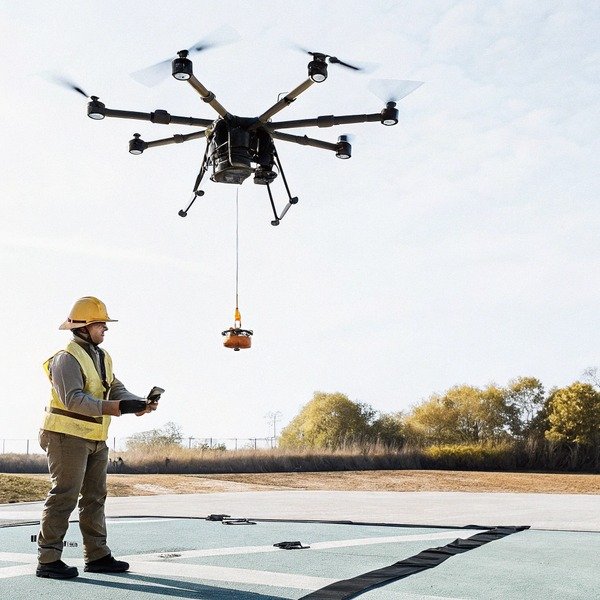
We often see clients struggle with missed targets because they rely on specs rather than field validation. Watching a payload miss a fire by ten feet during a demo is a nightmare we help our partners avoid.
To test drop accuracy effectively, establish a baseline using static hover drops over a marked 6.5ft target zone. Progress to dynamic flight tests at varying speeds, measure deviation in concentric rings, and verify the alignment of targeting cameras with the physical release mechanism to ensure real-world precision.
Here is the detailed testing protocol we use to validate our systems before they leave the factory.
What specific flight altitudes and speeds should I use to evaluate the drop precision?
Our flight testing team in Xi'an spends hundreds of hours logging drop data from various heights to create reliable ballistic charts. Without this data, even the best hardware will fail in an emergency.
Conduct initial hover tests at 10 meters, 30 meters, and 50 meters to document impact scatter. Then, evaluate forward-flight precision by releasing payloads at speeds of 5m/s and 10m/s, calculating the necessary ballistic offset for a bombardier-style approach.
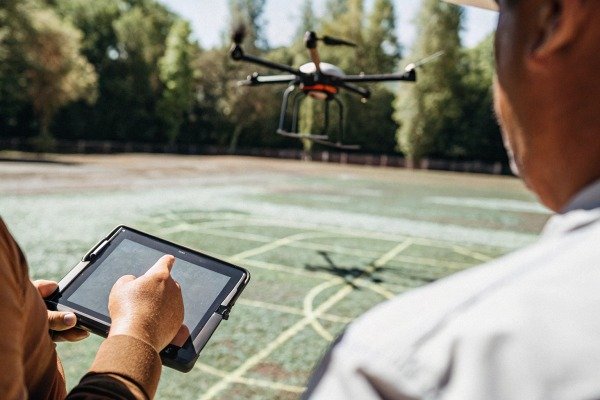
When we evaluate the precision of a new firefighting drone model firefighting drone 1, we do not just fly it up and press a button. We follow a strict matrix of altitudes and speeds. This is critical because the physics of a dropping object changes drastically depending on how high you are and how fast you are moving.
The Static Hover Benchmark
You should start with the "Static Hover" test. This is the simplest baseline. We recommend setting up a target zone on the ground with concentric rings. Each ring should represent a distance from the center (e.g., 0.5 meters, 1 meter, 2 meters).
- Low Altitude (10 meters): At this height, you are testing the release mechanism itself. Does the hook open instantly? Is there a delay? However, be careful. If the drone is too low, the propeller downwash (prop wash) can blow propeller downwash 2 the payload off course immediately after release. This is a common issue with lighter payloads like dry powder balls.
- Medium Altitude (30 meters): This is a standard operational height for many fire scenarios. It keeps the drone safe from most flames but is close enough for accuracy.
- High Altitude (50 meters+): At this height, wind shear becomes a major factor. wind shear 3 Even on a calm day, air currents are different at 50 meters than at ground level. You need to see how much the payload drifts naturally.
The Bombardier Approach (Dynamic Flight)
In a real fire, hovering directly over the flames is often impossible. The intense heat can melt plastic components or damage the battery. Therefore, your pilots will often need to drop the payload while the drone is moving forward. This is what we call the "Bombardier" approach.
Testing this requires you to calculate the forward throw. If you fly at 5 meters per second (m/s) and drop from 30 meters, the payload will not land directly below the release point. It will carry that forward momentum. forward momentum 4
We advise our clients to run trial flights at incremental speeds. Start at slow speeds (3 m/s) and move to faster operational speeds (10 m/s). You must measure the distance between the point of release (where the drone was when the hook opened) and the point of impact. This data helps pilots understand the "lead time" they need when aiming at a fire.
Testing Protocol Matrix
To help you organize your tests, we use a table similar to this one in our internal quality control:
| Test Scenario | Altitude | Speed | Goal | Acceptable Deviation |
|---|---|---|---|---|
| Baseline Hover | 10 Meters | 0 m/s | Check prop wash interference | < 0.5 Meters |
| Standard Ops | 30 Meters | 0 m/s | Verify vertical accuracy | < 1.0 Meter |
| High Clearance | 50 Meters | 0 m/s | Test drift without wind | < 2.0 Meters |
| Slow Approach | 30 Meters | 5 m/s | Test forward momentum | < 1.5 Meters |
| Fast Response | 30 Meters | 10 m/s | Test high-speed ballistic lead | < 3.0 Meters |
By filling out a table like this during your acceptance testing, you ensure the drone performs reliably across all likely operational scenarios.
How can I verify that the onboard targeting cameras and sensors are correctly calibrated for the drop?
We fine-tune every gimbal and FPV overlay before shipping to the US because we know a misaligned sight leads to failure. A camera that is off by even one degree causes massive errors at high altitudes.
Verify calibration by aligning the on-screen FPV crosshairs with the physical hook using a plumb line. Test the laser rangefinder against known distances and measure the input-to-action latency between the controller trigger and the servo activation.

The camera is the pilot's eye. If the "eye" is not looking exactly where the "hand" (the drop hook) is aiming, the mission will fail. We see many cheaper drones where the camera is mounted on the nose, but the drop system is on the belly. This creates a parallax error that increases with altitude.
The Parallax Problem
Parallax error occurs when the viewing angle does not match the drop angle. Parallax error 5 To test this, you need a plumb line—a simple string with a weight on the end.
- Hover the drone at a low altitude (about 5 meters).
- Hang a plumb line from the physical drop hook so it touches the center of your ground target.
- Look at the controller screen. Does the digital crosshair on the screen line up exactly with the target on the ground?
- If the crosshair is centered on the screen but the plumb line is off-center, your camera angle is wrong. You need to adjust the camera gimbal pitch or the software overlay settings. camera gimbal 6
Laser Rangefinder Verification
Standard barometers are not accurate enough for firefighting. Smoke and heat change air pressure, which confuses the drone's altitude sensors. This is why we equip our SkyRover units with laser or radar rangefinders.
You must test this sensor against a known measurement. Place the drone at a measured height of 20 meters. Check the On-Screen Display (OSD). Does it read 20 meters? If it reads 18 meters or 22 meters, your drop calculations will be wrong. A 10% error in altitude reading can result in a significant miss when calculating trajectory.
Input Latency (Lag)
Another hidden issue is "input lag." This is the delay between when you press the "Drop" button on the remote and when the servo actually opens the hook.
In a static hover, lag does not matter much. But if the drone is flying at 10 meters per second, a 0.5-second delay means the drone travels 5 meters before the payload drops. That is a massive miss.
You can test this by recording the drone with a high-speed camera (or a smartphone in slow-motion mode). Press the trigger and film the hook. Review the footage to measure the frames between the button press and the hook opening. If the lag is consistent, you can train pilots to compensate. If it is inconsistent, the system is unreliable.
Calibration Checklist
Use this simple checklist to verify your targeting system:
| Component | Test Method | Why it Matters |
|---|---|---|
| FPV Camera Angle | Plumb line alignment test | Ensures "Aim Point" equals "Drop Point." |
| Laser Altimeter | Measure against tape measure | Heat/smoke confuses standard barometers. |
| Video Transmission | Check for video freeze/lag | Pilot needs real-time feedback to aim. |
| Servo Response | High-speed video analysis | Delay causes misses in moving shots. |
How do I evaluate the drone's ability to maintain stability during the sudden weight change of a release?
During our early R&D phases, we once saw a prototype flip upside down after releasing a heavy fire extinguishing ball. It is a terrifying sight, and it is exactly what we test for to ensure pilot safety.
Assess stability by measuring the flight controller's response time to sudden weight loss. The drone must recover its center of gravity and hover altitude within seconds without oscillating or drifting more than 1 meter horizontally.

When a drone drops a payload, the physics change instantly. The motors are spinning hard to lift the extra weight. The moment that weight is gone, the drone has too much thrust. It will shoot upwards.
Simultaneously, the Center of Gravity (CG) shifts. Center of Gravity (CG) 7 If the payload was slightly forward or backward, the drone will pitch or roll aggressively when the weight disappears.
Testing the "Jump" Effect
The first thing to test is the vertical jump. Load the drone to its maximum capacity (e.g., 20kg for our larger models). Hover at a safe altitude. Trigger the release.
A good flight controller will detect the acceleration spike immediately flight controller 8 and reduce motor power. You should see the drone jump up slightly—maybe 1 to 2 meters—and then lock back into a stable hover.
If the drone shoots up 10 meters, the flight controller tuning (PID gains) is too slow. PID gains 9 This is dangerous because the drone could hit obstacles overhead, like tree branches or power lines.
Asymmetric Load Testing
Many modern firefighting drones carry multiple payloads. For example, a rack of four extinguishing balls. What happens if you drop only one?
The drone is now unbalanced. It is heavier on the left side than the right. We rigorously test this "asymmetric" scenario.
- Load the drone with uneven weight.
- Hover and release one item.
- Watch the drone's arms. Does one side dip? Does it start to drift sideways?
- The flight controller should fight this imbalance automatically. The motors on the heavy side should spin faster to compensate.
Evaluating Recovery Time
You need to quantify how "stable" the drone is. We look for "Recovery Time." This is the time it takes for the drone to stop moving after the drop.
- Excellent: < 1 second. The drone barely twitches.
- Acceptable: 1-3 seconds. The drone wobbles but self-corrects quickly.
- Dangerous: > 3 seconds or continuous oscillation. The drone enters a "wobble of death" or drifts away.
If you are buying a heavy-lift drone, ask the supplier for their heavy-lift drone 10 "Max Unbalanced Load" rating. This tells you how much weight difference the motors can handle between the left and right sides.
Stability Data Log Analysis
| Metric to Analyze | What it indicates | ideal Result |
|---|---|---|
| Vertical Spike | How high it jumps after release | < 2 Meters |
| Horizontal Drift | Did the CG shift cause movement? | < 1 Meter |
| Motor Output | Are motors overheating to compensate? | Below 80% capacity |
| IMU Vibration | Is the frame shaking after release? | Low vibration levels |
Should I test the drop accuracy under different wind conditions to ensure real-world reliability?
We export many units to coastal regions in the US and Europe where winds are unpredictable. If a drone can only aim correctly in a calm warehouse, it is useless for an outdoor wildfire.
Test in crosswinds and tailwinds up to 12m/s to determine the maximum effective operational wind speed. Additionally, simulate thermal updrafts to account for the vertical air resistance found above active fires, which alters drop trajectory.
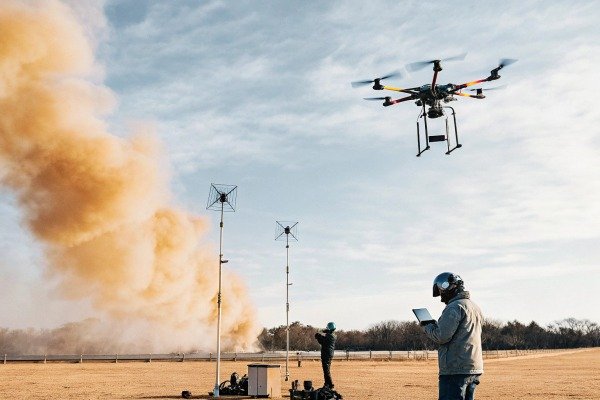
Wind is the enemy of accuracy. A 10kg extinguisher ball has a large surface area. A strong gust of wind will push it off course the moment it leaves the hook.
Crosswind vs. Tailwind
You need to test different wind angles.
- Tailwind: If the wind is behind the drone, the payload will travel further than expected. You need to aim "short."
- Headwind: The wind pushes the payload back. You need to aim "long."
- Crosswind: This is the hardest. The payload drifts sideways. The pilot must "crab" the drone (fly at an angle) to compensate.
We recommend testing on a day with 5-8 m/s winds, or using large industrial fans if you are testing indoors (though outdoor is better). Measure how far the payload drifts from the target compared to your calm-day baseline.
The Thermal Updraft Factor
This is something most buyers forget. Fires create heat. Heat makes air rise. This rising air (updraft) pushes against the falling payload.
In a real fire, a gravity drop falls slower than normal because of this resistance. This means the payload stays in the air longer, giving the wind more time to push it off course.
While you cannot safely create a massive fire for testing, you can adjust your calculations. If you are dropping over a hot zone, expect the payload to land "long" (overshoot) or drift more. We advise our clients to fly slightly lower to minimize the time the payload spends in the updraft, provided it is safe for the drone.
Establishing a Wind Limit
Every drone has a "Max Flight Wind Speed," but there is also a "Max Effective Drop Wind Speed."
- Flight Wind Speed: The drone can fly without crashing (e.g., 15 m/s).
- Drop Wind Speed: The drone can drop a payload accurately (e.g., 8 m/s).
You must find the second number. If the wind is 12 m/s, maybe the drone can fly, but the payload will miss the target by 20 meters. In that case, you should not deploy the payload. You are wasting resources.
Wind Correction Table
Here is a simplified guide on how we categorize wind effects for our pilots:
| Wind Condition | Wind Speed | Expected Drift (from 30m height) | Pilot Action |
|---|---|---|---|
| Calm | 0-2 m/s | < 1 Meter | Aim directly at target. |
| Breezy | 3-6 m/s | 2-4 Meters | Slight offset required. |
| Windy | 7-10 m/s | 5-10 Meters | Significant offset. Expert pilots only. |
| Stormy | > 12 m/s | Unpredictable | Do Not Drop. Abort Mission. |
Conclusion
Testing drop accuracy is not just about hitting a target; it is about verifying the safety and reliability of the entire system. By rigorously testing altitude variables, calibration alignment, stability recovery, and wind resistance, you ensure your equipment performs when lives are on the line. We encourage all our partners to validate these metrics to maximize their investment.
Footnotes
1. The NFPA establishes standards for the use of unmanned aircraft in fire service. ↩︎
2. NASA provides technical reports on aerodynamics and rotor downwash effects. ↩︎
3. Official definition and safety information regarding wind shear from NOAA. ↩︎
4. Educational resource explaining the physics of momentum in motion. ↩︎
5. General overview of the optical phenomenon affecting targeting accuracy. ↩︎
6. Leading manufacturer of specialized gimbals for industrial drones. ↩︎
7. Official FAA handbook covering weight and balance principles for aircraft. ↩︎
8. An open-source standard for drone autopilot software used in industrial systems. ↩︎
9. Explanation of the control loop mechanism used for drone stability. ↩︎
10. Product page for a prominent heavy-lift delivery drone used in industry. ↩︎
 English
  Español de México
  Deutsch
  Français
  Русский
  العربية
Comments
No comments yet. Be the first to share your thoughts!
Leave a Comment