
When we ship our heavy-lift units to international clients, we often see field tests fail simply because the wrong people are observing. You need a specific team to catch issues before you buy.
To ensure a successful evaluation, you must organize a cross-functional team including certified drone pilots for flight control, incident commanders for strategic payload assessment, technical engineers for maintenance verification, and IT specialists for data security. Including frontline firefighters ensures operational usability, while safety officers verify compliance with protocols like NIST standards during the evaluation.
Let’s break down exactly who you need on the ground to make this investment count.
Why should I include experienced pilots to evaluate flight stability and control?
In our flight testing facility, we notice that untrained operators often miss subtle motor vibrations or drift. Only a seasoned pilot feels the difference between stable flight and potential failure.
Experienced pilots are crucial for assessing flight characteristics such as signal latency, stability in high winds, and controller ergonomics. They possess the muscle memory to detect micro-vibrations or drift that could jeopardize a mission, ensuring the drone performs reliably under the intense pressure of real-world fireground operations and complex maneuvers.

Assessing Flight Characteristics and NIST Standards
When you unbox a sample unit, the glossy brochure figures regarding flight time and wind resistance are theoretical. You need a certified pilot to validate these claims in the real world. From our manufacturing perspective, we engineer flight controllers to handle diverse conditions, but local environments vary. An experienced pilot does more than just fly; they push the aircraft to its limits to see how the stabilization algorithms react to sudden gusts or thermal updrafts common in fires.
We strongly recommend using the National Institute of Standards and Technology (NIST) standard test methods National Institute of Standards and Technology (NIST) 1 during your evaluation. A certified pilot should fly the Basic Basic Proficiency Evaluation for Remote Pilots (BPERP) 2 Proficiency Evaluation for Remote Pilots (BPERP). This involves specific lane maneuvers that test precision. A novice might be able to hover, but an expert can tell you if the drone feels "mushy" or responsive when making tight turns in an obstructed lane. They will immediately notice if the drone drifts when the sticks are centered, which indicates poor GPS lock or sensor calibration issues—problems you do not want to discover during an actual emergency.
Evaluating Controller Ergonomics and Fatigue
Firefighting missions can last for hours, requiring multiple battery swaps and continuous piloting. Your pilot needs to assess the physical interface. Is the controller too heavy? Is the screen bright enough under direct sunlight? We often see procurement managers overlook screen brightness (measured in nits), but a pilot knows that 1000 nits is the minimum for daytime visibility. If the pilot cannot see the telemetry data clearly without a hood, situational awareness is compromised.
Furthermore, the pilot evaluates the signal transmission latency. In a lab, latency is minimal. In the field, with interference from radios and buildings, lag can increase. A skilled pilot can detect milliseconds of delay that might cause a collision during a close-range inspection of a burning structure.
Key Performance Indicators for Pilots
Your pilot should score the drone on the following criteria during the field test:
| Test Category | What the Pilot Checks | Passing Criteria |
|---|---|---|
| Hover Stability | Ability to hold position without stick input in wind. | Drift < 0.5 meters in 15 mph wind. |
| Signal Latency | Delay between stick movement and drone response. | Latency under 150ms at 500 meters range. |
| Fail-Safe RTH | Accuracy of Return-to-Home function. | Landing within 1 meter of launch point. |
| Visual Line of Sight | Visibility of the drone against the sky (LEDs/Color). | Clearly visible orientation at 300 meters. |
| Payload Weight | Handling change when carrying a full load (e.g., extinguisher). | No significant loss in agility or lift. |
Should technical engineers be present to assess ease of assembly and maintenance?
Our assembly line focuses on modularity, but we know real-world wear is different. An engineer on your team spots potential fatigue points and repair difficulties that marketing brochures never mention.
Technical engineers must attend to evaluate the physical robustness of the airframe and the speed of field repairs. They verify battery swapping mechanisms and diagnose potential failure points in the hardware, ensuring the drone can be easily serviced and maintained without requiring expensive factory returns after every minor incident or hard landing.

Verifying Modularity and Field Repairability
When we design industrial drones, we aim for durability, but "durable" means different things in a factory versus a fire station. You need a technical engineer or a logistics specialist present to strip the drone down. They should test how quickly arms can be replaced if a motor fails. If a prop arm is damaged during a wildfire operation, can it be swapped in the field with basic tools, or does the entire unit need to be shipped back to China?
Your engineer should inspect the wiring and connectors. Are they proprietary, or are they standard connectors that can be easily sourced or repaired? We have seen departments purchase expensive units only to find that a simple broken connector grounds the fleet for weeks because it requires a specialized crimping tool. The engineer assesses the quality of the carbon fiber molding, looking for weak spots carbon fiber molding 3 in the landing gear which takes the most abuse during rough landings on uneven terrain.
Battery Management and Turnaround Time
The flight endurance of a drone is useless if the turnaround time on the ground is too long. Engineers need to time the battery swap process. In a high-stakes environment like the Menlo Park Fire Protection District hazardous material drills, every second counts. If the battery latch mechanism is stiff, difficult to operate with gloves, or prone to jamming, your engineer will flag this as a critical failure.
They should also evaluate the battery charging station. Does it require a complex generator setup, or can it run off standard truck power? Heat management is another engineering concern. After a 30-minute flight, batteries get hot. Does the system have a cooling period before recharging? An engineer understands the chemistry of LiPo batteries and can predict the long-term lifecycle chemistry of LiPo batteries 4 costs based on how the drone manages power draw and heat dissipation.
Durability Checklist for Engineers
The following table outlines what your technical staff should physically inspect:
| Component | Inspection Focus | Red Flag Warning |
|---|---|---|
| Propeller Arms | Locking mechanism security and ease of folding. | Wiggle or play in the locked position. |
| Connectors | Weatherproofing (IP rating IP rating 5) and durability. | Exposed wires or non-waterproof ports. |
| Landing Gear | Shock absorption and clearance for payload. | Rigid plastic that cracks on impact. |
| Motor Mounts | Heat dissipation and debris protection. | Open vents that allow water/dust ingress. |
| Transport Case | Speed of deployment from the case. | Requires removing propellers to fit in case. |
Do I need fire safety experts to verify the accuracy of the extinguishing payload?
We configure payloads for precision, yet valid field data comes from fire experts. They know if a thermal signature is a true hotspot or just a reflection, ensuring the tool actually works.
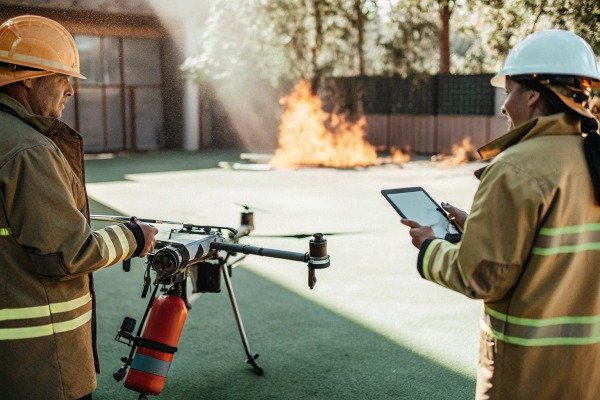
Fire safety experts are essential to verify that the drone’s payload release mechanism, thermal sensors, and zoom capabilities meet strategic firefighting needs. They determine if the extinguishing agent hits the target accurately and if the thermal imagery provides actionable data for identifying hotspots and directing ground crews effectively.
Strategic Validation by Incident Commanders
The person who will ultimately make the call to deploy the drone—the Incident Commander (IC) Incident Commander (IC) 7—must be satisfied with the data it provides. We can install the highest resolution thermal cameras available, but if the color palette does not align with what firefighters are trained to see, the data is confusing. An IC needs to test the drone in a simulated fire scenario, such as a controlled burn or a search and rescue drill.
They need to verify the zoom capabilities. Can the drone read a hazmat placard from a safe distance? Can it identify a person through thick smoke? These are not specs you can read on a datasheet; they must be visually confirmed. The IC also assesses the integration of the drone into the broader command structure. Does the drone pilot need to stand next to the IC, or can the video feed be cast to a command tablet? This workflow analysis is critical for minimizing radio traffic and maximizing situational awareness.
Testing Extinguishing and Drop Mechanisms
If you are purchasing a drone equipped with fire extinguishing balls or liquid payloads, a fire safety expert must test the release mechanism. Accuracy is paramount. In our testing fields, we use targets to calibrate drops, but in the field, wind and prop wash affect the trajectory.
A fire expert should evaluate the "spread" of the extinguishing agent. Does the drone need to be at a specific altitude for the extinguisher to be effective? Furthermore, they need to assess the safety of the mechanism. Is there a physical safety pin? Is the trigger on the remote distinct enough to prevent accidental discharge? We have seen cases where confusing switch layouts led to payloads being dropped on vehicles or personnel during training. A subject matter expert ensures that the payload is both effective against the fire and safe for the crew below.
Operational Scenarios for Evaluation
To truly test the payload, your fire experts should run these scenarios:
- Hotspot Detection: Use a heat source (like a barbecue or controlled burn barrel) to test thermal sensitivity and isotherm settings. isotherm settings 8
- Search and Rescue: Hide a "victim" in tall grass or woods to test the optical zoom and thermal contrast.
- Hazmat Identification: Place a placard with text at 100 feet and determine the maximum distance at which it can be read.
- Payload Drop: Attempt to drop a payload into a marked 10-foot circle from an altitude of 50 feet.
Is it necessary to have IT specialists test the data transmission and software interface?
We embed strong encryption in our software, but compatibility varies globally. An IT pro ensures our transmission protocols actually shake hands with your department’s existing dispatch systems without leaking data.
IT specialists are mandatory to test data encryption, live-streaming integration, and software stability. They ensure the drone’s transmission system does not interfere with existing radio frequencies and that all flight logs and video feeds are stored securely, complying with local data sovereignty and surveillance laws.

Cybersecurity and Data Sovereignty
As an exporter, we are acutely aware of the scrutiny regarding data security, especially in the US and Europe. Your IT specialist is your first line of defense. They need to perform a packet capture analysis during the flight test to see exactly where data is being sent. Is the drone trying to connect to a server in a foreign country? Can the drone fly in "Local Data Mode" where no information leaves the device?
This is critical for compliance with government regulations. The IT specialist should verify that the video encryption (typically AES-256) is active and effective. AES-256 9 They also need to check the storage media. Is the SD card encryption proprietary? If the drone crashes and is lost, can a civilian pick it up and view the footage? These privacy concerns must be addressed before the purchase order is signed.
Radio Frequency (RF) Interference and Integration
Fire departments operate in a noisy RF environment with high-powered handheld radios, mobile repeaters, and cellular modems. An IT or communications technician needs to bring a spectrum analyzer to the field test. They must ensure that the drone’s control link (often 2.4GHz or 5.8GHz) does not get washed out when a fire truck’s radio is keyed up nearby.
Furthermore, they test the integration with software platforms like DroneSense or Axon. DroneSense or Axon 10 If your department uses a specific platform for live streaming to the Emergency Operations Center (EOC), the IT specialist needs to verify compatibility. We often provide SDKs (Software Development Kits), but your IT team needs to confirm that the API actually works with your specific version of the dispatch software. A laggy video feed at the EOC renders the drone useless for remote command decisions.
IT and Software Evaluation Metrics
Your IT specialist should document the following technical aspects:
| Feature | Verification Task | Security Standard |
|---|---|---|
| Data Transmission | Monitor network traffic during flight. | No unauthorized outbound connections. |
| Encryption | Verify video feed and control link security. | AES-256 encryption on all links. |
| RF Environment | Test control link near active fire radios. | No signal loss with 5W handheld nearby. |
| Firmware Updates | Check the process for updating software. | Ability to update offline (via SD card). |
| Live Streaming | Latency test to central command software. | < 2 seconds latency to web dashboard. |
Conclusion
Building the right team for field testing transforms a simple demo into a rigorous validation process. By involving pilots, engineers, fire experts, and IT specialists, you ensure the drone meets NIST standards, integrates with your ops, and survives the harsh reality of firefighting. This due diligence protects your budget and your community.
Footnotes
1. Official homepage of the standards body recommended for drone testing protocols. ↩︎
2. Direct link to the specific NIST standard test methods for aerial systems. ↩︎
3. Scientific overview of carbon fiber reinforced polymers and their material properties. ↩︎
4. Authoritative safety information on lithium-ion battery hazards from the National Fire Protection Association. ↩︎
5. Official standard definition of Ingress Protection ratings by the International Electrotechnical Commission. ↩︎
6. Official FAA regulations regarding visual line of sight operations for commercial drones. ↩︎
7. Professional association resource for fire service leadership and incident command structures. ↩︎
8. Technical explanation of isotherm features from a leading thermal camera manufacturer. ↩︎
9. General background information on the encryption standard used for data security. ↩︎
10. Official website of the software platform mentioned for public safety drone operations. ↩︎
 English
  Español de México
  Deutsch
  Français
  Русский
  العربية
Comments
No comments yet. Be the first to share your thoughts!
Leave a Comment