
Freezing temperatures can instantly ground a critical rescue mission, risking lives and expensive equipment. At our facility, we solve this by integrating smart thermal protocols directly into our power systems. power systems 1
Most suppliers do not offer active heating pads as standard; instead, we rely on advanced Battery Management Systems (BMS) and pre-heating protocols. While rated for -20°C, optimal safety requires verifying specific low-temperature certifications and using insulated cases during transport to prevent voltage sag.
Let’s explore the specific technologies and operational realities of flying in freezing conditions.
How does the intelligent battery heating system work to ensure flight safety for my drones in freezing conditions?
When we calibrate flight controllers for export, we see that cold starts are the biggest risk to mission success. We design systems to mitigate this thermal shock.
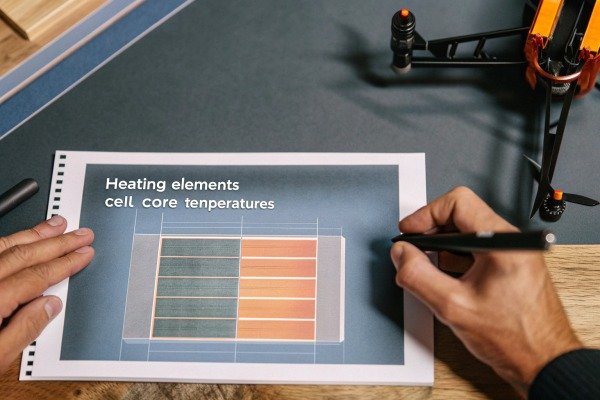
Intelligent systems use self-heating mechanisms activated by internal internal resistance 2 sensors when temperatures drop below 5°C. This warms the cell core to safe operating levels between 15°C and 20°C, ensuring voltage stability and preventing sudden power loss during critical takeoff sequences.
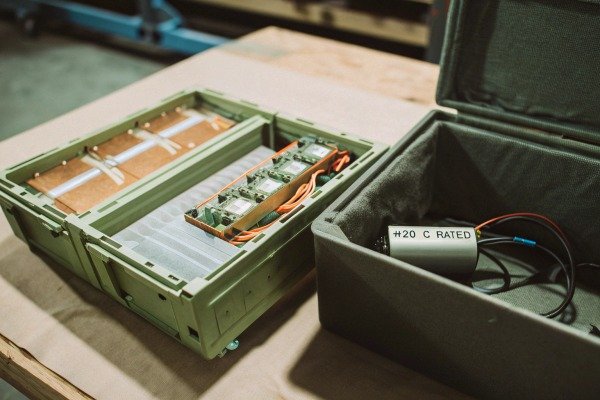
The chemistry inside a lithium-based battery is incredibly sensitive to temperature. lithium-based battery 3 Through our R&D process, we have found that the internal resistance of a battery cell spikes dramatically as the thermometer drops. If a pilot attempts to pull high current—which is necessary for a heavy firefighting drone carrying a payload—from a cold battery, the voltage will sag instantly. This triggers the drone’s safety cutoff, causing an immediate forced landing or a crash.
To prevent this, we utilize a sophisticated Battery Management System (BMS). Battery Management System 4 The BMS is the brain of the battery pack. In our high-end models, the BMS monitors temperature using 10K NTC (Negative Negative Temperature Coefficient 5 Temperature Coefficient) thermal sensors. When these sensors detect that the ambient temperature is below a set threshold, typically around 5°C (41°F), the system enters a "self-heating" mode.
The Self-Heating Mechanism
This is not usually a separate heater like a coil in an electric stove. Instead, the battery uses its own energy to run current through a resistive film or uses a specific discharge pattern that generates waste heat internally. This process warms the electrolyte and the anode/cathode materials. The goal is to raise the core temperature to at least 15°C or 20°C.
Safety Lockouts
A critical feature we program into the firmware is the "Takeoff Lockout." Even if the pilot pushes the throttle, the drone will refuse to spin the motors if the battery core is too cold. This might feel frustrating in an emergency, but it is a fail-safe to prevent the drone from falling out of the sky 30 seconds later.
Temperature Stages and BMS Actions
| Internal Temp (°C) | Internal Temp (°F) | BMS Status | Pilot Action Allowed |
|---|---|---|---|
| Below 5°C | Below 41°F | Critical Cold | Takeoff Locked. Heating active. |
| 5°C to 15°C | 41°F to 59°F | Warming Phase | Takeoff Locked. Pre-heating cycle running. |
| 15°C to 20°C | 59°F to 68°F | Ready State | Takeoff allowed. Voltage monitoring active. |
| Above 60°C | Above 140°F | Overheat Warning | Return to Home (RTH) triggered. |
By understanding these stages, operators can better plan their deployment sequence. The heating system essentially buys safety at the cost of a small amount of initial power.
Can I request customized battery insulation or heating parameters for my specific regional climate needs?
Our engineering team frequently adapts standard designs for clients in colder regions like Alaska or Northern Europe. We understand that one standard setting does not fit all climates.
Yes, buyers can request customized firmware adjustments to alter low-temperature warning thresholds and heating activation points. Additionally, we can supply external insulation stickers and specialized hard cases to maintain thermal retention for operations in climates exceeding standard rating limits.
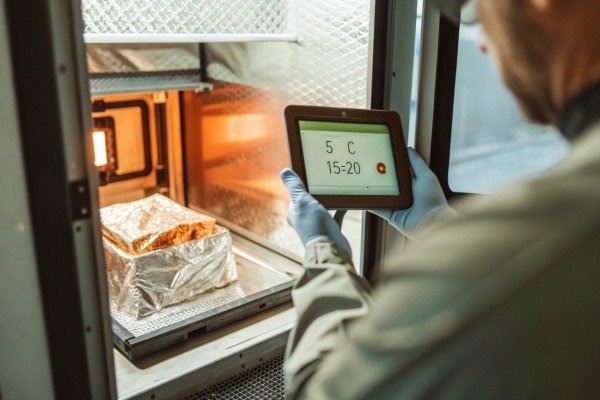
Standard industrial drones are generally rated to operate down to -20°C (-4°F). However, we know that many of our clients operate in environments that push these limits, such as high-altitude mountain rescue or arctic industrial inspections. mountain rescue 6 In these cases, standard settings are often too conservative or physically insufficient.
Firmware Customization
We can modify the BMS firmware for specific orders. For example, a standard battery might trigger a "Low Voltage Warning" at 3.5V per cell. In extreme cold, voltage sags are natural and don't necessarily mean the battery is empty. We can lower this alarm threshold to prevent premature Return-to-Home (RTH) triggers, provided the pilot understands the risks. Return-to-Home 7 We can also adjust the self-heating activation point. Instead of waiting for the battery to hit 5°C to start heating, we can set it to activate at 10°C, ensuring the battery is always "warm and ready" during standby, though this consumes more standby power.
Physical Insulation Solutions
Software helps, but physics rules supreme. We often supply or recommend physical insulation kits.
- Insulation Stickers: These are simple, adhesive foam layers applied to the exterior of the battery. They reduce the rate of heat loss to the freezing air during flight.
- Protective Covers: For specific airframes, we design plastic or carbon fiber cowlings that block wind chill. Wind chill does not lower the temperature below ambient, but it strips away the heat generated by the battery much faster.
- Heated Transport Cases: This is the most effective customization. We provide hard cases with built-in heating elements powered by a separate 12V source (like a fire truck). This ensures the batteries are at 25°C before they are even placed in the drone.
Comparison of Cold Weather Solutions
| Solution Type | Implementation Time | Cost Impact | Effectiveness in Extreme Cold (-20°C+) |
|---|---|---|---|
| Standard Firmware | None (Factory Default) | Low | Moderate (Risk of early RTH) |
| Custom Firmware | 1-2 Weeks (R&D) | Medium | High (Optimized thresholds) |
| Insulation Stickers | Immediate | Low | Low (Passive retention only) |
| Heated Hard Case | Immediate | Medium | Critical (Active prevention) |
We highly recommend the Heated Hard Case approach. It is better to keep the battery warm externally than to force the battery to waste its own energy heating itself up.
Will the activation of the battery heating function significantly reduce the flight endurance of my firefighting drones?
We often warn our distributors that battling physics requires energy, and heat generation always comes at a cost to flight time. Ignoring this trade-off leads to failed operations.
Activating internal heating elements consumes battery capacity, typically reducing total flight endurance by 20% to 30%. This reduction is compounded by increased air density in cold weather, requiring pilots to plan for shorter operational windows and frequent battery swaps.
This is the most common question we receive from procurement managers, and the answer requires honest technical assessment. The short answer is yes, heating reduces flight time. However, it is not just the heater that consumes power; the environment itself changes how the drone flies.
The Energy Cost of Heat
The self-heating process is an electrical short-circuit controlled by the BMS. It burns energy to create heat. Depending on how cold the battery is at start-up, the pre-heating cycle can consume 5% to 10% of the total capacity before the motors even spin. Once in the air, the battery usually stays warm due to the high discharge rate required to lift the drone, so the active heater often turns off. However, that initial 10% loss is gone forever.
The "Double Whammy" of Cold Weather
It is not just the heater eating your battery life. Cold air is denser than warm air. While denser air actually helps propellers generate lift more efficiently, the battery chemistry becomes sluggish. The chemical reactions that release electrons slow down. This means the battery cannot sustain the same voltage at a given amp draw.
Furthermore, the flight controller might limit the maximum speed to protect the battery, meaning it takes longer to get to the fire line.
Planning for Reduced Endurance
We advise fire departments to adjust their standard operating procedures (SOPs). If a drone is rated for 30 minutes of flight time at 20°C, you should plan for only 20 to 22 minutes at -10°C. This safety margin is vital. If you push the drone to the limit in the cold, the voltage drop at the end of the flight will be precipitous, leading to a crash on landing.
Estimated Flight Time Reduction
| Ambient Temperature | Heating Activation | Air Density Factor | Est. Flight Time Reduction |
|---|---|---|---|
| 20°C (68°F) | Inactive | Standard | 0% (Baseline) |
| 0°C (32°F) | Active (Pre-heat) | Moderate | 10% – 15% |
| -10°C (14°F) | Active (High Load) | High | 20% – 25% |
| -20°C (-4°F) | Max Output | Very High | 30% – 35% |
You must purchase extra batteries for winter operations. A cycle that usually requires 2 sets of batteries might require 3 or 4 sets in freezing conditions because charging speeds are also throttled in the cold to prevent lithium plating. lithium plating 8
What testing data or certifications can you provide to prove my drones will perform reliably in extreme low temperatures?
Before any model leaves our factory in Chengdu, it undergoes rigorous environmental stress testing to ensure reliability. We do not rely on guesswork when safety is on the line.
Reputable manufacturers provide test reports verifying stable discharge rates at -20°C and cycle life data exceeding 2,000 cycles. Look for UN38.3 certification and specific IP ratings that validate seal integrity against condensation and thermal shock during rapid temperature changes.

Trust, but verify. In the industrial drone market, specific certifications act as the proof of our claims. When we export to the US or Europe, we provide comprehensive data packs that demonstrate the battery's resilience.
UN38.3 Certification
This is the global standard for the transport of lithium batteries. transport of lithium batteries 9 While primarily focused on transport safety, the testing protocols involve extreme thermal cycling. The batteries are subjected to rapid temperature changes from +72°C to -40°C. If a battery passes UN38.3, it proves the physical construction (seals, welds, and casing) can withstand the expansion and contraction caused by extreme cold without leaking or exploding.
Discharge Curve Reports
We provide discharge curves generated in our climatic chambers. A normal discharge curve slopes gently downwards. A cold-weather discharge curve looks different: it has an immediate steep drop (voltage sag), then a recovery as the battery warms up internally, and then a steady decline.
- What to look for: Ask your supplier for the "Voltage Sag Delta" at -10°C. If the voltage drops below 3.0V per cell immediately upon load, the battery is not suitable for heavy lift operations, regardless of what the marketing brochure says.
IP Ratings and Condensation
Cold weather often means moisture. When you bring a drone from a -10°C exterior into a +25°C fire truck, condensation forms instantly on cold surfaces—including inside the battery connector. We certify our batteries to IP54 or higher to ensure that this moisture does not cause a short circuit. IP54 or higher 10
Essential Data for Procurement
| Document/Test | Purpose | What it Proves |
|---|---|---|
| UN38.3 Test Report | Transport Safety | Mechanical integrity in thermal shock (-40°C). |
| Climatic Chamber Log | Performance Verification | Actual flight time and voltage stability at -20°C. |
| IP Rating Certificate | Ingress Protection | Resistance to snow melt and condensation. |
| MSDS (Material Safety Data Sheet) | Chemical Safety | Chemical composition stability in various temps. |
We encourage all our partners to request these specific documents. A supplier who cannot provide a discharge curve for -10°C likely hasn't tested their product in those conditions.
Conclusion
Buyers must prioritize verified heating capabilities and robust BMS protocols to ensure mission success in freezing environments. Always demand cold-weather test data before finalizing your fleet procurement.
Footnotes
1. Official FAA safety data regarding power systems in commercial drone operations. ↩︎
2. Educational resource explaining how temperature affects the internal resistance of batteries. ↩︎
3. Provides technical background on the chemical composition of drone batteries. ↩︎
4. Technical maintenance guide from an industry leader regarding battery management systems. ↩︎
5. Technical explanation of Negative Temperature Coefficient sensors used in thermal monitoring. ↩︎
6. News report on the increasing use of drones in emergency mountain rescue. ↩︎
7. Manufacturer guide explaining the Return-to-Home safety feature in industrial drones. ↩︎
8. Scientific research from a national laboratory explaining the causes of lithium plating. ↩︎
9. Official UN manual for testing criteria regarding the transport of dangerous goods. ↩︎
10. Official standard for ingress protection ratings against moisture and solids. ↩︎

 English
  Español de México
  Deutsch
  Français
  Русский
  العربية
