Losing a lucrative government bid often happens not because the hardware failed, but because the supporting documentation lacked authority and precision.
You need a comprehensive marketing kit including high-resolution thermal thermal view 1 operational footage, NDAA compliance certifications, validated field test reports, and customizable white papers. These materials prove reliability, satisfy FAA regulations, and demonstrate technical superiority to US fire chiefs and procurement officers.
Let’s examine the specific assets required to successfully market these advanced machines.
Which high-resolution images and flight videos are essential for showcasing drone performance?
When we test our optical zooms in the high winds of our Chengdu flight facility, we know a single clear image can close a deal.
Prioritize 4K video showing stabilization in high winds and side-by-side thermal versus RGB feeds. Still images must detail the gimbal mechanism and payload release systems to prove the drone handles real-world emergency scenarios like hotspot detection.
Visuals That Prove Operational Capability
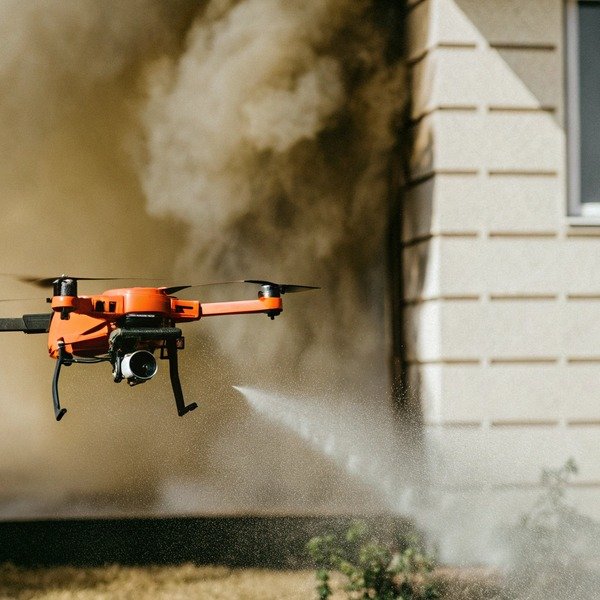
In the US market, fire chiefs are not impressed by cinematic, slow-motion shots of a drone flying over a sunny beach. They need to see the "Black and Orange" housing of the SkyRover unit battling elements that would ground lesser aircraft. To effectively market to public safety agencies, your visual library must bridge the gap between specification sheets and field reality. public safety agencies 2
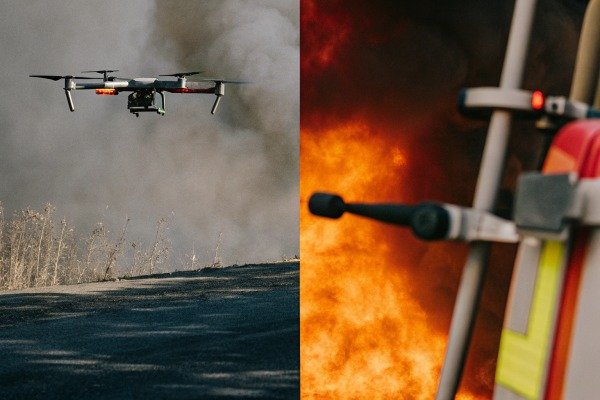
You need to request raw, unedited footage that demonstrates the drone's specific utility in firefighting. This includes split-screen video feeds where one side shows the standard RGB view and the other shows the thermal view thermal view 3. This allows buyers to see how the sensor cuts through smoke to identify heat signatures. Since our drones feature a prominent bright orange housing, photos should highlight this design choice, emphasizing visibility during smoke-filled operations.
Key Visual Assets Checklist
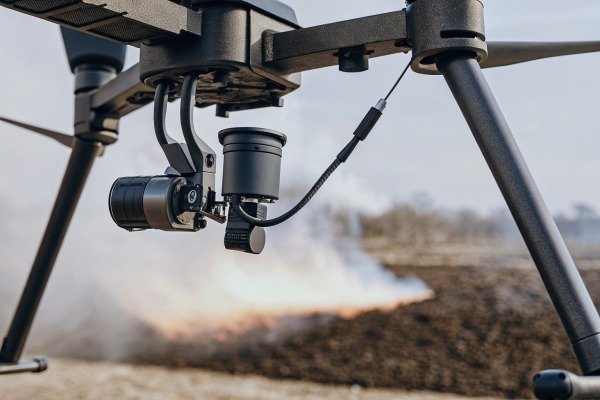
Furthermore, you need close-up photography of the mechanical components. Buyers want to see the build quality of the cross-shaped frame and the robustness of the landing gear. landing gear 4 If the drone supports payload drops—like fire retardant balls or life vests—you need video evidence of the release mechanism in action. Static images are insufficient for proving that a mechanism won't jam during a critical mission.
Recommended Media Types for US Promotion
| Asset Type | Technical Requirement | Marketing Purpose |
|---|---|---|
| Thermal Footage | 640×512 resolution, White-hot/Black-hot palettes | Proves the sensor can detect hotspots through dense smoke. |
| Wind Resistance Video | 4K at 60fps, showing gimbal stability in 12m/s wind | Demonstrates flight controller reliability in bad weather. |
| Payload Mechanism | Macro photography and Slow-motion video | Validates the capacity to carry and drop suppression spheres. |
| Component Close-ups | High-res (24MP+) images of motors and joints | Highlights industrial-grade build quality over consumer toys. |
By securing these specific visual assets, you move the conversation from "Does it fly?" to "How does it work?" This visual proof is the first step in building the confidence necessary for a department to request a live demo.
Do I need detailed technical white papers to satisfy strict government procurement standards?
Our engineering team often spends more time documenting data security protocols than designing airframes to ensure our partners can bypass regulatory hurdles.
Detailed white papers are mandatory to bypass scrutiny regarding data privacy and component origin. You must provide NDAA compliance statements, FCC transmission logs, and battery safety certifications to meet strict federal and state procurement rules.
Navigating the Regulatory Landscape
The United States procurement landscape for drones has shifted dramatically. It is no longer enough to offer a durable drone with long flight endurance; the software and internal components must pass rigorous security vetting. As a distributor, if you cannot produce a white paper detailing the data transmission protocols immediately, you will likely be disqualified from federal or state-level bids.
You need to request documentation that specifically addresses the National Defense Authorization Act (NDAA) concerns National Defense Authorization Act 5. Even if the drone is assembled in China, we can provide transparency reports on the chipset origins and firmware security. These white papers must explain that the drone does not transmit flight logs to external servers without user authorization. This "Local Data Mode" is a key selling point for US agencies worried about data sovereignty.
Essential Compliance Documentation
Beyond security, safety certifications are paramount. safety certifications 6 Fire departments require proof that the batteries will not overheat inside a fire truck and that the radio transmission will not interfere with emergency frequencies. You should request FCC authorization documents and UN38.3 battery transport certificates. These papers are not just administrative; they are liability shields for the department purchasing the equipment.
Document Checklist for Public Safety Bids
| Document Name | Critical Content | Why US Buyers Need It |
|---|---|---|
| NDAA Compliance Statement | Chipset origin, firmware security protocols | Essential for federal grant eligibility (e.g., FEMA). |
| Data Privacy White Paper | AES-256 encryption details, "Offline Mode" verification | Assures buyers that mission data stays local. |
| FCC Equipment Authorization | Radio frequency compliance, signal strength limits | Legal requirement to operate on US airwaves. |
| UN38.3 Battery Test Report | Shock, vibration, and thermal resistance results | Required for shipping and storage safety compliance. |
Having these white papers ready allows you to proactively address the "elephant in the room" regarding foreign-made technology. It shifts the focus from origin to compliance and capability.
How can real-world case studies and field test reports help me build trust with local agencies?
We track every flight hour in extreme heat to generate hard data that wins arguments against skepticism.
Field test reports from comparable environments are crucial for validating performance claims. Case studies should highlight successful payload drops, response times under 60 seconds, and durability in temperatures exceeding 100°F to build immediate trust.

Moving From Specs to Solutions
A specification sheet can say a drone flies for 45 minutes, but a fire chief wants to know if it can fly for 45 minutes while carrying a thermal payload over a forest fire. Real-world case studies are the bridge between factory data and field reality. We encourage our partners to request raw operational logs from us, which show how the drone performs when the motors are hot and the battery is draining fast.
For the US market, you need case studies that mirror American geography and infrastructure. While we test in diverse environments, framing the data to show relevance to US wildfires or urban search search and rescue 7 and rescue (SAR) is vital urban search and rescue 8. A strong case study includes the "Problem-Solution-Result" framework. For example, detail a mission where the drone's infrared camera located a missing person in dense foliage when a ground team failed.
The Power of Third-Party Validation
Field test reports are more technical than case studies. These should ideally come from third-party testing or pilot programs. If you are selling to a fire department, they will ask, "Who else is using this?" If you have a report showing that a department in a neighboring state reduced their search times by 50% using this specific SkyRover model, the sale becomes much easier.
Structure of a High-Impact Case Study
| Section | Content Requirement |
|---|---|
| Mission Profile | Describe the environment (e.g., High-altitude mountain rescue, 15mph winds). |
| The Challenge | The limitation of traditional methods (e.g., "Helicopters were grounded due to smoke"). |
| Drone Solution | How the specific model was deployed (e.g., "Deployed in 2 mins, thermal sensors located heat source"). |
| Quantitative Results | Hard numbers (e.g., "Saved $12,000 in fuel costs," "Reduced operation time by 3 hours"). |
These narratives allow you to sell the outcome of safety and efficiency, rather than just selling a plastic and metal tool.
Should I request customizable product brochures that allow me to add my own branding?
We purposely leave white space on our technical sheets to ensure our partners can build their own local authority.
Requesting editable source files allows you to align the product with your local brand identity. Customizable brochures let you adjust technical language for specific state grants while maintaining accurate engineering specifications provided by the factory.

The Importance of Brand Consistency
In the industrial drone market, trust is often transferred from the local dealer to the product. A fire chief trusts you, Olivia, because you are in their time zone and pick up the phone. If you hand them a brochure that looks like a generic factory handout with broken English or irrelevant metric units, that trust erodes.
We provide "White Label" or editable marketing kits because we understand this dynamic. You need the ability to place your logo next to the SkyRover product image. This signals that you are not just a reseller, but an authorized partner with direct support from the manufacturer. It reassures the buyer that if the drone breaks, they call you, and you have the backing to fix it.
Tailoring Content for Grant Applications
Another critical reason for customizable materials is the US grant system. Many departments buy drones using FEMA grants or the Assistance to Firefighters Grant (AFG) Assistance to Firefighters Grant 9. These applications require specific language regarding "efficiency," "officer safety," and "interoperability."
By having editable brochures, you can tweak the copy to highlight the specific features that qualify for these grants without altering the core technical specs. technical specs 10 You can emphasize the "rapid deployment" features for a department focused on response times, or "thermal accuracy" for a department focused on SAR.
Elements of a Dealer-Ready Kit
- Source Files: InDesign or Illustrator files, not just flattened PDFs, allowing for text editing.
- High-Res Transparent PNGs: Product images with backgrounds removed for easy insertion into your own proposals.
- Localized Spec Sheets: Option to toggle between Metric (meters) and Imperial (feet/miles) units for US clients.
- Warranty Templates: Clear, professional warranty documents that you can co-brand to assure local service.
Conclusion
To successfully sell firefighting drones in the US, you need more than just hardware. You require a strategic toolkit containing high-quality thermal visuals, rigorous compliance documentation like NDAA white papers, proven case studies, and flexible marketing assets. These materials build the necessary trust to navigate complex government procurement processes.
Footnotes
1. Technical guide explaining how thermal imaging sensors work in tandem with visual cameras for public safety. ↩︎
2. NFPA 2400 provides standards for professional qualifications and operations for public safety drone programs. ↩︎
3. NIST provides authoritative research on thermal imaging technology used in firefighting. ↩︎
4. General background on the design and function of aircraft landing gear systems. ↩︎
5. The Defense Innovation Unit defines the standards for NDAA-compliant drone technology. ↩︎
6. Official FAA guidance for public safety agencies and government entities using drones for emergency response. ↩︎
7. Academic research on the efficacy of using thermal sensors on drones for search and rescue operations. ↩︎
8. FEMA manages the National Urban Search & Rescue Response System standards. ↩︎
9. Official FEMA page for the Assistance to Firefighters Grant program. ↩︎
10. ISO standard specifying the technical requirements and classification for unmanned aircraft systems. ↩︎

 English
  Español de México
  Deutsch
  Français
  Русский
  العربية
