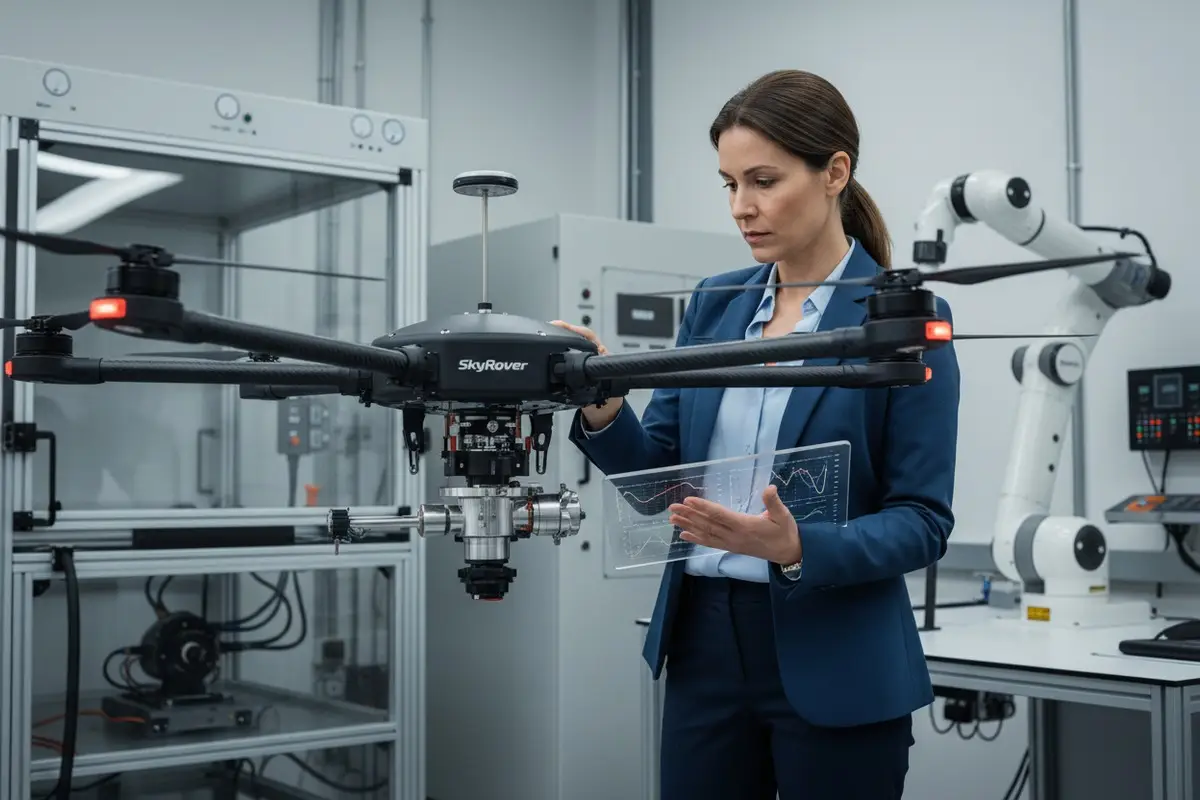

Lorsque notre équipe d'ingénierie a commencé à tester les systèmes de pulvérisation il y a cinq ans, nous avons perdu près de 40% de produits chimiques à cause de la dérive lors des essais sur le terrain. VMD supérieur à 200μm 1. Cette leçon coûteuse nous a tout appris sur l'évaluation des buses. Si vous achetez des drones sans vérifier les performances de dérive, vous risquez des dommages aux cultures, des amendes réglementaires 2, et du gaspillage de produits chimiques.
Pour évaluer la conception des buses de drones agricoles pour la dérive de pulvérisation, examinez les spécifications de taille des gouttelettes (VMD supérieur à 200 μm réduit la dérive), vérifiez que les courbes pression-débit correspondent aux affirmations du fabricant, évaluez le positionnement de la buse dans un rayon de 75% du diamètre du rotor et demandez des données de test en soufflerie avant l'achat en gros.
Ce guide vous présente le processus d'évaluation exact que notre équipe utilise conceptions de buses à compensation de pression 3. Vous apprendrez quels types de buses fonctionnent le mieux, comment personnaliser les configurations et comment vérifier les affirmations des fabricants. Commençons par les bases.
Quels types de buses dois-je choisir pour assurer le meilleur contrôle de la dérive de pulvérisation pour mes drones agricoles ?
Notre usine a testé plus de 50 configurations de buses sur différentes plateformes de drones. De nombreux acheteurs ont du mal à choisir entre les conceptions hydrauliques, centrifuges et à induction d'air. Le mauvais choix peut augmenter la dérive de 300% ou plus.
Pour un contrôle optimal de la dérive des pulvérisations, choisissez des buses à induction d'air (AI) pour des gouttelettes grossières avec une VMD supérieure à 400 µm, des buses à jet plat hydrauliques (séries XR, TX) pour une couverture équilibrée, ou des atomiseurs rotatifs centrifuges pour une taille de gouttelette réglable. Les buses à induction d'air réduisent le risque de dérive le plus efficacement.

Comprendre les options de buses hydrauliques
Les buses hydrauliques 4 restent le choix le plus courant pour les drones agricoles. Elles utilisent la pression pour fragmenter le liquide en gouttelettes. Notre chaîne de production intègre actuellement trois séries hydrauliques principales.
La série XR offre des motifs de jet plat à portée étendue. Ces buses produisent des gouttelettes moyennes à grossières en fonction des réglages de pression. Cependant, nous avons mesuré des déviations d'angle de pulvérisation allant jusqu'à 10% par rapport aux spécifications du fabricant lors des tests de qualité.
Les buses de la série TX créent des gouttelettes très fines à fines (61-144μm VMD). Bien qu'excellentes pour la couverture, ces fines gouttelettes dérivent facilement. Nous recommandons les buses TX uniquement pour les applications en serre intérieure ou dans des conditions de vent nul.
Les buses de la série TP fournissent des motifs de jet plat uniformes. Elles fonctionnent bien pour les applications de diffusion, mais nécessitent une gestion minutieuse de la pression pour contrôler la taille des gouttelettes.
Atomiseurs rotatifs centrifuges expliqués
Les buses centrifuges utilisent des disques rotatifs pour créer des gouttelettes. Le DJI Agras T40 et les plateformes similaires présentent souvent cette conception. Nos ingénieurs ont constaté que ces atomiseurs offrent un excellent contrôle de la taille des gouttelettes grâce à l'ajustement de la vitesse du disque.
Cependant, les buses centrifuges présentent des défis en matière de dérive. Nos tests en soufflerie montrent que les gouttelettes voyagent sur plus de 4 mètres sous le vent, même sans vent environnemental. Le flux d'air du rotor et le mouvement brownien provoquent ce déplacement.
Buses à induction d'air pour la réduction de la dérive
Buses à induction d'air 5 mélangent de l'air à la solution de pulvérisation. Cela crée des gouttelettes plus grosses et remplies d'air qui résistent à la dérive. Lorsque notre équipe est passée aux buses AI sur des plateformes de test, nous avons réduit la dérive hors cible d'environ 45 %.
Le compromis implique la pénétration de la canopée. Les gouttelettes plus grosses peuvent ne pas atteindre les feuilles inférieures aussi efficacement. Pour certaines applications de protection des cultures, cette limitation est importante.
| Type de buse | Plage VMD (μm) | Risque de dérive | Meilleure application | Précision de l'angle |
|---|---|---|---|---|
| XR Hydraulique | 150-400 | Moyen | Cultures générales | déviation de ±10 % |
| TX Hydraulique | 61-144 | Haut | Serres, sans vent | déviation de ±7 % |
| AI Anti-Dérive | 400-600+ | Faible | Zones sensibles à la dérive | déviation de ±5% |
| Centrifuge | 100-500 (réglable) | Moyenne-élevée | Application à taux variable | Dépendant de la vitesse du disque |
Faire votre choix
Tenez d'abord compte de votre réglementation locale. Certaines régions exigent désormais des tailles de gouttelettes minimales. Vérifiez si vos cultures cibles nécessitent une pénétration fine du spray ou tolèrent des gouttelettes grossières. Tenez compte des conditions de vent typiques de votre zone d'exploitation.
Nous recommandons toujours aux acheteurs de demander des échantillons de buses pour des tests sur le terrain avant de s'engager dans des commandes en gros. Ce qui fonctionne dans les spécifications peut performer différemment sur votre plateforme de drone spécifique.
Comment puis-je personnaliser la configuration de la buse avec mon fournisseur pour répondre aux réglementations locales spécifiques en matière de dérive ?
D'après notre expérience d'exportation vers les États-Unis et l'Europe, nous avons constaté que la réglementation variait considérablement entre les États et les pays. Une configuration qui passe l'inspection au Texas peut enfreindre les règles en Californie. Les acheteurs sous-estiment souvent la personnalisation dont ils ont réellement besoin.
Pour personnaliser les configurations de buses pour les réglementations locales, partagez vos exigences régionales en matière de tampons de dérive, spécifiez les mandats de taille minimale des gouttelettes, demandez des systèmes de pression réglables et travaillez avec des fournisseurs qui proposent des conceptions de rampe modulaires. Documentez toutes les spécifications dans les accords d'achat pour vérification de la conformité.

Rassembler vos exigences réglementaires
Avant de contacter un fournisseur, compilez vos exigences locales. De nombreux États américains spécifient désormais des zones tampons près des zones sensibles. La réglementation européenne impose souvent des valeurs minimales de DVG pour certains pesticides.
Notre équipe commerciale maintient une base de données des réglementations sur la dérive par région. Nous recommandons aux acheteurs de demander ces informations lors des consultations initiales. Comprendre ce dont vous avez besoin évite des refontes coûteuses plus tard.
Les facteurs réglementaires clés comprennent :
- Exigences minimales de taille des gouttelettes
- Distances de zone tampon des plans d'eau
- Restrictions de hauteur d'application
- Limites de fonctionnement de la vitesse du vent
- Documentation requise pour les inspections
Travailler avec votre fournisseur sur la conception
Lorsque notre équipe d'ingénierie collabore avec les clients, nous suivons un processus de personnalisation structuré. Premièrement, nous examinons les positions existantes des buses sur le cadre du drone. Normes ISO 16119-5 7 recommandent de positionner les buses à moins de 75% du diamètre du rotor.
Ensuite, nous évaluons les options de configuration de la rampe. Certaines réglementations exigent un espacement spécifique des buses pour une couverture uniforme. D'autres exigent des systèmes d'arrêt redondants pour la protection des zones tampons.
| Élément de personnalisation | Option standard | Option personnalisée | Impact du délai de livraison |
|---|---|---|---|
| Espacement des buses | Fixe 50cm | Variable 30-70cm | +2 semaines |
| Plage de pression | 2-4 bar | 1-6 bar réglable | +1 semaine |
| Longueur de la flèche | Largeur de châssis standard | Étendu/rétractable | +3 semaines |
| Zones de coupure | Aucun | Commande individuelle des buses | +2 semaines |
| Surveillance du débit | Débit de base | Temps réel par buse | +4 semaines |
Documentation des spécifications pour la conformité
Chaque personnalisation doit apparaître dans les spécifications écrites. Nos contrats incluent les numéros de modèle des buses, les plages de pression de fonctionnement, le VMD attendu à des pressions spécifiques et les courbes de débit.
Cette documentation remplit deux objectifs. Elle vous protège lors des inspections réglementaires. Elle fournit également des normes claires pour le contrôle qualité lors de l'arrivée des expéditions.
Demandez des certificats de conformité pour toute réclamation liée à la dérive. Les fabricants réputés fournissent des données de test montrant les performances réelles par rapport aux spécifications.
Planification des futures modifications réglementaires
Les réglementations évoluent constamment. En 2026, plusieurs juridictions mettront en œuvre des exigences plus strictes en matière de pulvérisation par drone. Nous concevons des systèmes en tenant compte des voies d'amélioration.
Interrogez votre fournisseur sur les composants modulaires. Pouvez-vous échanger les buses sans remplacer l'ensemble du système de pulvérisation ? Les mises à jour logicielles prendront-elles en charge les nouvelles exigences de débit ?
L'intégration de la flexibilité dans votre achat initial permet de réaliser des économies importantes lorsque les règles changent.
Quelles caractéristiques de conception dois-je rechercher pour garantir que mes buses de drone maintiennent une taille de gouttelette constante ?
Lorsque nous calibrons nos contrôleurs de vol et nos systèmes de pulvérisation, la cohérence des gouttelettes est la principale métrique de performance. Une taille de gouttelette incohérente signifie que certaines zones reçoivent trop de produits chimiques tandis que d'autres en reçoivent trop peu. Les deux scénarios gaspille de l'argent et nuit à l'efficacité.
Pour une taille de gouttelette constante, recherchez des conceptions de buses à compensation de pression, des orifices en céramique ou en polymère résistants à l'usure, des capteurs de débit intégrés pour une surveillance en temps réel et des systèmes qui maintiennent une pression stable malgré les changements de niveau du réservoir. Ces caractéristiques garantissent une application uniforme tout au long de chaque vol.

Systèmes de stabilité de pression
La taille des gouttelettes change considérablement avec les variations de pression. Nos tests montrent qu'une chute de pression de 0,5 bar peut modifier la VMD de 50 μm ou plus. Cela est particulièrement important lorsque les niveaux du réservoir diminuent pendant le vol.
Les systèmes de pulvérisation de qualité comprennent des pompes à compensation de pression. Celles-ci maintiennent un débit constant, quel que soit le volume du réservoir. Certains systèmes avancés utilisent des pompes à vitesse variable qui s'ajustent automatiquement en fonction des retours des capteurs.
Vérifiez si le système comprend des manomètres ou des affichages numériques. La surveillance en temps réel aide les opérateurs à identifier les problèmes avant qu'ils n'affectent la qualité de la couverture.
Matériau de la buse et résistance à l'usure
Les orifices de buse s'usent avec le temps. Les orifices usés produisent des gouttelettes plus grosses à la même pression. Notre équipe de contrôle qualité remplace les buses de test après 100 heures de fonctionnement.
Les choix de matériaux ont un impact significatif sur la durée de vie :
| Matériau | Durée de vie typique | Niveau de coût | Meilleur pour |
|---|---|---|---|
| Polymère | 50-100 heures | Faible | Opérations légères et économiques |
| Acier inoxydable | 100-200 heures | Moyen | Utilisation agricole générale |
| Acier trempé | 200-400 heures | Moyenne-élevée | Formulations abrasives |
| Céramique | 400-800+ heures | Haut | Opérations commerciales intensives |
| Carbure de tungstène | 800-1500+ heures | Très élevé | Besoins de durabilité maximale |
Lorsque notre chaîne de production construit des systèmes haut de gamme, nous utilisons par défaut des orifices en céramique. Le coût initial plus élevé se rentabilise grâce à des performances constantes et à une fréquence de remplacement réduite.
Intégration des capteurs de débit
Les systèmes de pulvérisation avancés pour drones comprennent des capteurs de débit à chaque position de buse. Ces capteurs détectent en temps réel les blocages, les changements de débit liés à l'usure et les incohérences de pression.
Notre logiciel de contrôle le plus récent alerte les opérateurs lorsque les débits s'écartent des valeurs attendues. Cela évite que des champs entiers ne reçoivent des taux d'application incorrects.
Demandez aux fournisseurs potentiels si leurs systèmes prennent en charge la surveillance par buse. Les débitmètres de système complet manquent les problèmes localisés que les capteurs individuels détectent immédiatement.
Considérations sur le souffle du rotor
Le souffle du rotor affecte considérablement le comportement des gouttelettes. En vol stationnaire, le souffle pousse les gouttelettes directement vers le bas, améliorant le dépôt. À des vitesses de déplacement, cet effet s'affaiblit.
Le positionnement des buses par rapport aux rotors est extrêmement important. Nos données d'ingénierie confirment les recommandations de l'ISO : positionnez les buses à moins de 75% du diamètre du rotor pour une utilisation optimale du souffle. Les buses situées au-delà de cette zone subissent un flux d'air turbulent et imprévisible.
La hauteur de vol affecte également la cohérence. Les recherches montrent que les hauteurs supérieures à 10 pieds augmentent considérablement le potentiel de dérive. Nous recommandons de voler à l'altitude minimale de sécurité pour votre culture et votre terrain spécifiques.
Équilibre vitesse et couverture
La vitesse de vol a un impact sur l'uniformité de la couverture et le dépôt des gouttelettes. Des vitesses plus lentes améliorent la pénétration de la canopée mais réduisent l'efficacité opérationnelle. Des vitesses plus rapides couvrent plus de surface mais peuvent sacrifier la qualité de l'application.
Nos essais sur le terrain suggèrent des vitesses optimales comprises entre 3 et 6 mètres par seconde pour la plupart des applications agricoles. Cette plage équilibre l'efficacité de la couverture avec des niveaux de dérive acceptables.
Testez votre configuration de buse spécifique à différentes vitesses avant la pulvérisation de production. La plateforme XAG P20, par exemple, atteint environ 65% de dépôt en bande avec un certain déplacement sous le vent. Comprendre les performances réelles de votre système évite les surprises pendant les opérations.
Comment puis-je vérifier les affirmations d'un fabricant concernant la dérive des pulvérisations avant de m'engager dans un achat en gros ?
Notre équipe d'assurance qualité rejette environ 15% des expéditions de buses entrantes en raison d'inadéquations de spécifications. Si les fabricants ne peuvent pas respecter leurs propres normes internes de manière constante, les acheteurs doivent vérifier les affirmations indépendamment. Faire confiance uniquement aux supports marketing conduit à des erreurs coûteuses.
Vérifiez les affirmations du fabricant concernant la dérive en demandant les données des essais en soufflerie, en exigeant la documentation des courbes pression-débit, en menant des essais de dépôt sur le terrain avec des cartes de collecte, en utilisant des logiciels de modélisation de la dérive tels qu'AGDISPpro, et en testant la taille réelle des gouttelettes avec un équipement de diffraction laser avant l'achat.

Demande de documentation technique
Commencez par demander les spécifications techniques complètes. Les fabricants réputés fournissent des courbes pression-débit montrant les relations exactes entre la pression de fonctionnement et le volume de sortie. Notre équipe d'ingénierie génère ces courbes pour chaque lot de buses que nous produisons.
Comparez les courbes fournies aux normes de l'industrie. Les débits doivent correspondre aux affirmations du fabricant dans des tolérances serrées. Nos mesures montrent que les angles de pulvérisation peuvent dévier jusqu'à 10% pour la série XR et 7% pour la série TX par rapport aux spécifications publiées.
Les signaux d'alerte sont les suivants
- Données manquantes sur la courbe pression-débit
- Gammes de tailles de gouttelettes vagues sans conditions de test spécifiques
- Pas de résultats de tests en soufflerie
- Refus de fournir des unités d'échantillons pour les tests
Données de tests en soufflerie
Les simulations en soufflerie permettent une évaluation contrôlée de la dérive. Ces tests mesurent le comportement des gouttelettes dans des conditions de vent standardisées sans variables de terrain.
Demandez si le fabricant a effectué des tests en soufflerie. Demandez les rapports de données réels, pas seulement des résumés. Recherchez les paramètres de test, y compris la vitesse du vent, la pression de la buse et les distances de mesure.
Notre entreprise s'associe à des centres de recherche universitaires pour une vérification indépendante en soufflerie. Ces tests tiers ajoutent une crédibilité que les tests internes seuls ne peuvent pas fournir.
Protocoles d'essais sur le terrain
Menez vos propres essais sur le terrain avant l'achat en gros. Utilisez des cartes sensibles à l'eau ou des traceurs fluorescents pour mesurer les schémas de dépôt réels.
Mettez en place des stations de collecte à différentes distances du trajet de pulvérisation :
- Dans la zone de couverture prévue
- À 5 mètres sous le vent
- À 10 mètres sous le vent
- À 25 mètres sous le vent
Comparez les résultats aux affirmations du fabricant. Des écarts importants indiquent soit des erreurs de spécification, soit des problèmes de contrôle qualité.
Utilisation d'un logiciel de modélisation de la dérive
AGDISPpro 9 et des outils logiciels similaires modélisent la dérive de pulvérisation en fonction des paramètres d'entrée. Ces programmes ont été validés pour les applications de drones et peuvent prédire les performances avant les tests sur le terrain.
Entrez les spécifications revendiquées par le fabricant dans le logiciel de modélisation. Comparez les distances de dérive prédites aux seuils acceptables pour votre application.
| Méthode de vérification | Coût | Temps nécessaire | Niveau de précision |
|---|---|---|---|
| Examen des documents | Gratuit | 1-2 jours | Faible-Moyen |
| Demande de données de soufflerie | Gratuit | 3-5 jours | Moyenne-élevée |
| Essai sur le terrain (basique) | $500-1000 | 1 semaine | Haut |
| Logiciel de modélisation de la dérive | $200-500/license | 2-3 jours | Moyen |
| Essais par diffraction laser | $2000-5000 | 1-2 semaines | Très élevé |
| Essais en laboratoire par des tiers | $3000-8000 | 3-4 semaines | Le plus élevé |
Évaluation d'unité d'échantillon
Demandez des buses d'échantillon pour une évaluation pratique. Testez-les sur votre plateforme drone existante si possible. Mesurez les débits réels par rapport aux spécifications annoncées.
Vérifiez les indicateurs de qualité physique :
- Qualité de finition de l'orifice
- Précision du filetage
- Cohérence du matériau
- Intégrité du joint
Nos inspecteurs de contrôle qualité examinent ces facteurs pour chaque lot de production. Les acheteurs doivent appliquer une surveillance similaire aux échantillons avant de s'engager dans de grosses commandes.
Tendances de certification par des tiers
Les organismes de réglementation exigent de plus en plus de tests standardisés pour la certification des buses à faible dérive. D'ici 2026, plusieurs régions imposeront ces certifications pour certaines applications agricoles.
Interrogez les fabricants sur leur statut de certification. La conformité aux tests ISO démontre un engagement envers des performances vérifiées. Les fabricants qui investissent dans la certification maintiennent généralement un meilleur contrôle qualité global.
Les futurs drones agricoles pourraient inclure des capteurs d'analyse du spectre de gouttelettes en temps réel. Ces technologies permettront des ajustements dynamiques des buses pendant le fonctionnement. L'adoption précoce de systèmes de buses vérifiés et certifiables positionne votre exploitation pour ces exigences évolutives.
Conclusion
L'évaluation des buses de drones agricoles nécessite une vérification systématique de la taille des gouttelettes, des relations pression-débit, des spécifications de positionnement et des données de test de dérive. Utilisez ce guide comme votre liste de contrôle d'achat pour réduire la dérive de 20 à 50% et protéger votre investissement.
Notes de bas de page
1. Explique le diamètre médian en volume (DMV) et son importance pour réduire la dérive des pulvérisations. ︎
2. Fournit un exemple faisant autorité des amendes de l'EPA pour violations d'application de pesticides. ︎
3. Discute de la façon dont la pression affecte les performances de la buse et du rôle de la compensation dans une application cohérente. ︎
4. Détaille la fonction et les caractéristiques des buses hydrauliques dans la pulvérisation agricole. ︎
5. Explique comment les buses à induction d'air réduisent la dérive des pulvérisations en créant des gouttelettes plus grosses remplies d'air. ︎
6. Décrit les buses centrifuges et leur application dans les drones agricoles pour une pulvérisation précise. ︎
7. Fournit la portée de la norme internationale pour les systèmes de pulvérisation aérienne en agriculture. ︎
8. Met en évidence la durabilité et la résistance à l'usure des orifices de buse en céramique dans la pulvérisation agricole. ︎
9. Site officiel d'AGDISPpro, un logiciel de modélisation de la dérive des pulvérisations à partir d'applications aériennes. ︎
 English
  Español de México
  Deutsch
  Français
  Русский
  العربية
Comments
No comments yet. Be the first to share your thoughts!
Leave a Comment