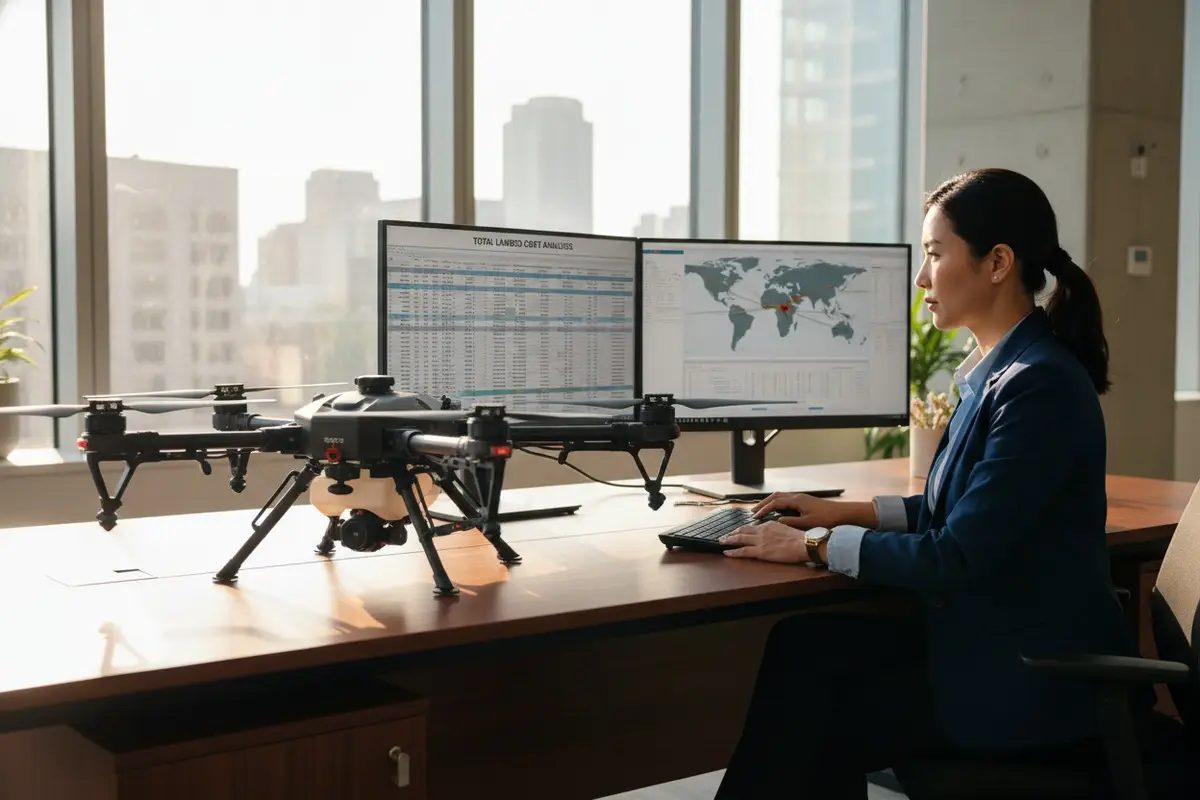

Cuando nuestro equipo de producción envía drones agrícolas al extranjero, los compradores a menudo se enfrentan a costos inesperados que inflan sus presupuestos entre un 30 y un 50%. código HS 8806 1. Esta brecha de precios oculta frustra a los importadores y reduce los márgenes de beneficio.
El costo total de llegada es igual al precio del producto más el envío, los derechos de aduana, los impuestos, el seguro y las tarifas de manipulación. Para drones agrícolas de China, espere un 25-40% de costos adicionales sobre el precio FOB debido a los aranceles de la Sección 301, las regulaciones de baterías de litio y la manipulación especializada de carga para marcos voluminosos de hexacópteros.
Comprender cada componente del costo le ayuda a presupuestar con precisión y evitar sorpresas. Permítame guiarle a través del desglose completo basado en nuestra experiencia de exportación a EE. UU. y Europa.
¿Cómo puedo estimar con precisión las tarifas de envío y entrega puerta a puerta para el envío de mi dron?
Nuestro equipo de logística maneja envíos de drones a diario y vemos que los compradores subestiman constantemente los costos de flete. Los voluminosos marcos de fibra de carbono y las baterías de litio crean desafíos de envío únicos.
Para estimar el envío con precisión, calcule el peso volumétrico (largo × ancho × alto ÷ 5000), compare el flete marítimo ($60-100 por unidad) frente al flete aéreo ($300-500 por unidad), agregue recargos por mercancías peligrosas para baterías de litio e incluya tarifas de entrega de última milla que varían entre $50-200 según el destino.

Comprender el peso volumétrico frente al peso real
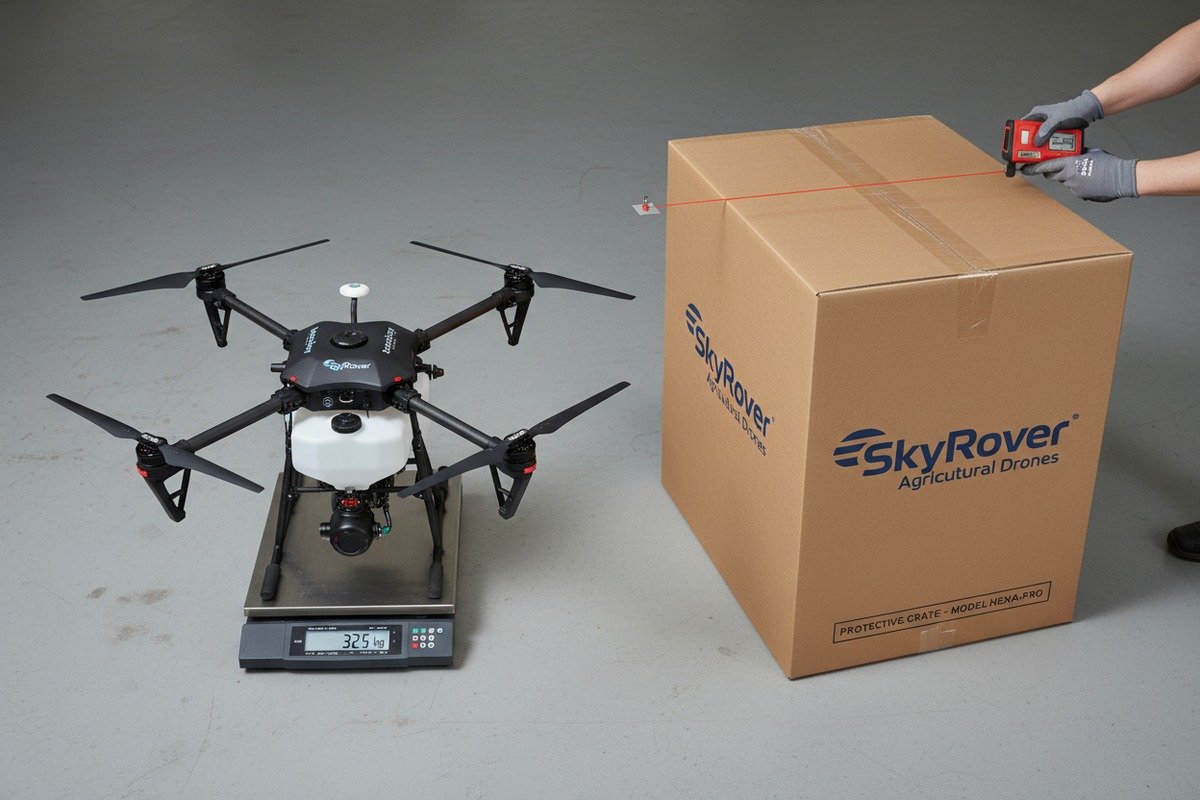
Las empresas de transporte cobran en función de lo que sea mayor: el peso real o peso volumétrico 2. Los drones agrícolas presentan un desafío aquí. Nuestros drones hexacópteros pesan entre 25 y 35 kg, pero ocupan un espacio considerable debido a sus amplios brazos de rotor y embalaje protector.
Para un dron pulverizador agrícola típico, las dimensiones del cartón miden aproximadamente 120 cm × 80 cm × 60 cm. Esto crea un peso volumétrico de 115,2 kg (120 × 80 × 60 ÷ 5000), muy superior al peso real. Los transportistas le cobrarán en función de esta cifra mayor.
Comparación de flete marítimo frente a flete aéreo
| Factor | Transporte marítimo | Transporte aéreo |
|---|---|---|
| Costo por unidad (100 drones) | $60-100 | $300-500 |
| Tiempo de tránsito (China a EE. UU.) | 25-35 días | 5-7 días |
| Lo mejor para | Grandes pedidos a granel | Envíos urgentes |
| Tamaño del contenedor | 20 pies o 40 pies | Paletas de carga |
| Manejo de baterías | Clase Estándar 9 | Estrictas reglas de la IATA |
| Riesgo de daño | Más alto | Más bajo |
El transporte marítimo sigue siendo la opción más económica para pedidos superiores a 50 unidades. Desde los puertos de Shanghái o Ningbo hasta Los Ángeles, espere $4,000-6,000 por un contenedor de 20 pies con capacidad para aproximadamente 80-100 drones agrícolas. Esto se desglosa en aproximadamente $50-75 por unidad solo para el transporte marítimo.
El transporte aéreo solo tiene sentido para pedidos de muestras o reabastecimiento de emergencia. El costo se multiplica por 5-8, pero ahorra 3-4 semanas de tiempo de tránsito.
Cargos ocultos en la entrega puerta a puerta
Cuando cotizamos la entrega puerta a puerta, los compradores deben comprender la estructura completa de tarifas:
- Cargos de manejo en puerto: $150-300 por envío en origen y destino
- Despacho de aduanas: $100-300 para procesamiento de documentación
- Almacenamiento en almacén: $0.30-0.50 por unidad por día si ocurren retrasos en la recogida
- Cargos por demora: $100-150 por día por detención de contenedor
- Transporte de última milla: $200-500 dependiendo de la distancia al destino final
Las baterías de litio en drones agrícolas activan la clasificación de mercancías peligrosas de Clase 9. regulaciones de baterías de litio 3 Esto añade $200-500 por envío para manejo especial y documentación. Nuestro equipo de envíos prepara certificaciones de baterías UN38.3 y documentos MSDS para prevenir retrasos en aduanas.
Ejemplo de costo real
Para un pedido de 100 unidades de drones pulverizadores agrícolas enviados desde Xi'an a Chicago:
| Componente de costo | Importe |
|---|---|
| Flete marítimo (consolidado) | $5,500 |
| Cargos portuarios (origen + destino) | $450 |
| Recargo por manejo de mercancías peligrosas | $350 |
| Despacho de aduanas | $250 |
| Transporte de última milla | $400 |
| Envío total | $6,950 |
| Envío por unidad | $69.50 |
¿Qué aranceles e impuestos de importación específicos se me cobrarán al traer drones agrícolas a mi país?
En nuestra experiencia exportando a los mercados de EE. UU. y la UE, los aranceles aduaneros representan el costo más subestimado. Los compradores a menudo se centran en el precio del producto, ignorando que los aranceles pueden agregar un 25-30% a su inversión total.
Los drones agrícolas de China enfrentan múltiples capas de aranceles: arancel base MFN (0-4.7%), aranceles de la Sección 301 (25% para importaciones a EE. UU.) y el IVA/GST del país de destino (7-21%). El código HS 8806.21 se aplica a los UAV agrícolas, con aranceles calculados sobre el valor CIF (costo del producto más seguro más flete).

Comprensión de la Clasificación del Código HS
Correcto Clasificación del código del Sistema Armonizado 4 determina su tasa de arancel. Los drones agrícolas entran en el código HS 8806, con la subcategoría 8806.21 que cubre específicamente aeronaves no tripuladas con un peso máximo de despegue superior a 250 g pero no superior a 7 kg, y 8806.22 para modelos más pesados.
Nuestros drones pulverizadores agrícolas suelen pesar entre 25 y 50 kg completamente cargados, lo que los sitúa en el código HS 8806.22 o potencialmente en el 8806.29 para configuraciones especializadas. Una clasificación errónea de su código HS puede dar lugar a sanciones de hasta el doble del valor del producto.
Estructura de Aranceles de Importación de EE. UU.
| Tipo de impuesto | Tarifa | Aplicado a |
|---|---|---|
| Arancel Base MFN | 0-3.2% | Valor CIF 5 |
| Sección 301 Arancel | 25% | Valor CIF + Arancel MFN |
| Cargo por procesamiento de mercancías | 0.3464% | Valor CIF (mínimo 31 USD, máximo 614 USD) |
| Tasa de mantenimiento portuario | 0.125% | Valor CIF (solo envíos marítimos) |
El arancel de la Sección 301 impacta significativamente las importaciones de drones agrícolas. Desde 2018, la mayoría de los drones chinos caen bajo las categorías de Lista 3 o Lista 4, lo que genera un arancel adicional del 25%. Esta política se mantiene sin cambios hasta 2026.
Cálculo del Arancel Total para Importación a EE. UU.
Permítanme mostrarles cómo se acumulan los aranceles. Para 100 drones agrícolas a 2000 USD FOB cada uno:
- Costo del producto: $200,000
- Flete a EE. UU.: $6,000
- Seguro (1%): $2,060
- Valor CIF: $208,060
Ahora aplique aranceles:
- Arancel MFN (3.2%): $6,658
- Sección 301 (25% sobre $214,718): $53,680
- MPF (0.3464%): $614 (con límite)
- HMF (0.125%): $260
Aranceles totales: $61,212 o $612 por unidad
Esto añade 30.6% al costo de su producto antes de que los drones siquiera pasen por la aduana.
Estructura de aranceles de importación de la UE
Las importaciones de la Unión Europea enfrentan cálculos diferentes:
| Componente | Tarifa | Notas |
|---|---|---|
| Arancel aduanero | 2.7-4.7% | Basado en el código HS |
| IVA | 19-27% | Varía según el estado miembro |
| Procesamiento de Aduanas | €50-200 | Por declaración |
La UE no impone aranceles tipo Sección 301 a los drones chinos, lo que hace que las importaciones europeas sean más rentables. Sin embargo, el IVA se aplica a la suma del valor CIF más los derechos de aduana, creando un efecto de capitalización.
Consideraciones sobre la importación de baterías
Las baterías de litio a menudo requieren una clasificación SA separada (8507.60) con diferentes tasas arancelarias. Cuando enviamos drones con baterías instaladas, la aduana puede evaluar aranceles combinados o separados. Declararlos juntos bajo los códigos SA de drones simplifica el procesamiento, pero requiere documentación clara que muestre las baterías como componentes integrales.
¿Cómo incluyo los costos de marca OEM y empaque personalizado en mi precio total de llegada?
Nuestros equipos de ingeniería y diseño colaboran diariamente con los compradores en proyectos de personalización. Marca OEM 7 transforma un producto genérico en la identidad de su propia marca, pero agrega costos que muchos importadores pasan por alto en sus presupuestos iniciales.
Los costos de marca OEM incluyen la aplicación del logotipo ($2-5 por unidad), esquemas de color personalizados ($500-2,000 de utillaje), embalaje de marca ($3-8 por unidad), personalización del manual del usuario ($200-500 de configuración) y marca de la interfaz de software ($1,000-5,000 único). Tenga esto en cuenta en su cálculo por unidad antes de comparar las cotizaciones de los proveedores.
Tipos de personalización OEM
Cuando los compradores se acercan a nosotros para servicios OEM, ofrecemos varios niveles de personalización:
Marca básica incluye impresión o grabado de logotipos en el cuerpo del dron, el controlador y la batería. Esto cuesta $2-5 por unidad con tarifas de configuración mínimas. El proceso utiliza grabado láser o pegatinas de alta calidad según el material de la superficie.
Personalización de color requiere cambiar el acabado estándar de fibra de carbono negro mate. Nuestra línea de producción puede aplicar colores personalizados a los componentes de plástico, pero los marcos de fibra de carbono suelen permanecer en su acabado natural por integridad estructural. Los colores personalizados agregan $500-2,000 en costos de herramientas más $5-15 por unidad para pintar.
Empaquetado OEM completo reemplaza nuestras cajas estándar con su embalaje de marca. Esto incluye:
- Cajas impresas personalizadas
- Inserciones de espuma de marca
- Su logotipo en todos los materiales protectores
- Manuales de instrucciones personalizados
- Bolsas de accesorios de marca
Desglose de costos de embalaje
| Nivel de embalaje | Costo por unidad | MOQ | Tiempo de entrega |
|---|---|---|---|
| Estándar (neutral) | Incluido | Ninguno | Inmediato |
| Solo pegatinas con logotipo | $1-2 | 50 unidades | 3-5 días |
| Caja semi-personalizada | $3-5 | 100 unidades | 7-10 días |
| Embalaje totalmente personalizado | $6-10 | 200 unidades | 14-21 días |
| Caja minorista premium | $12-20 | 500 unidades | 21-30 días |
Personalización de software e interfaz
Los drones agrícolas modernos dependen en gran medida del software. Nuestro equipo de desarrollo puede personalizar:
- Interfaz de aplicación móvil con su marca
- Pantalla de inicio del controlador de vuelo
- Marca blanca de plataforma en la nube
- Nomenclatura de la versión del firmware
La personalización del software generalmente requiere una tarifa de desarrollo única de $1,000-5,000, dependiendo de la complejidad. Esto crea una diferenciación genuina del producto que la marca de hardware por sí sola no puede lograr.
Impacto en el costo total de llegada
Agregar la marca OEM a un dron agrícola de $2,000 aumenta los costos de la siguiente manera:
- Producto base: $2,000
- Aplicación de logotipo: $3
- Embalaje semipersonalizado: $5
- Personalización del manual (amortizado): $2
- Marca de software (amortizado en 500 unidades): $6
Adiciones OEM: $16 por unidad o 0.8% del costo del producto
Si bien el porcentaje parece pequeño, recuerde que este $16 se multiplica a través de los aranceles. Con una tasa de arancel combinada del 28%, su costo OEM de $16 se convierte en un impacto de costo de llegada de $20.48.
Cantidades Mínimas de Pedido para Personalización
Los servicios OEM requieren pedidos mínimos para justificar los costos de configuración:
| Servicio | MOQ Típico |
|---|---|
| Impresión de logotipo | 50 unidades |
| Colores personalizados | 100 unidades |
| Diseño de empaque | 200 unidades |
| Personalización de software | 500 unidades |
| Rediseño completo del producto | 1,000 unidades |
Planificar cuidadosamente su primer pedido es importante. Pedir 100 unidades con personalización completa puede costar más por unidad que pedir 200 unidades debido a las tarifas de configuración amortizadas.
¿Qué presupuesto adicional debo reservar para soporte técnico y piezas de mantenimiento después de mi compra?
Nuestro equipo de soporte postventa maneja cientos de consultas técnicas mensualmente. Vemos de primera mano cómo los costos posteriores a la compra toman desprevenidos a los compradores. Los importadores inteligentes presupuestan el soporte continuo desde el primer día.
Presupuesto 15-25% del costo inicial del producto anualmente para soporte técnico y repuestos. Los componentes críticos incluyen hélices ($50-100 por juego), baterías ($300-500 cada una, vida útil de 2-3 años), bombas de pulverización ($150-250) y controladores de vuelo ($400-800). El soporte técnico remoto suele costar $500-2,000 anualmente, mientras que el servicio in situ añade $2,000-5,000 por visita.

Inventario esencial de piezas de repuesto
Los drones agrícolas operan en condiciones difíciles. El polvo, los productos químicos y los impactos requieren el reemplazo regular de piezas. Según los comentarios de nuestros clientes, recomendamos tener en stock:
Artículos de alto desgaste (reemplazar cada 50-100 horas de vuelo):
- Juegos de hélices: $50-100 cada uno, mantenga 4-6 juegos
- Boquillas de pulverización: $15-30 cada una, mantener 10-20 piezas
- Filtros y mallas: $10-25 cada uno, mantener 10 piezas
Artículos de desgaste medio (reemplazar cada 200-500 horas de vuelo):
- Paquetes de baterías: $300-500 cada uno, mantener 2-3 extras por dron
- Conjuntos de motor: $150-300 cada uno, mantener 2 juegos
- Componentes del tren de aterrizaje: $80-150 por juego
Artículos de bajo desgaste (reemplazar según sea necesario):
- Placas de control de vuelo: $400-800
- Módulos GPS: $200-400
- Unidades de cámara/sensor: $500-1,500
Calculadora de costos de repuestos
| Categoría de pieza | Costo anual por dron | Recomendación de stock |
|---|---|---|
| Hélices | $200-400 | 4-6 juegos |
| Baterías | $600-1,000 | 2-3 unidades |
| Componentes del sistema de pulverización | $150-300 | Varios |
| Motores/ESCs | $100-200 | 1-2 juegos |
| Electrónica | $100-300 | Componentes clave |
| Partes Anuales Totales | $1,150-2,200 | – |
Para un dron de $2,000, esto representa 57-110% de costo inicial durante el primer año. Sin embargo, los costos disminuyen en años posteriores a medida que acumula inventario y aprende patrones de uso.
Opciones de Soporte Técnico
Ofrecemos paquetes de soporte por niveles:
Soporte por correo electrónico/chat (incluido con la compra):
- Respuesta en 24-48 horas
- Guía básica de solución de problemas
- Notificaciones de actualización de firmware
- Sin costo adicional el primer año
Soporte Remoto Premium ($500-1,500 anuales):
- Respuesta prioritaria en 4-8 horas
- Diagnóstico por videollamada
- Flasheo remoto de firmware
- Gerente de cuenta dedicado
Soporte Técnico Presencial ($2,000-5,000 por visita):
- Técnico capacitado de fábrica
- Reparaciones complejas y calibración
- Entrenamiento de pilotos
- Viaje y alojamiento incluidos
Consideraciones de garantía
Las garantías estándar cubren defectos de fabricación pero excluyen:
- Daños por colisión
- Daños por agua más allá de la clasificación IP
- Mantenimiento inadecuado
- Modificaciones no autorizadas
- Degradación de la batería después de 300 ciclos
Los programas de garantía extendida cuestan entre el 5% y el 10% del precio del producto anualmente y pueden cubrir escenarios adicionales. Evalúe si la cobertura extendida tiene sentido financiero según su intensidad de uso.
Costos de entrenamiento y documentación
El entrenamiento adecuado reduce significativamente los costos de mantenimiento. Presupueste para:
| Tipo de entrenamiento | Costo | Duración |
|---|---|---|
| Entrenamiento en video en línea | Gratis - 200€ | A su propio ritmo |
| Entrenamiento virtual en vivo | $300-500 | 2-4 horas |
| Entrenamiento básico presencial | $1,000-2,000 | 1-2 días |
| Entrenamiento avanzado de mantenimiento | $2,500-5,000 | 3-5 días |
Invertir $1,000-2,000 en capacitación adecuada puede reducir los costos anuales de mantenimiento en un 30-40% a través del manejo adecuado y el cuidado preventivo.
Resumen del Costo Total de Propiedad
Durante un período operativo de 3 años, espere:
- Año 1: Costo del producto + 35% (aterrizaje + configuración + repuestos iniciales)
- Año 2: 20-30% del costo del producto (repuestos + soporte)
- Año 3: 15-25% del costo del producto (repuestos + soporte)
TCO a 3 años: 170-190% del costo inicial del producto
Para un dron agrícola de $2,000, esto significa una inversión total de $3,400-3,800 durante tres años, o aproximadamente $1,130-1,270 anuales. Esta comprensión le ayuda a fijar el precio de sus servicios con precisión y a mantener márgenes de beneficio saludables. Costo Total de Propiedad 8
Conclusión
Calculando el costo total de llegada 9 requiere tener en cuenta el precio del producto, el envío, los aranceles, la personalización OEM y el soporte continuo. Nuestra experiencia demuestra que una planificación precisa evita sorpresas en el presupuesto y protege sus márgenes de beneficio al importar drones agrícolas de China.
Notas al pie
1. Proporciona detalles específicos del código del Sistema Armonizado para aeronaves no tripuladas. ↩︎
2. Explica el cálculo del peso volumétrico y su importancia en los costos de envío. ↩︎
3. Detalla las regulaciones internacionales para el envío de baterías de litio por vía aérea. ↩︎
4. Guía oficial de códigos del Sistema Armonizado para el comercio internacional. ↩︎
5. Define CIF (Costo, Seguro y Flete) y su papel en el envío internacional. ↩︎
6. Proporciona información oficial sobre los aranceles que afectan a las importaciones de China. ↩︎
7. Explica el concepto de Fabricante de Equipo Original (OEM) y su función. ↩︎
8. Definición y explicación integral del Costo Total de Propiedad. ↩︎
9. Define y explica los componentes del costo total de llegada. ↩︎
 English
  Español de México
  Deutsch
  Français
  Русский
  العربية
Comments
No comments yet. Be the first to share your thoughts!
Leave a Comment