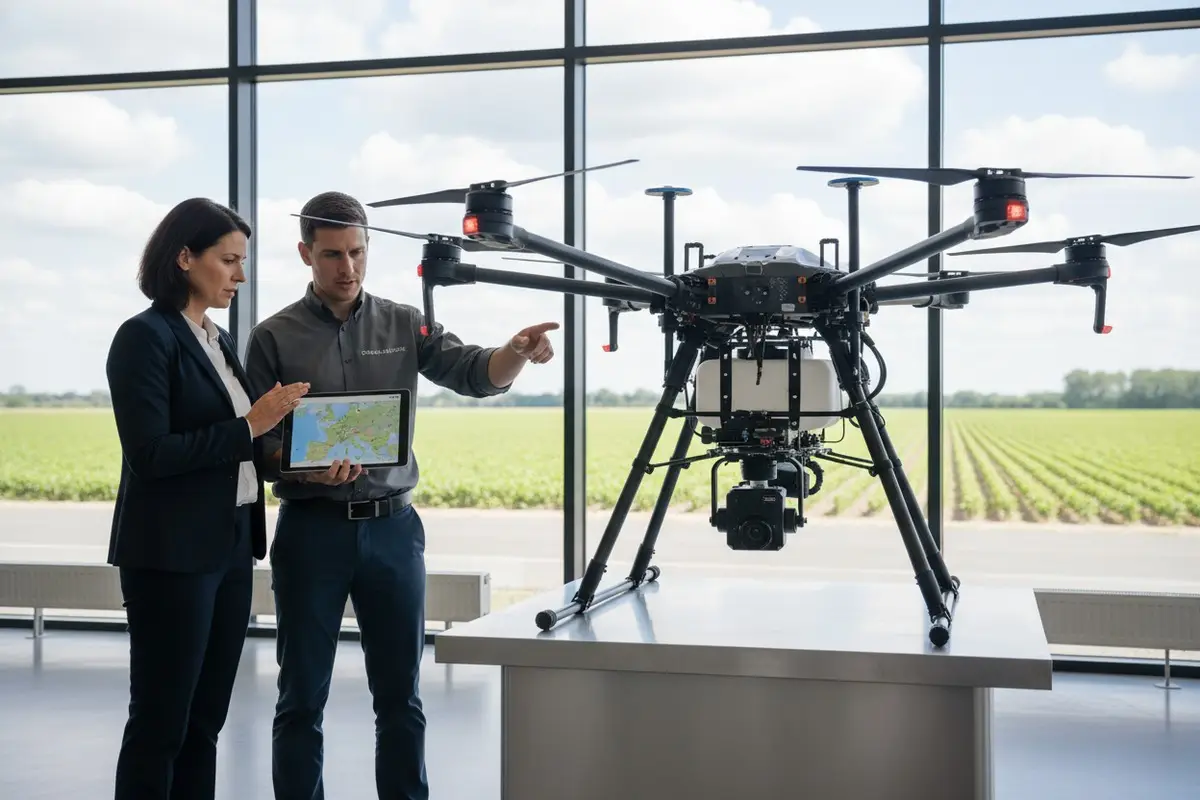

When our engineering team first started shipping agricultural drones to European distributors, we quickly learned that understanding EU farming goes far beyond basic specs Shapefiles 1. Many buyers struggle to separate suppliers who truly grasp European agriculture from those who just say they do.
To assess supplier knowledge of European farming, verify their understanding of EASA drone categories, ask specific questions about regional crop types and terrain, confirm software compatibility with EU farm management systems, and test their ability to customize features for local conditions. Request documentation proving regulatory compliance and field experience.
This guide walks you through practical steps to evaluate whether a drone supplier truly understands your European market. We will cover regulation checks, technical assessments, and real-world testing methods.
How do I verify that the supplier understands the specific EU regulations for my agricultural drone imports?
Our export documentation team handles EASA compliance 2 questions weekly. Many importers assume all drone suppliers understand EU rules, but this assumption often leads to grounded fleets and costly delays.
Verify supplier knowledge by asking them to explain the three EASA categories (Open, Specific, Certified), current registration thresholds, Remote ID requirements, and any national derogations like Poland's agricultural exemption. A knowledgeable supplier should cite specific payload limits and operational distances without hesitation.

Understanding the EASA Category System
The European Union Aviation Safety Agency (EASA) divides drone operations into three categories. EASA drone categories 3 Each category has different requirements. Your supplier must know which category your agricultural operations fall under.
The Open category covers low-risk operations. It has three subcategories: A1, A2, and A3. Most agricultural spraying drones operate in A3 because they fly away from people. The Specific category requires authorization for medium-risk operations. The Certified category applies to high-risk scenarios like passenger transport.
Key Regulatory Questions to Ask Your Supplier
Ask these direct questions during your supplier evaluation:
| Question | Expected Answer | Red Flag Response |
|---|---|---|
| What is the current EU drone registration threshold? | Currently 250g, proposed reduction to 100g by Q3 2026 | "I think it's 500g" or vague answers |
| What is Remote ID and when is it required? Remote ID requirements 4 | Electronic identification broadcasting location and ID, mandatory for most operations | "Remote ID is optional" or unfamiliarity |
| Can you explain Poland's agricultural derogation? | Allows <105kg drones in A3 category with VLOS, 30m altitude, 30m bystander distance until Jan 2026 | No knowledge of national exemptions |
| What does VLOS mean for ag operations? | Visual Line of Sight—operator must see drone at all times | Confusion with BVLOS capabilities |
The 2026 Drone Security Package Impact
The EU Commission is pushing the Drone Security Package for Q3 2026 approval. This package brings major changes. Registration drops from 250g to 100g. This means 99% of consumer and agricultural drones will need registration.
The package also introduces the "EU Trusted Drone" label. This label addresses supply chain security concerns. It prioritizes NDAA-compliant drones for government and agricultural contracts. Chinese drone manufacturers face increasing scrutiny under these rules.
When we prepare export documentation at our facility, we now include compliance certificates for both current and upcoming regulations. Your supplier should proactively discuss these changes.
National Variations Matter
EU regulations harmonize many rules, but national variations exist. Poland's derogation helps agricultural operations. Germany has strict no-fly zones. France requires specific training certifications.
A supplier with real EU experience will mention these differences without prompting. They should ask which member states you operate in before quoting specifications.
Can the manufacturer explain how their drone technology addresses the unique terrain and crop types in my European market?
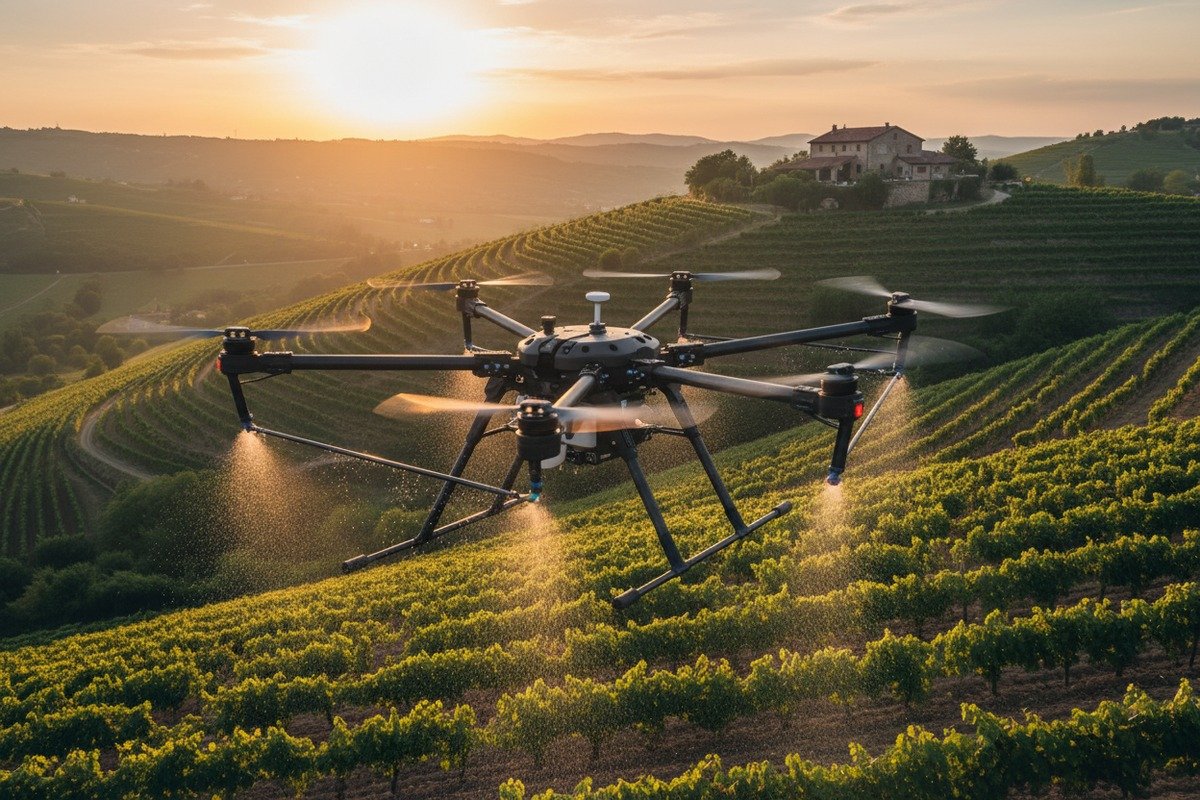
During product development meetings, our engineers always ask which European regions the drones will serve. Vineyards in Tuscany require completely different configurations than wheat fields in northern France.
A knowledgeable manufacturer should explain specific technical adaptations for your terrain—including flight altitude limits for hilly vineyards, spray pattern adjustments for row crops, and sensor configurations for variable weather. They should reference actual European crop cycles and common pest pressures without generic marketing language.
European Agricultural Diversity Demands Specific Solutions
Europe has remarkable agricultural diversity. Your supplier must demonstrate they understand this.
France and Germany dominate arable crop production. These regions need drones optimized for large-field mapping and variable rate applications. The terrain is mostly flat. Flight paths can be long and straight.
Italy and Spain lead vineyard production. These operations require precision navigation through narrow rows. Hilly terrain demands superior obstacle avoidance. Spray systems need fine droplet control to avoid drift between rows.
The Netherlands and UK focus on livestock and mixed farming. Drones here often monitor animal health, check fencing, and assess pasture conditions. The maritime climate brings frequent rain and wind challenges.
Technical Specifications for Different Farming Systems
| Farming System | Key Drone Requirements | Typical European Regions |
|---|---|---|
| Arable Crops | Large tank capacity (20L+), wide spray boom, long flight time, GPS auto-grid | France, Germany, Poland |
| Vineyards | Compact frame, precision nozzles, RTK positioning, slope stability | Italy, Spain, Portugal |
| Orchards | Adjustable spray angle, height sensors, branch detection | Greece, Spain, Netherlands |
| Livestock | Thermal imaging, long-range transmission, weather resistance | UK, Ireland, Netherlands |
| Greenhouses | Indoor GPS alternatives, gentle flight, humidity resistance | Netherlands, Spain |
Weather Pattern Considerations
European weather varies significantly by region. Mediterranean areas face hot, dry summers. Northern regions deal with frequent rain and overcast skies.
Ask your supplier how their drones handle:
- Wind gusts common in coastal and elevated areas
- Morning dew affecting spray adherence
- Rapid temperature changes in alpine regions
- Limited daylight during winter months
Our production line tests all agricultural models in wind tunnels up to 12 m/s. We also conduct humidity chamber tests for northern European conditions.
Pesticide Application Standards
The EU Plant Protection Products Regulation 5 sets strict rules for agricultural spraying. Your supplier should know these limits affect drone specifications.
Buffer zones near water sources require precise boundary detection. Drift reduction technology becomes essential near protected areas. Spray pressure and droplet size must meet EU standards for different chemical types.
A qualified supplier will ask about your specific application needs before recommending tank sizes and nozzle types.
What should I look for to ensure their software is compatible with my local European farm management systems?
Our software development team works closely with European clients on integration projects. Compatibility issues cause more post-sale frustrations than hardware problems. Many buyers overlook software until after purchase.
Look for suppliers who can name specific European farm management platforms their software integrates with, demonstrate data export in standard formats like ISOXML and shapefiles, confirm GDPR compliance for data handling, and provide API documentation for custom integrations. Request live demonstrations with your existing systems.

Common European Farm Management Platforms
European farmers use various software ecosystems. Your drone supplier should know the major players in your region.
| Platform | Primary Region | Integration Priority |
|---|---|---|
| 365FarmNet | Germany, Central Europe | ISOXML 6, machinery sync |
| Agrivi | Eastern Europe, expanding | API access, multi-crop |
| Gatekeeper | UK, Ireland | Field records, compliance |
| SMAG | France | Prescription maps, traceability |
| Agricolus | Italy, Mediterranean | Vineyard modules, IoT |
When we develop flight control software, we prioritize ISOXML compatibility because it connects with most European machinery systems.
Data Format Standards
European precision agriculture 7 relies on standardized data formats. Your supplier should support:
- ISOXML: The ISO 11783 standard used by most European tractors and implements
- Shapefiles: GIS format for boundary and zone mapping
- GeoTIFF: Georeferenced imagery for prescription maps
- CSV/Excel: Simple formats for record keeping
Ask for sample data exports. Review them with your farm management software before committing to a purchase.
GDPR Compliance for Farm Data
The General Data Protection Regulation 8 affects agricultural data handling. Drone-collected imagery may include identifiable features. Flight logs contain location data.
Your supplier must explain:
- Where farm data is stored (EU servers preferred)
- Who has access to collected data
- How long data is retained
- Procedures for data deletion requests
At our company, we offer local data storage options for European clients concerned about cross-border data transfers.
API and Custom Integration Capabilities
Larger agricultural operations need custom integrations. Your supplier should provide:
- Published API documentation
- Developer support contacts
- Sample integration code
- Webhook capabilities for automated workflows
Ask to see existing integration examples. Request references from European clients who have connected the drone software to their systems.
Language and Unit Considerations
Software localization matters for daily operations. Check that the drone software supports:
- Your local language in the interface
- Metric units throughout (hectares, liters, meters)
- Local date formats
- Currency for any in-app purchases or subscriptions
How can I test if their engineering team has the expertise to customize drone features for my European farming clients?
When prospective clients visit our R&D center in Xi'an, we walk them through our customization process. Real engineering capability shows in specific conversations, not general promises. Testing this before you buy saves significant trouble later.
Test engineering expertise by requesting technical discussions with actual engineers, asking for case studies of previous European customizations, proposing a hypothetical modification scenario, and reviewing their change management process. Capable teams provide detailed timelines, cost breakdowns, and potential limitations without overpromising.

Direct Engineer Access Matters
Sales teams often promise customizations they cannot deliver. Insist on speaking directly with engineering staff.
During these conversations, evaluate:
- Technical vocabulary accuracy
- Willingness to say "no" or "I need to check"
- Knowledge of component limitations
- Understanding of certification implications
Our engineering team of 70 includes specialists in flight control, spray systems, and software development. We encourage clients to interview relevant specialists before large orders.
Case Study Evaluation Framework
Request documented examples of previous European projects. Evaluate them using this framework:
| Evaluation Criteria | Strong Indicator | Weak Indicator |
|---|---|---|
| Problem definition | Specific EU client need identified | Vague "improvement" claims |
| Technical approach | Detailed engineering solution | Generic feature addition |
| Testing protocol | Field trials in similar conditions | Lab testing only |
| Timeline accuracy | Delivered within stated period | Significant delays |
| Client feedback | Direct quotes, verifiable reference | Anonymous testimonials |
The Hypothetical Modification Test
Present a realistic customization scenario. For example:
"Our French vineyard clients need a drone that can operate in rows 1.5 meters apart, with spray coverage of 4 hectares per battery charge, integrated with SMAG software for prescription maps."
A capable engineering team will:
- Ask clarifying questions about terrain slope and vine height
- Calculate feasibility based on existing platform capabilities
- Identify which requirements are straightforward versus challenging
- Provide rough timeline and cost estimates
- Note any certification impacts
Vague or immediately positive responses suggest limited real capability.
Customization Categories and Complexity
Understand which modifications are simple versus complex:
Hardware Modifications
- Simple: Tank size changes, nozzle swaps, camera mounts
- Moderate: Frame geometry adjustments, motor upgrades
- Complex: Complete spray system redesign, new sensor integration
Software Modifications
- Simple: Interface translation, unit conversion
- Moderate: New data export formats, prescription map support
- Complex: Custom flight algorithms, third-party API development
Certification Implications
Any modification affecting flight safety may require recertification. Ask how changes impact existing EASA compliance.
Post-Customization Support Structure
Customized products need ongoing support. Clarify:
- Who maintains modified firmware versions?
- How are bugs in custom features handled?
- What is the update pathway when base software changes?
- Are spare parts for modified components stocked?
We maintain dedicated support engineers for customized products. This ensures clients receive help from someone who understands their specific configuration.
Conclusion
Selecting an agricultural drone supplier for European markets requires thorough assessment of regulatory knowledge, regional farming expertise, software compatibility, and engineering capability. Use the frameworks and questions in this guide during your evaluation process. The right supplier will welcome detailed scrutiny and provide clear, specific answers.
Footnotes
1. Authoritative explanation of Shapefiles from Esri, the developer of the format. ↩︎
2. Official EASA page providing information for drone operators and pilots regarding their responsibilities and compliance. ↩︎
3. Provides official EASA information on drone operational categories. ↩︎
4. Provides official EASA information on drone Remote ID requirements. ↩︎
5. Official EU regulation governing the placing of plant protection products on the market. ↩︎
6. Explains ISO 11783, which includes ISOXML as a data exchange format. ↩︎
7. Provides an official definition and context for precision agriculture from the FAO. ↩︎
8. Provides the official legal text of the European Union’s data protection regulation. ↩︎

 English
  Español de México
  Deutsch
  Français
  Русский
  العربية
Comments
No comments yet. Be the first to share your thoughts!
Leave a Comment